


The CIA, Narcotics & Underworld: Doug Valentine Interview
January 7, 2010
Richard Helms, chief of the Central Intelligence Agency’s Clandestine Services, asked the Agency to start funding a biochemical warfare program in 1953 called MKULTRA, which included the drugging of unwitting suspects in New York’s Greenwich Village with LSD and other hallucinogens. One of the safehouses was at 81 Bedford Street across from Chumley’s speakeasy. While many of Greenwich Village’s buildings today bear historic plaques, the CIA’s mind control experiments at 81 Bedford Street go unacknowledged.
Several years ago, when I was trying to make the distinction between Lewis Lapham, the Editor of Harper’s Magazine – whose roots are in an old San Francisco banking family – and Lewis Lapham, the Central Intelligence Agency’s man, I was directed to author Doug Valentine by Lou Wolf of Covert Action Quarterly, who described Valentine as one of the most knowledgeable people on the CIA.
Valentine told me the two Laphams were not the same man. I was relieved. But in the next breath he said that Tony Lapham, Harper’s Editor Lewis Lapham’s brother, had been both a covert CIA agent and General Counsel to the CIA, appointed in 1976 by then Director of Central Intelligence, George H.W. Bush. I was again concerned.
 The Strength of the Pa...
Best Price: $7.95
Buy New $12.00
(as of 12:30 UTC - Details)
The Strength of the Pa...
Best Price: $7.95
Buy New $12.00
(as of 12:30 UTC - Details)

Lewis Lapham has since left Harper’s to start his own publication.
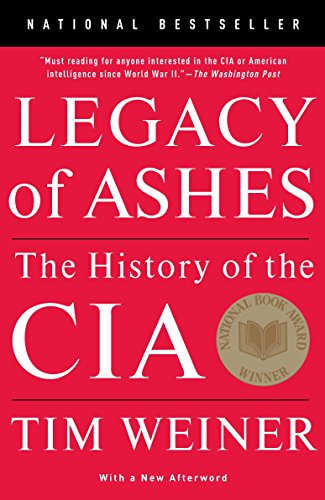
I’ve kept in touch with Doug, and recently asked him if he’d help me to flesh-out the new CIA book, Legacy of Ashes by Tim Weiner, the New York Times National Security reporter.
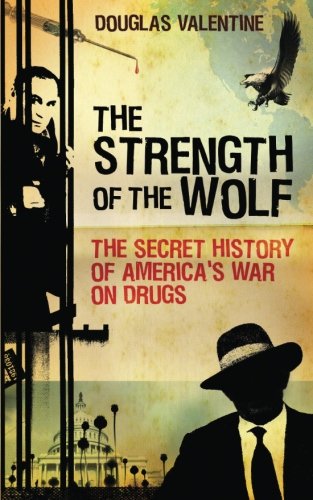
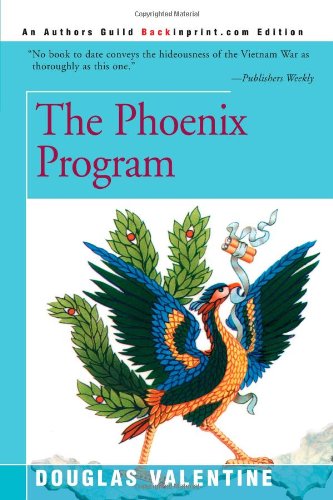
Doug Valentine is a poet and also the author of several incredibly rich and revealing books on the workings of National Security. Best known of these is the Phoenix Program about the Vietnam War and Strength of the Wolf: The Secret History of America’s War on Drugs.
His new book, Strength of the Pack, volume two about America’s war on drugs, will be published next year by the University of Kansas Press.
 The Strength of the Wo...
Best Price: $16.57
Buy New $107.83
(as of 07:35 UTC - Details)
The Strength of the Wo...
Best Price: $16.57
Buy New $107.83
(as of 07:35 UTC - Details)
Strength of the Wolf documents the history of the Federal Bureau of Narcotics. The FBN rubbed up against the CIA and FBI until it was finally rubbed out by "the Establishment" in 1968. Valentine attributes the demise of the FBN to the bureau’s success in penetrating the Mafia and the French connection and case-making agents uncovering "the Establishment’s ties to organized crime".
Unlike the Weiner book’s interviews with 10 CIA Directors, Valentine says the CIA did its best to prevent Strength of the Wolf from going forward. My interview with Doug Valentine follows.
Suzan Mazur: The New York Times National Security reporter, Tim Weiner, is out with a 60-year history of the Central Intelligence Agency’s failures called Legacy of Ashes. Weiner was recently a guest on the Charlie Rose Show talking about the CIA book. I’d like to use that interview as a backdrop for our conversation.
Over the past 15 years the Charlie Rose Show’s host and executive producer, the elegant Charlie Rose, has established himself as sort of the US minister of propaganda, using PBS as a platform, and funding from major foundations and major banks to broadcast his public affairs program from New York Mayor Mike Bloomberg’s Bloomberg News studios in Manhattan.
Sometimes the propaganda is a result of Rose not knowing the material, making it a perfect showcase for the Kissingers, Holbrookes, etc. to maneuver around in.
 The Phoenix Program
Best Price: $7.70
Buy New $108.10
(as of 01:20 UTC - Details)
The Phoenix Program
Best Price: $7.70
Buy New $108.10
(as of 01:20 UTC - Details)
For the record, I appeared on the broadcast in the 1990s when the show first went national, to discuss the crisis in Sudan. The Khartoum government had been overwhelmingly condemned for human rights violations by the UN. It was not letting in Western journalists. Osama bin Laden, Carlos the Jackal and Abu Nidal were all based in Khartoum at the time.
Is it a coincidence that bin Laden was there? Maybe not. Khartoum had been the CIA’s most important outpost in Africa and Sudan’s de facto leader, Hassan Turabi, had an interesting history with the CIA, most visibly through Operation Moses.
I managed to get in and do a videotaped interview in Khartoum with Hassan Turabi.
It’s to Charlie Rose’s credit that he attempted a segment on Sudan when nobody else was really. Fortunately, John McLaughlin followed up, inviting me for an in-depth look at the issues.
However, even in those years, the Charlie Rose Show seemed controlled or perhaps bungled so that none of the footage from my conversation in Khartoum with Turabi or discussion of that conversation or even discussion of my visit to Khartoum made it into the broadcast.
Rose’s focus was on starvation, and a decade and a half later we still have starvation – now in Darfur – because the media backed by big money will not look squarely at the problem. It takes work and honesty. As you’ve said so well in the introduction to your book, Strength of the Wolf: The Secret History of America’s War on Drugs:
“Much of our history is hidden behind a wall of national security and that sad fact prevents America from realizing its destiny.”
 Legacy of Ashes: The H...
Best Price: $2.13
Buy New $8.95
(as of 06:40 UTC - Details)
Legacy of Ashes: The H...
Best Price: $2.13
Buy New $8.95
(as of 06:40 UTC - Details)
My first question to you is this: In Tim Weiner’s hour-long talk with Charlie Rose about his book on the CIA, Weiner made the point that the late Director of Central Intelligence, Richard Helms, thought it was tragic that the US did not care enough anymore about espionage, which “seeks to know the world” through secrecy and deception. Charlie Rose replied, “I do too.” What is US national security all about really – whose national security is being served?
Doug Valentine: It’s a class issue. The CIA has not been running around the world trying to improve the lives of poor people, to raise their standard of living, even though they say they’re out there trying to bring freedom and democracy to the world. They’re just as likely to back a Pinochet, a despot, as they are to fight a Communist.
Suzan Mazur: What do you suppose the New York Times is up to with the Weiner book? Why is a reporter from one of the most important commercial newspapers, sticking it to the CIA by exposing the CIA’s 60 years of horrific failure, with monarchs and dictators on the payroll (King Hussein of Jordan for 20 years, Mobutu, etc.), when as you note in your richly informative book on the Federal Bureau of Narcotics, “Establishment privateers run the secret government”?
Doug Valentine: Most of what Weiner writes about the CIA is already known. It’s a history book with a bias, not an expose, at least not for the Vietnam generation. He doesn’t even really get into the current Bush administration. He gives us a predictable treatment of William Casey and the Contras, when there was an incredible revival of the CIA under Casey.
 TDY
Best Price: $91.18
Buy New $157.66
(as of 01:45 UTC - Details)
TDY
Best Price: $91.18
Buy New $157.66
(as of 01:45 UTC - Details)
Suzan Mazur: Weiner plays up the fact that long-time CIA counterintelligence chief, James Angleton, was constantly spilling the beans to Kim Philby during their frequent liquid lunches – Philby, a British agent who turned out to be a spy for the Soviet Union.
Doug Valentine: Angleton was key to understanding the CIA. Weiner hasn’t detailed Angleton’s relationship with the underworld through the Federal Bureau of Narcotics. He hasn’t gotten past CIA 101.
 The Hotel Tacloban
Best Price: $21.15
Buy New $25.00
(as of 01:35 UTC - Details)
The Hotel Tacloban
Best Price: $21.15
Buy New $25.00
(as of 01:35 UTC - Details)
Angleton had his own mysterious agenda, counterintelligence, seeking out enemy agents inside the CIA. He had liaison to the Mafia through Charles Siragusa, a Federal Bureau of Narcotics agent – and Mario Brod, a labor lawyer from Connecticut and New York, who as an Army counterintelligence officer had worked with Angleton at OSS – Office of Strategic Services, the forerunner of the CIA.
As I say in the book, James Angleton alone possessed the coveted Israeli account. His loyalty was to the Director of Central Intelligence, Allen Dulles – then Richard Helms, who was chief of Clandestine Services and later DCI. Director William Colby was his enemy.
Through Angleton’s relationships with Italian royalty, Tibor Rosenbaum [Mossad agent], Charlie Siragusa [FBN agent], Hank Manfredi [FBN], and Mario Brod, he was certainly aware of Meyer Lansky’s central role as the Mafia’s banker in the Caribbean – where Lansky’s mob associate from Las Vegas, Moe Dalitz, opened an account at Castle Bank – as well as in Mexico, where Angleton’s friend, Winston M. Scott, was station chief, and certainly kept tabs on Lansky’s associate, former Mexican president Miguel Aleman. As ever, Angleton and Lansky were the dark stars of the intelligence and financial aspects of international drug smuggling. Alan Block devotes some pages to this in his book, Masters of Paradise.
January 7, 2010
 A Case for Secession-Monetary Policy