


Our Greatest Presidents?
June 14, 2010
And so it goes. It is clear that Commager’s favorite is FDR. Here are some of History’s conclusions about FDR: Among his qualities were
honesty, resolution, fortitude, compassion, a sense of justice …. How right Franklin Roosevelt was when he said: "The Presidency is preeminently a place of moral leadership."
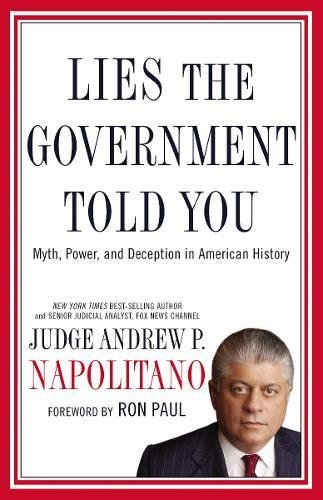 Lies the Government To...
Best Price: $0.25
Buy New $4.46
(as of 12:15 UTC - Details)
Lies the Government To...
Best Price: $0.25
Buy New $4.46
(as of 12:15 UTC - Details)

Roosevelt was "prepared to put principle above politics — and above popularity." The way Commager phrases the outstanding example of Roosevelt’s loyalty to "principle" is interesting: he "risked the loss of the 1940 election by stretching the Constitution to its permissible limits in order to aid beleaguered Britain" against Germany (emphasis added). "History," Commager adds, "has vindicated him well."
This is the famous historian’s little way of getting around a fact that, since the golden age of presidential glorification, has become common knowledge: namely, that Roosevelt committed the United States to war against Germany — through his promises to foreign leaders and his directives to the American armed forces — in 1940 (at the latest), without even the knowledge of Congress, and in direct contravention of his assurances to the American people, whom he treated as fools. By now, this much is established: as C. Boothe Luce put it for all time, "he lied us into war."
For sure — honesty, as Commager assures us, was one of FDR’s great virtues. And Eleanor’s mind was a model of Cartesian clarity. But what is the use? Commager’s out-of-date nonsense, masquerading as historical wisdom, is what they are going to teach little children in the government’s schools. After Vietnam and Nixon, the professional custodians of the tarnished symbols of the American state are panicky. They do what they can to patch things over — old pimps to an old whore dressed up as history. But how much longer?
 During the Crack-Up Boom