


Soldiers Against War The Story of the World War I Christmas Truce
The Story of the World War I Christmas Truce
December 12, 2014
The Christmas Truce, which occurred primarily between the British and German soldiers along the Western Front in December 1914, is an event the official histories of the “Great War” leave out, and the Orwellian historians hide from the public. Stanley Weintraub has broken through this barrier of silence and written a moving account of this significant event by compiling letters sent home from the front, as well as diaries of the soldiers involved. His book is entitled Silent Night: The Story of the World War I Christmas Truce. The book contains many pictures of the actual events showing the opposing forces mixing and celebrating together that first Christmas of the war. This remarkable story begins to unfold, according to Weintraub, on the morning of December 19, 1914:
“Lieutenant Geoffrey Heinekey, new to the 2nd Queen’s Westminster Rifles, wrote to his mother, ‘A most extraordinary thing happened. . . Some Germans came out and held up their hands and began to take in some of their wounded and so we ourselves immediately got out of our trenches and began bringing in our wounded also. The Germans then beckoned to us and a lot of us went over and talked to them and they helped us to bury our dead. This lasted the whole morning and I talked to several of them and I must say they seemed extraordinarily fine men . . . . It seemed too ironical for words. There, the night before we had been having a terrific battle and the morning after, there we were smoking their cigarettes and they smoking ours.” (p. 5)
Silent Night: The Stor... Best Price: $1.50 Buy New $67.33 (as of 11:15 UTC - Details)

Weintraub reports that the French and Belgians reacted differently to the war and with more emotion than the British in the beginning. The war was occurring on their land and “The French had lived in an atmosphere of revanche since 1870, when Alsace and Lorraine were seized by the Prussians” in a war declared by the French. (p. 4). The British and German soldiers, however, saw little meaning in the war as to them, and, after all, the British King and the German Kaiser were both grandsons of Queen Victoria. Why should the Germans and British be at war, or hating each other, because a royal couple from Austria were killed by an assassin while they were visiting in Bosnia? However, since August when the war started, hundreds of thousands of soldiers had been killed, wounded or missing by December 1914 (p. xvi). It is estimated that over eighty thousand young Germans had gone to England before the war to be employed in such jobs as waiters, cooks, and cab drivers and many spoke English very well. It appears that the Germans were the instigators of this move towards a truce. So much interchange had occurred across the lines by the time that Christmas Eve approached that Brigadier General G.T. Forrestier-Walker issued a directive forbidding fraternization:
“For it discourages initiative in commanders, and destroys offensive spirit in all ranks . . . . Friendly intercourse with the enemy, unofficial armistices and exchange of tobacco and other comforts, however tempting and occasionally amusing they may be, are absolutely prohibited.” (p. 6–7).
Later strict orders were issued that any fraternization would result in a court-martial. Most of the seasoned German soldiers had been sent to the Russian front while the youthful and somewhat untrained Germans, who were
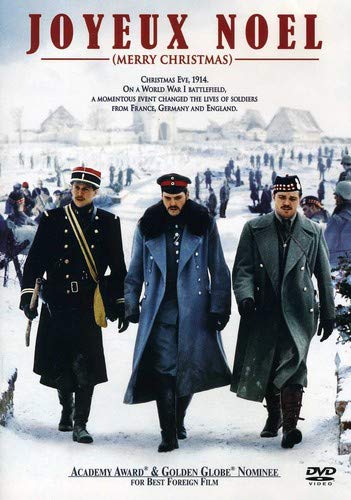 Joyeux Noel (Widescreen)
Best Price: $2.58
Buy New $9.99
(as of 12:30 UTC - Details)
recruited first, or quickly volunteered, were sent to the Western Front at the beginning of the war. Likewise, in England young men rushed to join in the war for the personal glory they thought they might achieve and many were afraid the war might end before they could get to the front. They had no idea this war would become one of attrition and conscription or that it would set the trend for the whole 20th century, the bloodiest in history which became known as the War and Welfare Century. As night fell on Christmas Eve the British soldiers noticed the Germans putting up small Christmas trees along with candles at the top of their trenches and many began to shout in English “We no shoot if you no shoot.”(p. 25). The firing stopped along the many miles of the trenches and the British began to notice that the Germans were coming out of the trenches toward the British who responded by coming out to meet them. They mixed and mingled in No Man’s Land and soon began to exchange chocolates for cigars and various newspaper accounts of the war which contained the propaganda from their respective homelands. Many of the officers on each side attempted to prevent the event from occurring but the soldiers ignored the risk of a court-martial or of being shot. Some of the meetings reported in diaries were between Anglo-Saxons and German Saxons and the Germans joked that they should join together and fight the Prussians. The massive amount of fraternization, or maybe just the Christmas spirit, deterred the officers from taking action and many of them began to go out into No Man’s Land and exchange Christmas greetings with their opposing officers. Each side helped bury their dead and remove the wounded so that by Christmas morning there was a large open area about as wide as the size of two football fields separating the opposing trenches. The soldiers emerged again on Christmas morning and began singing Christmas carols, especially “Silent Night.” They recited the 23rd Psalm together and played soccer and football. Again, Christmas gifts were exchanged and meals were prepared openly and attended by the opposing forces. Weintraub quotes one soldier’s observation of the event: “Never . . . was I so keenly aware of the insanity of war.” (p. 33).
Joyeux Noel (Widescreen)
Best Price: $2.58
Buy New $9.99
(as of 12:30 UTC - Details)
recruited first, or quickly volunteered, were sent to the Western Front at the beginning of the war. Likewise, in England young men rushed to join in the war for the personal glory they thought they might achieve and many were afraid the war might end before they could get to the front. They had no idea this war would become one of attrition and conscription or that it would set the trend for the whole 20th century, the bloodiest in history which became known as the War and Welfare Century. As night fell on Christmas Eve the British soldiers noticed the Germans putting up small Christmas trees along with candles at the top of their trenches and many began to shout in English “We no shoot if you no shoot.”(p. 25). The firing stopped along the many miles of the trenches and the British began to notice that the Germans were coming out of the trenches toward the British who responded by coming out to meet them. They mixed and mingled in No Man’s Land and soon began to exchange chocolates for cigars and various newspaper accounts of the war which contained the propaganda from their respective homelands. Many of the officers on each side attempted to prevent the event from occurring but the soldiers ignored the risk of a court-martial or of being shot. Some of the meetings reported in diaries were between Anglo-Saxons and German Saxons and the Germans joked that they should join together and fight the Prussians. The massive amount of fraternization, or maybe just the Christmas spirit, deterred the officers from taking action and many of them began to go out into No Man’s Land and exchange Christmas greetings with their opposing officers. Each side helped bury their dead and remove the wounded so that by Christmas morning there was a large open area about as wide as the size of two football fields separating the opposing trenches. The soldiers emerged again on Christmas morning and began singing Christmas carols, especially “Silent Night.” They recited the 23rd Psalm together and played soccer and football. Again, Christmas gifts were exchanged and meals were prepared openly and attended by the opposing forces. Weintraub quotes one soldier’s observation of the event: “Never . . . was I so keenly aware of the insanity of war.” (p. 33).
 All Quiet on the Weste...
Best Price: $3.23
Buy New $5.37
(as of 01:05 UTC - Details)
The first official British history of the war came out in 1926 which indicated that the Christmas Truce was a very insignificant matter with only a few people involved. However, Weintraub states:
All Quiet on the Weste...
Best Price: $3.23
Buy New $5.37
(as of 01:05 UTC - Details)
The first official British history of the war came out in 1926 which indicated that the Christmas Truce was a very insignificant matter with only a few people involved. However, Weintraub states:
“During a House of Commons debate on March 31, 1930, Sir H. Kinglsey Wood, a Cabinet Minister during the next war, and a Major ‘In the front trenches’ at Christmas 1914, recalled that he ‘took part in what was well known at the time as a truce. We went over in front of the trenches and shook hands with many of our German enemies. A great number of people [now] think we did something that was degrading.’ Refusing to presume that, he went on, ‘The fact is that we did it, and I then came to the conclusion that I have held very firmly ever since, that if we had been left to ourselves there would never have been another shot fired. For a fortnight the truce went on. We were on the most friendly terms, and it was only the fact that we were being controlled by others that made it necessary for us to start trying to shoot one another again.’ He blamed the resumption of the war on ‘the grip of the political system which was bad, and I and others who were there at the time determined there and then never to rest . . . Until we had seen whether we could change it.’ But they could not.” (p. 169–70).
 German and British soldiers fraternize – Christmas 1914 Beginning with the French Revolution, one of the main ideas coming out of the 19th century, which became dominant at the beginning of the 20th century, was nationalism with unrestrained democracy. In contrast, the ideas which led to the American Revolution were those of a federation of sovereign states joined together under the Constitution which severely limited and separated the powers of the national or central government in order to protect individual liberty. National democracy was restrained by a Bill of Rights. These ideas came into direct conflict with the beginning of the American War Between the States out of which nationalism emerged victorious. A principal idea of nationalism was that the individual owed a duty of self-sacrifice to “The Greater Good” of his nation and that the noblest act a person could do was to give their life for their country during a war, which would, in turn, bring him immortal fame. Two soldiers, one British and one German, both experienced the horrors of the trench warfare in the Great War and both wrote moving accounts which challenged the idea of the glory of a sacrifice of the individual to the nation in an unnecessary or unjust war. The British soldier, Wilfred Owen, wrote a famous poem before he was killed in the trenches seven days before the Armistice was signed on November 11, 1918. He tells of the horror of the gas warfare which killed many in the trenches and ends with the following lines:
If in some smothering dreams you too could pace Behind the wagon that we flung him in, And watch the white eyes writhing in his face, His hanging face, like a devil’s sick of sin; If you could hear, at every jolt, the blood Come gargling from the froth-corrupted lungs, Obscene as cancer, bitter as the cud Of vile, incurable sores on innocent tongues – My friend, you would not tell with such high zest To children ardent for some desperate glory The old Lie: Dulce et decorum est Pro patria mori. (The Latin phrase is translated roughly as “It is sweet and honorable to die for one’s country,” a line from the Roman poet Horace used to produce patriotic zeal for ancient Roman wars.) .
 The Costs of War: Amer...
Best Price: $1.99
Buy New $13.46
(as of 08:00 UTC - Details)
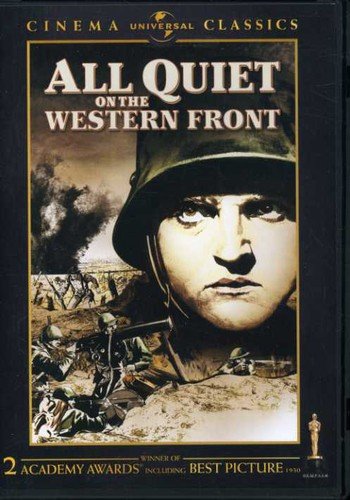
The German soldier was Erich M. Remarque who wrote one of the best anti-war novels of all time, entitled All Quiet On The Western Front, which was later made into an American movie that won the Academy Awards in 1929 as the “Best Movie” of the year. He also attacked the idea of the nobility of dying for your country in a war and he describes the suffering in the trenches:
The Costs of War: Amer...
Best Price: $1.99
Buy New $13.46
(as of 08:00 UTC - Details)
The German soldier was Erich M. Remarque who wrote one of the best anti-war novels of all time, entitled All Quiet On The Western Front, which was later made into an American movie that won the Academy Awards in 1929 as the “Best Movie” of the year. He also attacked the idea of the nobility of dying for your country in a war and he describes the suffering in the trenches:
“We see men living with their skulls blown open; We see soldiers run with their two feet cut off; They stagger on their splintered stumps into the next shell-hole; A lance corporal crawls a mile and half on his hands dragging his smashed knee after him; Another goes to the dressing station and over his clasped hands bulge his intestines; We see men without mouths, without jaws, without faces; We find one man who has held the artery of his arm in his teeth for two hours in order not to bleed to death.”
Thomas Hardy’s poem “The Man He Killed,” was published in 1902 and was inspired by the Boer War, but it captures the spirit of the Christmas Truce in 1914:
Had he and I but met By some old ancient inn, We should have sat us down to wet Right many a nipperkin! . But ranged as infantry, And staring face to face, I shot at him as he at me, And killed him in his place. . I shot him dead because – Because he was my foe, . Just so: my foe of course he was; That’s clear enough; although . He thought he’d ‘list, perhaps, Off-hand like – just as I – Was out of work – had sold his traps – No other reason why. . Yes, quaint and curious war is! You shoot a fellow down You’d treat if met where any bar is, Or help to half-a-crown. .
The last chapter of Weintraub’s book is entitled “What If – ?” This is counterfactual history at its best and he sets out what he believes the rest of the 20th century would have been like if the soldiers had been able to cause the Christmas Truce of 1914 to stop the war at that point. Like many other historians, he believes that with an early end of the war in December of 1914, there probably would have been no Russian Revolution, no Communism, no Lenin, and no Stalin. Furthermore, there would have been no vicious peace imposed on Germany by the Versailles Treaty, and therefore, no Hitler, no Nazism and no World War II. With the early truce there would have been no entry of America into the European War and America might have had a chance to remain, or return, to being a Republic rather than moving toward World War II, the “Cold” War (Korea and Vietnam), and our present status as the world bully.  Weintraub states that:
” . . . Franklin D. Roosevelt, only an obscure assistant secretary of the navy – of a fleet going nowhere militarily – would have returned to a boring law practice, and never have been the losing but attractive vice presidential candidate in 1920, a role earned by his war visibility. Wilson, who would not be campaigning for reelection in 1916 on a platform that he kept America out of war, would have lost (he only won narrowly) to a powerful new Republican president, Charles Evans Hughes . . . . ” (p. 167). He also suggests another result of the early peace would have been: “Germany in peace rather than war would have become the dominant nation in Europe, possibly in the world, competitor to a more slowly awakening America, and to an increasingly ambitious and militant Japan. No Wilsonian League of Nations would have emerged . . . Yet, a relatively benign, German-led, Commonwealth of Europe might have developed decades earlier than the European Community under leaders not destroyed in the war or its aftermath” (p. 167).
Many leaders of the British Empire saw the new nationalistic Germany (since 1870–71) as a threat to their world trade, especially with Germany’s new navy. The idea that economics played a major role in bringing on the war was confirmed by President Woodrow Wilson after the war in a speech wherein he gave his assessment of the real cause of the war. He was campaigning in St. Louis, Missouri in September of 1919 trying to get the U.S. Senate to approve the Versailles Treaty and he stated:
“Why, my fellow-citizens, is there [anyone] here who does not know that the seed of war in the modern world is industrial and commercial rivalry?. . . This war, in its inception, was a commercial and industrial war. It was not a political war.”
The great economist, Ludwig von Mises, advocated a separation of the economy from the government as one important solution to war so that business interests could not get government assistance in foreign or domestic markets:
 Omnipotent Government
Best Price: $19.81
Buy New $31.85
(as of 03:10 UTC - Details)
Omnipotent Government
Best Price: $19.81
Buy New $31.85
(as of 03:10 UTC - Details)
Durable peace is only possible under perfect capitalism, hitherto never and nowhere completely tried or achieved. In such a Jeffersonian world of unhampered market economy the scope of government activities is limited to the protection of the lives, health, and property of individuals against violence or fraudulent aggression . . . All the oratory of the advocates of government omnipotence cannot annul the fact that there is but one system that makes for durable peace: A free market economy. Government control leads to economic nationalism and thus results in conflict.
[Omnipotent Government: The Rise of the Total State and Total War, pp. 284 and 286] Weintraub alludes to a play by William Douglas Home entitled A Christmas Truce wherein he has characters representing British and German soldiers who just finished a soccer game in No Man’s Land on Christmas day and engaged in a conversation which very well could represent the feelings of the soldiers on that day. The German lieutenant concedes the impossibility of the war ending as the soccer game had just done, with no bad consequences – “Because the Kaiser and the generals and the politicians in my country order us that we fight.”
“So do ours,” agrees Andrew Wilson (the British soldier) “Then what can we do?” “The answer’s ‘nothing.’ But if we do nothing . . . . like we’re doing now, and go on doing it, there’ll be nothing they can do but send us home.” “Or shoot us.” (p. 110)
 The Great War killed over ten million soldiers and Weintraub states, “Following the final Armistice came an imposed peace in 1919 that created new instabilities ensuring another war,” (p. 174). This next war killed more than fifty million people, over half of which were civilians. Weintraub writes:
“To many, the end of the war and the failure of the peace would validate the Christmas cease-fire as the only meaningful episode in the apocalypse. It belied the bellicose slogans and suggested that the men fighting and often dying were, as usual, proxies for governments and issues that had little to do with their everyday lives. A candle lit in the darkness of Flanders, the truce flickered briefly and survives only in memoirs, letters, song, drama and story.” (p. xvi).
He concludes his remarkable book with the following:
“A celebration of the human spirit, the Christmas Truce remains a moving manifestation of the absurdities of war. A very minor Scottish poet of Great War vintage, Frederick Niven, may have got it right in his ‘A Carol from Flanders,’ which closed, O ye who read this truthful rime . From Flanders, kneel and say: God speed the time when every day Shall be as Christmas Day. (p. 175) .
A Century of War: Linc... Best Price: $3.72 Buy New $8.50 (as of 07:45 UTC - Details)
Check Amazon for Pricing.
Amazon.com $50 Gift Ca... Buy New $50.00 (as of 11:05 UTC - Details)

 Time To Disarm the Police