


The Impossible Is Now Possible
August 3, 2010
James Ostrowski, author of Direct Citizen Action: How We Can Win the Second American Revolution Without Firing a Shot recently wrote, "In the realm of politics, the best chance the liberty movement has is not winning elections but convincing states and localities to stop cooperating with the federal government. I believe the Tenth Amendment Movement, as it is known, has great potential.”
An important revolutionary principle that American colonists learned from reading "Cato’s Letters” in the mid-18th century was this: Unjust laws must be resisted immediately, or they will set the stage for additional encroachments. One of "Cato’s Letters” explains:
“A nation has but two sorts of usurpation to fear, one from their neighbors and another from their own magistrates. Nor is a foreign usurpation more formidable than a domestic, which is the most dangerous of the two, by being hardest to remove and generally stealing upon the people by degrees, is fixed before is scarce felt or apprehended.”
Thomas Jefferson had a personal copy of "Cato’s Letters” in his home library and he put this principle into action when the so-called federalists began arresting their political opponents and throwing them in jail. While still serving as vice president, he secretly urged immediate resistance by drafting what have come to be known as the Kentucky Resolutions of 1798.
The reason he drafted those resolutions was to convince state legislators that nullification was the most appropriate form of immediate resistance. The reason I wrote this essay, is to convince American libertarians today of the same thing. I won’t go into detail explaining what nullification is. There are plenty of other articles widely available which already do that – not to mention Tom Woods’ latest, Nullification: How to Resist Federal Tyranny in the 21st Century.
The Problem of Power
In an oration in 1772, John Adams declared that, “Liberty, under every conceivable form of government is always in danger.”
26 years later, he personified that very danger when he signed into law the Alien and Sedition Acts, which made criticizing the president and others in the federal government a crime. Adams showed us that government is the greatest threat to liberty because it always tends toward the destruction of the individual’s natural rights.
 Direct Citizen Action:...
Best Price: $0.47
Buy New $5.75
(as of 09:05 UTC - Details)
Direct Citizen Action:...
Best Price: $0.47
Buy New $5.75
(as of 09:05 UTC - Details)

Because government is such a dangerous concentration of power, American revolutionaries recognized the absolute necessity of limiting government power and dividing it into as many competing jurisdictions as possible. The hope was that under such an arrangement, the federal government would be held in check and people would have the option to move freely between more powerful, but competing states. Competition would keep their multiple jurisdictions from becoming intolerably oppressive.
This decentralized condition, which is called federalism, should be very desirable to libertarians. Why? Because if they are forced to live under a government at all, this condition at least makes it much easier for them to move to a state with more freedom or chip away at their own state government, to the point that it barely escapes being no government at all. So why is this not our condition today? At least one very important reason is because we have not insisted that our state governments use nullification.
For the first time since the 1850s, such a condition is a real possibility in America. Political, technological and economic conditions are coinciding to create what could be a perfect storm. In military terminology, conditions such as weather can be used as force multipliers, which make a given force more effective than that same force would be without it. In addition to making the most of economic and technological force multipliers, what is needed next is greater acceptance and approval by the majority of Americans for the widespread use of state nullification. Successfully gaining that acceptance and approval at a time when the federal government is perceived as being bankrupt, both financially and morally, could bring about radical decentralization sooner than most libertarians could have imagined just two decades ago. In his 1975 research article entitled, The American Revolution and the Minority Myth, William F. Marina wrote:
"What I am suggesting is that the question of legitimacy is really at the heart of the whole process of revolution. A revolution is impossible unless a majority withdraws its allegiance from the old regime and begins to place it elsewhere. Often that process is masked to the point that when the old regime collapses, the fall appears more u2018sudden’ than was actually the case.”
Considering what lies ahead of us economically, it seems not only plausible, but probable, that people will soon begin to rapidly transfer legitimacy from Washington, DC to their state capital, partly from disgust and partly out of sheer necessity.
Nullification: Revolutionary or Reformist?
This scenario has nothing to do with overturning the constitutional order. In fact, it is precisely how the constitutional order was supposed to work in the first place. The use of nullification by states to neutralize acts of federal usurpation is both constitutional and revolutionary at the core. William J. Watkins explains it like this in his book, Reclaiming the American Revolution: The Kentucky and Virginia Resolutions and their Legacy:
"The Kentucky and Virginia Resolutions, written over two decades after the colonies declared independence from Great Britain, represent a reaffirmation of the spirit of 1776. At the core, the Resolutions are intrepid statements in favor of self-government and limited central authority. A product of the political and constitutional battlegrounds of the 1790s, the resolutions serve to link the federal union created by the Constitution with the aspirations of the patriots of the American Revolution. Indeed the touch of the author of the Declaration of Independence is unmistakable when one reads the Kentucky Resolutions of 1798.”
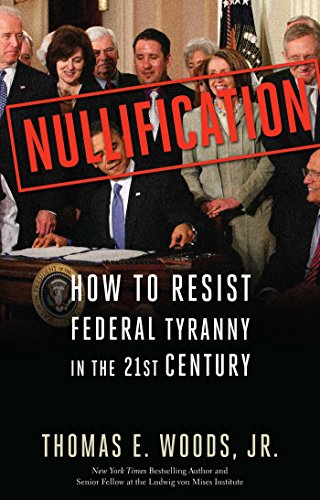 Nullification: How to ...
Best Price: $2.00
Buy New $8.34
(as of 05:25 UTC - Details)
Nullification: How to ...
Best Price: $2.00
Buy New $8.34
(as of 05:25 UTC - Details)
Unlike the reformist strategy which seeks to mobilize power within Washington, DC in order to reform and redirect that power, nullification seeks to diminish and redistribute that power through relentless, decentralized, but ideally coordinated, acts of state level, constitutional resistance.
Over the past few years, state legislators across the country have created a heavy wave of nullification legislation. We libertarians need to grab our surfboards!
Revolutionizing the Tea Party
As libertarians, we must play a leading role by carrying out the labor-intensive but very fruitful task of selling nullification to non-libertarians who are already mobilized. These Americans are extremely upset and have become very active in grassroots organizations. Unfortunately, they are transfixed by national politics and attribute too much importance to wining in federal elections. What they have not yet realized is that their almost exclusive reliance on electoral means to oppose federal tyranny will only get them more of the same. Libertarians should, therefore, act alongside them in ways that do not compromise our principles, while simultaneously winning their support for nullification legislation and directing their attention to state level solutions that involve more radical means of resistance. Those running for, or already elected to state office need to be sold on the constitutionality, morality and effectiveness of nullification. The good news is that unlike beltway insiders, most of these people actually live and work in your community.
Libertarian intellectuals, leaders and grassroots organizations have been busy manufacturing the tools and preparing the soil for us. Tom Woods, for example, has just written what some have called a handbook on nullification. One well-known talk show host has called it, "a battle plan” and "the answer to our prayers.” The Tenth Amendment Center has been tracking recent nullification legislation, writing new and improved bills, and working with state legislators to get them introduced and passed.
On top of all that, a host of organizations like Downsize DC, Campaign For Liberty, Daily Paul, and others have joined the Tenth Amendment Center and libertarian activist Trevor Lyman in sponsoring the Nullify Now! tour, something that advocates of this essential principle may have thought impossible just a few years ago. The tour will feature speakers almost all libertarians know and respect – Tom Woods, Jim Babka, Tom Mullen, Michael Boldin, Jack Hunter and others. These speakers will give grassroots activists and people in state government a logical, moral, and constitutionally sound case for nullification.
The ground has been prepared and conditions are favorable for radical decentralization. Whether a critical mass of libertarians will get involved in this new movement and make use of the tools available to them before this decisive point in history has passed us by remains to be seen. You can be sure that there are plenty of politicians in Washington, DC who live in fear of the day that states, guided by liberty activists, stand together and once again make use of that powerful weapon called nullification. That’s why they want it to remain taboo to even discuss it. And it’s why we libertarians must do everything we can to advertise it.
August 3, 2010
 The Mandatory Service Bill and the Impending Attack On Iran