


Readings for the Crisis
August 20, 2007
 On Friday the Federal Reserve lowered its discount rate 50 basis points to 5.75 percent. As the article linked above illustrates, the Fed decision showcases the corner into which the government has painted itself. If the Fed did "nothing" (i.e. continued to pump in counterfeit money to keep interest rates on target) then Wall Street could have suffered even further setbacks — troubling indeed since earlier in the week all of the gains of 2007 had evaporated.
On the other hand, if the Fed had announced a cut in the federal funds rate target ahead of its scheduled September 18 meeting, that could have worried investors that the situation was worse than earlier statements from the grand wizards had indicated. The solution? On Friday the Fed announced a moderate cut in the discount rate, not the more important federal funds target rate. (The discount rate is what the Fed itself charges banks to borrow reserves, whereas the fed funds rate is what member banks charge each other for overnight loans of reserves. In terms of volume, the interbank market dwarfs borrowing at the Fed window.) This way, the Fed is "doing something" while not contradicting its earlier announcements that things were fine and that rate cuts could wait until September. Ah, the stressful nuances of central banking!
 The money and banking systems of modern, heavily regulated economies are quite daunting indeed. If the government had a deficit, and cranked out a billion new $100 bills off the printing press to cover the hole, that would be easy to grasp. Of course, the public might get suspicious of such naked counterfeiting, especially when prices kept rising. Therefore, our system doesn’t work like that. Instead, we have a Federal Reserve System, with member banks that have to have a certain amount of reserves with the Fed or cash in the vault, backing up their outstanding checkable deposits. Inflation of the money supply is definitely occurring — just look at prices over the years! — but it’s a very subtle process.
Unfortunately, inflation of the money supply is an extremely important process, and everyone needs to understand the basics. For not only does monetary inflation lead to rising prices, it also causes the boom-bust cycle (which is blamed on the "free market"). In this article, I summarize articles and books of various depths, to bring the reader up to his or her desired level of understanding on this crucial topic.
 EASY PIECES FOR THOSE IN A HURRY
For those who just want to read a few short articles to get up to speed, I recommend the following:
- John Paul Koning does a great job explaining the August 10 Fed injection of $38 billion in "temporary" reserves. (However, if you don’t know what a repo is, you should first read the beginning of this Wikipedia entry before proceeding to Koning’s story.)
- To see how Austrian economics clashes with the typical financial press version of events, two of my previous articles should prove helpful: Here’s one on central banking (note that it was written in 2004 just after a rate hike) and another, more recent one explaining that economic growth doesn’t cause inflation.
- For other applications of Austrian business cycle theory to the financial news of the day, I highly recommend the LRC articles of Gary North, and the Mises.org articles of Frank Shostak and Robert Blumen.
 A BIGGER TIME COMMITMENT, BUT MORE REWARDING
For those who are willing to put a few hours into it, the following are accessible introductions to Austrian business cycle theory and the implied critique of the US monetary and banking system:
- Rothbard has written two excellent primers, What Has Government Done To Our Money? and The Case Against the Fed (reviewed here by David Gordon).
- Henry Hazlitt’s What You Should Know About Inflation gives you the "news you can use" in his refreshing style.
- Roger Garrison’s Power Point presentations are wonderful, but they are geared toward explaining the Austrian business cycle theory with the concepts and diagrams of mainstream economics. So if you remember the production possibilities frontier (PPF) from your intro econ class, you’ll love the slide show, but if you never took an undergrad economics class, you’re better off reading the original expositions rather than Garrison’s "translation."
 The chapters on capital structure and the business cycle in Gene Callahan’s Economics for Real People were designed to be painless reading for the layperson.
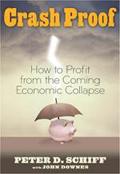
- I haven’t personally read it, but I hear good things about Peter Schiff’s Crash Proof: How to Profit From the Coming Economic Collapse. Schiff is famously pessimistic about the future of the US economy — financial writers can always go to him for a dire quote — and he ties his analysis to the Austrian school. (Long-time readers might be puzzled at my recommendation, since I’ve picked fights with Schiff in the past. But as I explain in this mea culpa, I am now much more sympathetic to his views.)
- If you prefer audio format, the lectures at Mises University are wonderful introductions to the entire core of Austrian theory. (Unfortunately, Roger Garrison’s lectures on the business cycle are rather tied to his Power Point presentation, and so don’t translate well into this medium. But the earlier lectures provide excellent background material to understand the present financial crisis. Also note that because of the redundancy, each lecture isn’t repeated in every archive for every year; you’ll have to search through multiple years to get every single lecture.)
 THE FULL STORY
Finally, for those who want to read full expositions of the Austrian theory of money, credit, and the business cycle, I recommend the following:
- Rothbard’s Man, Economy, and State (especially chapters 5 and 6, and section 11 of chapter 12). Although these recommended excerpts are lengthy, they are very clearly written and can be your one-stop shopping for a full explanation of the business cycle.
- The Austrian Theory of the Trade Cycle is a collection of essays by various writers. Its virtue is that it provides slightly different perspectives and writing styles, and so at least one of them is bound to appeal to the reader. On the downside, it doesn’t present a systematic exposition.
 Mises’ Human Action (especially chapters XIX and XX). It’s always fun and important to go back to the master, but this is rather heavy stuff.
- Hayek’s Prices and Production (.pdf) comes at the Misesian theory from a different angle, so to speak. Although this work is a classic in the literature, it is very difficult reading indeed and I recommend it only for trained economists who want to see a more analytical approach than that offered by Mises and Rothbard in their treatises.
CONCLUSION
When I was in graduate school, my peers would often ask, "So what the heck is Austrian economics?" If I thought the person really wanted to give me a good five minutes, I would steer the conversation to the Misesian theory of the business cycle. This is one clear-cut area where Austrian thinkers really know something important about the world that other people lack.
 In the coming years it seems the chickens will come home to roost from the negative (inflation adjusted) interest rates that Alan Greenspan foisted on the economy in the early 2000s. If you do your homework, you’ll understand why events are unfolding this way, and you just may be able to protect your assets as well.
 Cut the Alma Mater Cord