


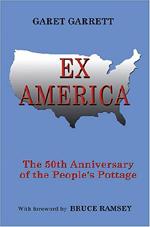
Ex America
October 5, 2004
With a foreword by Bruce Ramsey
Reviewed by Ryan McMaken by Ryan McMaken
 Perhaps as a symptom of the ongoing intellectual decline of the mainstream American right, it is not difficult to find people calling themselves "conservatives" who, without hesitation, sing the praises of Franklin Roosevelt, the New Deal, and the benefits of central planning and total war. We have the drivel spouted by so-called right-wing champions of freedom like Michelle Malkin and Les Kinsolving who in their uncritical view of American concentration camps, let us know that it is nothing less than treason to question the divine motives of their hero Roosevelt. And then, of course, there is neoconservative William Kristol, the Republican Party strategist and supposed paragon of the right who has lectured us on how America is a much a better place thanks to the great FDR. Careful not to alienate the beneficiaries of various New Deal welfare programs like pensioners, farmers, and others on the permanent dole, the "compassionate" and respectable leaders of today’s right now steadfastly profess to have rarely met a government program that they didn’t like.
Yet there once was a time when liberty was the language of the right, and with the release of the 50th Anniversary Edition of Garet Garrett’s The People’s Pottage, it is possible to once again read the eloquent prose of one of the greatest intellectuals of an American right that had not yet made its peace with the dismantling of free and republican government in America.
While only one of many American intellectuals of the 1930’s, 40’s and 50’s who breathlessly rallied against the statist tide, and who collectively have come to be known as the Old Right, Garet Garrett is without a doubt one of the most penetrating, eloquent, and readable writers of that era. With writers like Frank Chodorov, Rose Wilder Lane, John T. Flynn, Albert J. Nock, and others, Garrett helped lead an intellectual movement that is today best described as libertarian, and at the time was considered "rightist," or "individualist" or "liberal" in the classical sense. When it comes to detailed and exacting attacks on the New Deal and on the proponents of American Empire, few are as thorough as Garet Garrett.
In his history of the American Right, Justin Raimondo calls Garrett "Exemplar of the Old Right," and in his biographical introduction to this reissue of Garrett’s work, Bruce Ramsey notes that Garrett’s writing possesses "an unusual clarity of belief" in what were once the American virtues of "a pre—New Deal constitutionalism, an America-first foreign policy, a gold-backed currency and economic laissez-faire."
Labeled by some as "Profit’s Prophet" Garrett Brings to his writing a businesslike sensibility around what are to him the obvious benefits of a free economy. Yet although he sees much through an economic lens, Garrett pens no dry economic treatises. Indeed, Garrett’s method is political economy at its best, recognizing the intimate connection between economic freedom and political freedom — between a free marketplace and free men. Thus Garrett’s orientation toward the everyday realities of finance and business allows him to cut directly to the heart of the matter of the New Deal — of political chicanery, and of war. He did not give quarter to the flowery and deceptive language employed to mask Roosevelt’s relentless assaults on individualism, liberty, and peace, and consequently, his insights speak to us today with a clarity rarely found in the pages of libertarian polemics of any era.
This re-issue of The People’s Pottage has been released under the title Ex America, the title of one of the three essays that make up this volume. These three essays, "The Revolution Was" (1938), "Ex America" (1951), and "Rise of Empire" (1952), identify and chronicle three primary developments that in Garrett’s view provide the greatest threats to American liberties: the triumph of "revolution within the form," the primacy of deception as a rule of government expansion, and the unrivaled ascendancy of the executive branch. Garrett explains to us how development and acceleration of these factors in American political life had rendered the Old Republic a relic to be found only in the dustbin of history.
As one reads these essays, the word "relic" certainly comes to mind, for the pre-Roosevelt America that Garrett describes is so thoroughly unlike modern America (with our federal police forces, our omniscient IRS, and our almost annual invasions of foreign nations) that it requires a substantial amount of imagination to follow Garrett’s tales of an America where county commissioners were far more relevant to the lives of Americans than any president, and the federal government was more a far-off abstraction than a relentless confiscator of wealth and destroyer of liberties.
Garrett begins the first essay with a call to recognize the full extent of what had happened in America: "There are those who still think they are holding the pass against a revolution that may be coming up the road. But they are gazing in the wrong direction. The revolution is behind them. It went by in the Night of Depression, singing songs to freedom."
At least as early as 1938, Garrett was already well aware of the true nature of the New Deal. It was not merely an incremental change in the size and scope of government, but a true revolution "within the form." Garrett based these observations on the Aristotelian concept of the revolution that employs the "ancient laws" and claims to revere them while the true power has shifted from the traditional institutions to a new and revolutionary group hostile to the law they claim to defend.
Garrett believed that Roosevelt and the New Dealers had employed this tactic brilliantly, centralizing and seizing power after power, while many of his critics continued to discuss the legal minutiae of a revolution that had passed them by years earlier. Garrett is amazed by the resilience that Americans show in refusing to believe that any significant change had happened. Even after Roosevelt seized control of the entire American financial system, Americans refused to see the true meaning of what was going on. With Roosevelt’s leadership, the United States repudiated all of its legal and moral obligations to pay its debts to Americans in gold, it outlawed the private ownership of gold, it seized control of the entire banking system, it destroyed the savings of Americans with an unrestrained inflationary monetary policy, and generally enriched its treasury and its power-base by making countless new promises of largesse to Americans, and then making payments in devalued currency.
Americans had voted for none of this. In fact, the Democratic Party platform at the time specifically endorsed a hard money policy and called for "an immediate and drastic reduction of government expenditures." Roosevelt piously pledged that he would be bound by this platform, but as virtually all expansion of government power is based on deception, such promises proved to be worthless. For Garet Garrett, such lies were all part of the revolutionary plan, thus it was essential that one appear committed to the rule of law in order to be able to subvert it. Next would come a wresting of the economic power-centers of the economy from the private sector, a subtle takeover of private business through regulation, and finally, a substitution of a managed economy for a free one. Once economic control had been gained, political control would be easy to come by.
This is what Garrett saw as the revolution within the form. The Constitution was still revered in public. Words like "freedom" and "law" and "separation of powers" were still bandied about, but the meaning of the words had changed. "Freedom," for example, no longer meant the absence of government control. Now it meant having a claim on someone else’s livelihood, or as being one against the "greed" of the business classes. A decade before George Orwell would write 1984, Garet Garrett had discovered Newspeak, that essential tool of government in the modern democratic state.
By the time he would write his essay "Ex America" in 1951, Garrett had already seen many of the fruits of the Roosevelt revolution. The end of liberty and law in peacetime had of course been accompanied by its end in war as well. Garrett details its evolution: First to go was the separation of powers in domestic matters. With the rise of the administrative state, the entire relationship between the government and governed has changed: "the taxpayer who now goes on his errand to Washington is another person. He is timorous and respectful. He does not tell the bureaucrat; the bureaucrat tells him. He has the sense of dealing with a vast impersonal power, and it is power that may legally take away his entire income."
Garrett writes of a time when Americans thought and acted as if the Congress of the United States was the voice of the American people. This certainly had been the intent of the framers of the Constitution, since for them the Congress was to be the branch closest to the people, and thus the truer representative. By Garrett’s day, America had certainly dispensed with all that: "And note that when now we speak of government we mean not Congress, and of course not the Supreme Court, but the executive power, seated in the White House and spread among various administrative agencies that make and execute their own laws, thereby exercising legislative, executive, and judicial functions, all three at once."
Such assaults against liberty on the domestic front were nothing compared to the executive’s newfound powers in matters of war and peace. It is perhaps on this subject that Garrett is most famous, and in which he offers the most piercing analysis. With "Rise of Empire" (1952) Garrett provides an examination of the "Properties of Empire," the hallmarks of a society that has "crossed the boundary that lies between Republic and Empire," and even in 1952, Garrett believed that the evidence of empire was everywhere evident, yet many chose not to see it:
There was no painted sign to say: "You are now entering Imperium." Yet it was a very old road and the voice of history was saying "Whether you know it or not, the act of crossing may be irreversible. And now, not far ahead, is a sign that reads: "No U-turns."
If you say there were no frightening omens, that is true. The political foundations did not quake, the graves of the founders did not fly open, the Constitution did not tear itself up. If you say that people did not will it, that also is true. But if you say therefore it has not happened, then you have been so long bemused by words that your mind does not believe what the eye can see.
But what does the eye see? Garrett outlines five "properties of empire" that illustrate the machinations of empire for any educated citizen to see:
- Rise of the executive principle of government to a position of dominant power.
- Accommodation of domestic policy to foreign policy.
- Ascendancy of the military mind.
- A system of satellite nations for a purpose called collective security.
- An emotional complex of vaunting and fear.
Garrett found numerous examples to illustrate the fearful presence of all of these properties and their destructive effects on the Constitution and the rule of law in general. We need not recount here all the hallmarks of empire in Garrett’s day, for we have so many with us today that are amply evident, yet perhaps unseen, for like the people of Orwell’s Airstrip One, many of us have been "bemused by words" and are content to believe that slavery is freedom, hate is love, and war is peace.
Presidents are treated as scarce less than gods; government is not seen as an instrument with the sole purpose of protecting liberty, but as a messianic crusader against whomever or whatever a president happens to not like at any particular moment in time. Everywhere martial displays of unquestioned allegiance to the State are demanded of the people, even as American troops occupy over a hundred foreign nations, many of which are places few Americans have ever even heard of. And of course, there is Garrett’s "complex of vaunting and fear" where the American government is godlike and unassailable, yet somehow also forever at risk and on the brink of collapse demanding an unending infusion of treasure and power.
Fifty years later, it has been a long time since anyone has bothered to question any of the moral or Constitutional foundations of the presidential fondness for taxing and bombing and centralizing and regulating. How could anyone dare to ask such questions when we are constantly told that the needs of the unending cosmic battle make all Americans suspect, and that only traitors ask such unpleasant questions? We have come a long way from the days when Thomas Jefferson, in his Kentucky Resolution, would declare the states to be unconstrained by federal laws made by men claiming to act in the interest of "national security."
Today, for saying such things, Jefferson would surely be labeled a traitor, and men like Garet Garrett would be right beside him, for he would have found no quarter even among his fellows of the American right. As Garrett was writing "Rise of Empire," an altogether new right wing was emerging in America. This new "conservative movement" would deny the true liberalism of the Old Right, and in its place would graft an ideology that was at peace with the New Deal, executive supremacy, and the managed economy, all the while singing songs to freedom.
This coup was engineered by men like James Burnham, Whittaker Chambers, and William F. Buckley who would declare men like Garrett to be irrelevant, old-fashioned, and nave. They pretended to be against the Roosevelt revolution, but for them, the rights of Americans were little more than a sideshow to the march of the executive state toward world dominance and the "end of history." Burnham especially would declare the Rooseveltian "virtues" of the state-controlled economy and centralized power to be the wave of the future, and that all those who, like Garrett, might defend the advantages of a laissez-faire republic were but leftovers from an obsolete age.
It is safe to say that Garrett and the rest of the Old Right are now all but completely ignored by the modern conservative movement. For when an intellectual movement is busy extolling the virtues of a socialist healthcare system in Iraq or how the people of the world need a little more MTV to make them "civilized," it is a little inconvenient to get caught up in a discussion about the blessings of liberty.
 It boggles the mind that those claiming to be defenders of American liberties and American civilization now refer to "our great wartime president" or speak of the sacredness of social security and how "deficits don’t matter." It may be a testament to the completeness of the New Deal’s victory over a free society, or it may be due simply to a lack of imagination, but it appears that Garrett’s warnings about the permanence and extent of the revolution have been more right than we could have imagined. One can only hope that someday, the value of a free economy, sound money, and a sane foreign policy may once again be rediscovered, perhaps with the help of Garrett’s volume made available once again to enlighten a new generation of those who love liberty.
 Withdrawal on the Agenda