


The New Deal — Live and In Person!!!
July 20, 2009
Hail — Hail Arthurdale, Land of beginning again.
~ The Arthurdale Song
The West Virginia town of Arthurdale sits on a plateau 1,800 or so feet above sea level, nestled comfortably high and isolated among the Appalachian Plateau of Preston County. Like almost every small American town it is virtually unknown to all but the few who either live or have lived within her borders. There is nothing unusual in that — except in this case there is.
For a time from the initial birth of the town in 1934, Arthurdale was the epicenter of the New Deal, the Roosevelt Administration’s showpiece for what could be done for the common man. It was the first and most lavishly appointed of all the Subsistence Homesteads, a rather small New Deal program with the big goal of redistributing "excess" population from one area to another, the hoped for end result would be a "new American," living a communal life that would be a vast improvement on our country’s traditional individualism.
Arthurdale had the personal attention and fervent support of none other than Eleanor Roosevelt, who devoted the rest of her life — and a large part of her fortune — to the town’s residents. Having such a high-profile celebrity booster would prove to be a two-edged sword.
Subjected to intensely negative media coverage and a popular curiosity that rivaled anything today’s top celebrities endure from the paparazzi, for a few years the town’s name was on the lips of millions and mentioned repeatedly in the pages of newspapers and magazines from coast to coast.
Sightseers, their license plates bearing the mark of every state in the Union, flocked up the winding mountain roads to have a look for themselves in such numbers one of the town’s initial residents later complained, "got so a man couldn’t set down…without some stranger peeking in at the window or walking in to ask some fool questions."
But fame is fleeting, and today the town lay mostly forgotten, even the I-68 thruway which runs about 10 miles to her north does not see fit to mention Arthurdale on any road sign, but there I was driving up the mountain roads to see her for myself, going to peek in at the window to ask my own fool questions.
Night At The Museum
I’m going where there’s no depression, To the lovely land that’s free from care I’ll leave this world of toil and trouble, My home’s in Heaven, I’m going there
~ No Depression (1936)
As part and parcel to researching a book I’m writing on the town, I had arrived to attend a most illiberal of events — the annual New Deal Festival, held each year at Arthurdale. Despite the name, it is not so much a celebration of the era of FDR than it is a celebration of his likeable wife, Eleanor. As the town’s most prominent, enthusiastic booster she will always be Arthurdale’s First Lady, and compared to the litany of rogues, mountebanks, and tyrants that litter mankind’s history, she’s not a bad choice at all.
Why a small, obscure town has such fond memories of her and a litany of scatter-brained government interventions is easy to understand if you are aware of the town’s history, for if it wasn’t for the New Deal — and Eleanor Roosevelt in particular — Arthurdale wouldn’t even exist.
I had imagined that Arthurdale would be like every other historic site I’d ever visited. There would be a museum, a few history buffs like myself, and some old buildings to take pictures of, each one preserved to a greater or lesser extent. The first night of the festival was a combination Arthurdale High School reunion and celebration of the town’s 75th anniversary. I had bought tickets for the event with the hope of meeting one or two actual people who lived in the town and who could shed a little light on her history.
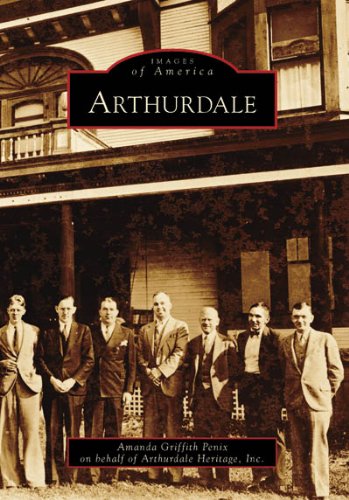 Arthurdale (WV) (Image...
Best Price: $10.00
Buy New $15.40
(as of 09:57 UTC - Details)
Arthurdale (WV) (Image...
Best Price: $10.00
Buy New $15.40
(as of 09:57 UTC - Details)

Admittedly I had assumed beforehand that my chances of finding any such people would be virtually nil, but that would make a fine introduction to the book, something along the lines of "so obscured by the passage of time that not even the people who live there now have any idea of what transpired." I couldn’t have been more wrong.
To this very day, the town is heavily populated with the direct descendants of the original homesteaders, their children and grandchildren, all of them very attached to the town — and each other — and all impressively knowledgeable about what transpired there. As outsiders among a group of people long acquainted with each other, my wife, son, and I stuck out like sore thumbs, and we were asked by the evening’s master of ceremonies — in a very kind, non-threatening manner — exactly who we were and why we were there.
Taking the microphone, I told them the who and the why (writing a book) and was shocked by the outpouring of genuine kindness and offers to provide any information I felt I needed. Invitations to move down there, look through family pictures and listen to their stories, and even a completely unexpected offer that opened the town museum’s archives piled up so quickly it was a task to keep up with all the names and information.
They all had one thing in common; the openhearted decency characteristic of the country dweller, a decency that always takes the city dweller by surprise. Their sense of community is notable, as it is something that cannot be legislated but earned only by that rare combination of loyalty to each other and the passage of time. Say what you will about the federal selection process that initially populated Arthurdale, the people who make up the town, both then and now, made for a good marriage.
The people strike a New Yorker as very religious (admittedly not a hard thing to do); I have never attended a town gathering that included a prayer to open and close the ceremonies. I’d hazard a guess that the number of churches in Preston County rivals the number of churches in my home city.
Right outside the window of the elementary school cafeteria where the reunion was being held, I could see the town church, a beautiful stone structure that the town residents built with their own hands — just as they had built every original structure within Arthurdale’s borders.
During the opening invocation, the prayer included a line that "we thank the Lord for our heritage" and their heritage, due to the town’s unique birth, is intimately and happily entwined with that of the New Deal. If my forebears had been plucked from the poverty stricken hellhole of a moribund coal-mining camp, as theirs were, and placed into a picture-postcard-worthy town set amongst gently rolling fertile hills, I’d likely feel the same way.
I had never been to an actual "living museum" in my life; Arthurdale fits the bill. Imagine going to research an old story — say ancient Rome — only to arrive and find a few Caesars still alive, and arrayed around them are their descendants, many still laying their heads in the very same homes their ancestors did. I was taken completely by surprise.
Who needs drugs when life throws this at you?
A Most Successful Failure
Friends of the subsistence homestead are very skeptical if this new pattern of life can develop without a great deal of social control.
~ M.L. Wilson, Director, Subsistence Homestead Division (1933)
Any group of individuals with shared life experiences have a collective memory, and the people who live in Arthurdale are still, to this day, deeply sensitive to anything critical written about their home town and its history. During my time there a number of people asked politely and openly that I please not call Arthurdale a failure, that all I had to do was look around and see that the town was thriving. 75 years on, with the nation’s focus long gone from Arthurdale, they still stand fearful of any negative press. They needn’t be fearful at all.
Two of the people most involved with the town’s early years, Eleanor Roosevelt and Elsie Clapp (who ran the Arthurdale school system) were, like me, New Yorkers, and they were, like me, outsiders. Sometimes it takes an outsider to look into your window and tell you what they see, to give an impartial observation and, to be blunt, no person who can perform basic math can look at the colossal waste of taxpayer money that happened at Arthurdale from 1934 to 1947 and come to any other conclusion then that, as a subsistence homestead, Arthurdale was a cataclysmic failure.
 The Forgotten Man: A N...
Best Price: $1.22
Buy New $7.00
(as of 05:55 UTC - Details)
The Forgotten Man: A N...
Best Price: $1.22
Buy New $7.00
(as of 05:55 UTC - Details)
Yet, it is not accurate to say that Arthurdale itself, as a going concern, is a failure because the town still exists. In 1987 one of the original homesteaders — a woman named Elma Martin — was asked her opinion about the town’s "success." She replied, "part of it was and part of it wasn’t," and that is the best, most accurate summation of the town’s history; she was a failure until she wasn’t.
It cannot be stressed enough that the failure of Arthurdale as a New Deal subsistence homestead had nothing at all to do with the people who were chosen to live there — they were allowed no authority to decide how things were to be run, what businesses they where to open, or even what curriculum the school would teach. In Stephen Haid’s outstanding dissertation on Arthurdale he noted "the perimeters for community decision-making existed only within the narrowest of limits." (Haid, 197)
Diane Ghirardo wrote of the homestead projects, "in their day-to-day operation American cooperatives revealed a pronounced drive to implement drastic social changes through the cooperatives by means of paternalistic and ultimately authoritarian control." (Ghirardo, 138)
In a 1987 interview, Mrs. Anna Houghton (another original homesteader) talked about the control over their lives by outsiders, stating "to say u2018go ahead and run it your own way’ and yet to have somebody else say u2018well, this is the way it has to be done if you’re gonna get any more money from me’ is the problem of any administration," and there we have the perfect description of the political control applied to Arthurdale from 1934 to 1947. Even Bushrod Grimes (the town’s first federal project manager) complained about the "use of army tactics with the homesteaders." (APP 2178/1)
On the other hand, the success of Arthurdale as a community has everything to do with the people who stayed on after the politicians packed up and left in 1947. It only began running under its own steam when the homesteaders themselves, the Luziers, McLaughlins, Bucklews and all the others, where able to act of their own free will, guided by their own wants and opinions instead of outsiders’ wants and opinions. Only then did the town became the success it is today.
It was the Allsopps and the Zinns and all the homesteaders in between, all derided as dirt poor, ignorant coal miners, who succeeded where all the big-brained intellectual titans of their time, combined with all the millions of dollars that the powerful could muster, utterly failed. They made a successful go of it and 62 years after they bought control of their own destiny, drive into Preston County and try finding, in the opinion of my wife, a prettier town to look at.
It is they, the people of Arthurdale, who reminded us yet again what people can do when they are left to their own devices. As generous with her money and time as Eleanor Roosevelt undoubtedly was, her money (and the taxpayer funds she added to her own) came with too high a price, and in the end what was truly needed for success was for she and her friends to simply stand aside and let the people of Arthurdale run the show.
It is a story that shouldn’t die. ~ Glenna Williams, original homesteader
Come Sunday morning, after a weekend walking among living, breathing history, I pointed the car east along I-68 and headed back to New York City, noting again the disrespect shown to Arthurdale by the billboards and signs listing attractions deemed worthwhile, a category for which she is inexplicably considered unfit. The town has slipped into that quiet, placid anonymity that the American small town excels at. Most towns deserve no mention, Arthurdale, in contrast, deserves to have her name shouted from the hilltops. Her story has much to teach us.
So now, three quarters of a century later, another outsider arrived among them, also in the midst of a depression, also from far off New York City, and if they haven’t grown tired of opinionated New Yorkers, I have to state mine that come next July’s New Deal festival the people of Arthurdale should, as is their pleasure, honor Eleanor Roosevelt but that they should also, first and foremost, honor themselves.
The success of Arthurdale is their story, and no one else’s.
 War, Secession, and Libertarianism