


A Reader's Guide to Bernanke's Preemptive Attack
November 30, 2009
Ben Bernanke is taking no chances. With his confirmation hearing for continuation as chairman of the Federal Reserve System only days away, he has written an op-ed for publication in Sunday’s Washington Post. We may interpret this article as a preemptive attack on his congressional critics, some of whom will no doubt take the opportunity afforded by next Thursday’s hearing to attack his management of the Fed and, indeed, the Fed itself.
Monetary-policy propaganda is a high art, and lay readers of Bernanke’s article may well be taken in by its artful formulation. Therefore, as a public service, I offer the following brief commentary, interweaved with CNN’s Saturday report on Bernanke’s Sunday op-ed.
NEW YORK (CNNMoney.com) — Federal Reserve Chairman Ben Bernanke, just days ahead of his confirmation hearing, is warning Congress that actions limiting the central bank’s independence could prove detrimental to the causes of financial reform and economic recovery.
Such a warning seizes the high ground by creating the presumption that Bernanke and the present Fed have proved themselves to be beneficial to the causes of financial reform and economic recovery. In the circumstances, that’s a highly questionable presumption. Some of us are inclined to believe that, all in all, the Fed and its glorious leaders, especially Alan Greenspan and Ben Bernanke, got us into our present troubles in the first place and that they have done nothing wise of late to repair the damage they brought on us, acting instead to create enormous risks for our future well-being and, in particular, great risks for the future purchasing power of the U.S. dollar.
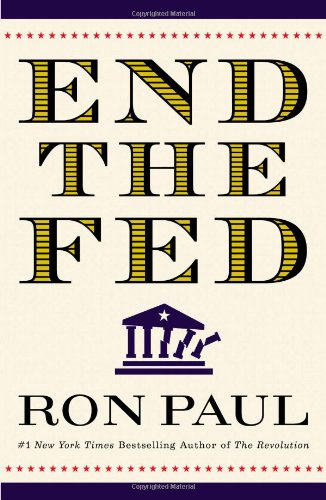 End the Fed
Best Price: $1.12
Buy New $8.53
(as of 10:10 UTC - Details)
End the Fed
Best Price: $1.12
Buy New $8.53
(as of 10:10 UTC - Details)

In an op-ed piece to be published in Sunday’s Washington Post, Bernanke criticizes two moves aimed at limiting the Fed — a proposal in the Senate to strip the central bank of its bank regulatory powers and a House Financial Services Committee vote to audit monetary policy deliberations and actions.
“These measures are very much out of step with the global consensus on the appropriate role of central banks, and they would seriously impair the prospects for economic and financial stability in the United States,” Bernanke wrote.
I suppose he is referring to the same sort of consensus that Al Gore likes to cite in regard to global warming. We know now, better than ever, that such consensus may well be manufactured by interested parties. I wonder, for example, whether anyone has ever checked to see how many monetary economists have previously enjoyed a grant, a salary, or some other perk from the Fed, or currently do so, or reasonably expect to do so someday.
And about this “economic and financial stability in the United States” that a Fed audit would threaten: Is Bernanke thinking about the stability we enjoyed between the world wars, when the Fed managed to bring about the onset on what proved to be the greatest depression in world history (an accomplishment for which he has previously accepted responsibility on behalf of the Fed)? Or perhaps he is thinking instead about the stability we enjoyed since 2001, when the Fed pushed the Fed funds rate quickly from 6.5 percent to 1 percent, held it at a negative real rate for several years, then pushed it up quickly to 5.25 percent in 2006—2007, then shoved it down quickly to almost zero in the past year? Zounds. It would certainly be tragic if the American people had to give up such remarkable stability. Or perhaps he is thinking about the fact that before the Fed was created, the dollar had retained its purchasing power more or less constant for more than a century, except for transitory war-related ups and downs, but since the Fed’s creation, the dollar has lost more than 95 percent of its purchasing power. Who calls this degree of debasement stability? Yes, it’s more stable than Zimbabwe’s currency. Bravo, Fed: you’ve yet to generate hyperinflation. But you may still do so before the present mess is completely washed away.
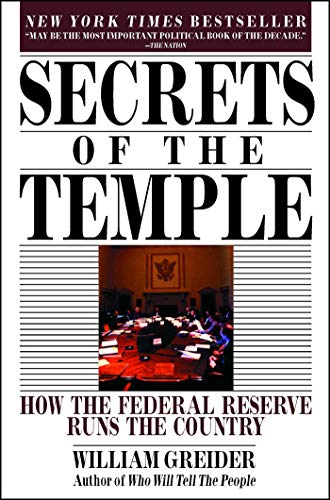 Secrets of the Temple:...
Best Price: $1.57
Buy New $15.97
(as of 02:40 UTC - Details)
Secrets of the Temple:...
Best Price: $1.57
Buy New $15.97
(as of 02:40 UTC - Details)
Let’s get serious. If the Fed is known for anything historically, it is for first pushing the monetary accelerator to the floor, then stomping on the monetary brake. To praise this outfit for its contribution to financial and economic stability is akin to praising Josef Stalin for his commitment to human rights.
Bernanke says the congressional moves are a byproduct of the public frustration over the financial crisis and the government’s response, especially the bailout of large banks. (Fed rage boils on Capitol Hill)
Odd that people would be upset, eh? Just because many of us have had our dreams of retirement destroyed and our very survival menaced by these monetary rulers of the universe. We need to take a more balanced view: even if you and I have been nearly wiped out, the kingpins at Goldman Sachs and Bank of America are doing very well. People who bought credit default swaps from AIG got their money, didn’t they (actually our money, but that’s only a detail)? So all in all, the country is in pretty good shape, on the average.
“The government’s actions to avoid financial collapse last fall — as distasteful and unfair as some undoubtedly were — were unfortunately necessary to prevent a global economic catastrophe that could have rivaled the Great Depression in length and severity, with profound consequences for our economy and society,” he wrote.
 You Need a Rifle