


A Guide to Keynes's Dangerous and Destructive Economics
April 18, 2013
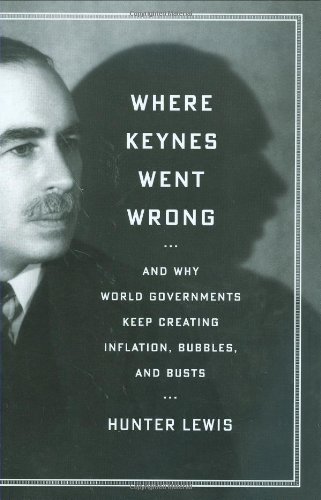
Where Keynes Went Wrong And Why Governments Keep Creating Inflation, Bubbles, and Busts. By Hunter Lewis. Axios Press, 2009. Vi + 384 pages. Defenders of Keynes, such as the recent convert Bruce Bartlett, often claim that he supported capitalism. (Bartlett’s The New American Economy has this as a primary theme.) His interventionist measures had as their aim not the replacement of capitalism by socialism or fascism. Rather, it is alleged, Keynes aimed to save the existing order. The unhampered market cannot by itself recover from a severe depression or at best can do so after long years of privation and unemployment. Keynes discovered a way by which the government, through an increase in spending, can restore the economy to prosperity. Only diehard purists could spurn Keynes’s gift to capitalism. Without it, would not revolutionary pressure mount in a severe depression to overturn capitalism and replace it with socialism or fascism? Hunter Lewis convincingly shows the error of this often heard line of thought. Keynes, far from being the savior of capitalism, aimed to replace free enterprise with a state-controlled economy run by “experts” like him. His prescriptions for recovery from depression do not save capitalism: they derail the price system by which it functions. As one would expect, Keynes lacks sound arguments to support his revolutionary proposals. Quite the contrary, Keynes defied common sense and willfully resorted to paradox. Indeed, as Lewis points out, the entire Keynesian edifice rests on a central paradox: impeding the central mechanism of the free market will restore prosperity. The free market works by price adjustments. If, e.g., consumers demand more of a product than is currently available, suppliers will raise their prices so that no imbalance exists. As consumers shift their demand from product to product, businesses must adjust their production schedules to meet changing preferences. If firms fail to do so, they face extinction. “If an economy is stumbling, and unemployment is high, it means that some prices are far out of balance with others. . . . Some companies, some industries may be doing well; others may be in desperate straits. What is needed is an adjustment of particular wages and particular prices within and between companies, within and between industries, within and between sectors. These adjustments are not a one-time event. They must be ongoing, as each such change leads to another in a vast feedback loop.” (p. 232). Keynes’s “remedies” for depression paralyze this process of price adjustment. In a depression, obviously, many businesses fail. When they go under, resources shift into uses that enable the demands of consumers to be satisfied better. If increases in government spending prop these failures up, consumer preferences are thwarted. This is just what Keynes proposed.
 Where Keynes Went Wron...
Best Price: $5.00
Buy New $9.79
(as of 05:00 UTC - Details)
Where Keynes Went Wron...
Best Price: $5.00
Buy New $9.79
(as of 05:00 UTC - Details)
 Further, Keynes ignored the significance of a fundamental fact. The rate of interest is also a price. It reflects the preferences of consumers for present over future goods: the greater the time preference, the higher the rate of interest. Keynes principal aim in economic policy, not only to combat depressions but more generally, was to keep the rate of interest low: ideally, it should be done away with entirely. To do so flies in the face of consumer preferences. If the rate of interest is forced below what it would have been on the unhampered market, then people are being compelled to invest more than they wish. The point holds altogether apart from the Austrian theory of the business cycle, which Lewis fully accepts. That theory tells us that forcing the rate of interest below the natural rate may lead to an unsustainable boom. But even if this theory were mistaken, interference with interest rates would still distort the economic system. “Businesses depend on prices to give then the information with which to run the economy. If the price system for interest rates is broken, no part of the price system is unaffected. ” (p. 90) To prevent the price system from functioning hardly seems the course of wisdom: why then did Keynes recommend it? He argued that in a depression, government action is needed to stave off disaster. If businesses are allowed to collapse, then a wave of pessimism will be set off. Entrepreneurs will anticipate yet further declines, and the economy will spiral downward into total disaster.
 The Road to Serfdom: T...
Best Price: $3.06
Buy New $1.99
(as of 03:40 UTC - Details)
Lewis has little difficulty in showing that this line of thought is mistaken. Why would not resources shift from collapsing businesses to others better suited to use them, without setting off a general conflagration? Keynes assumed without adequate basis that investors are driven by irrational “animal spirits.” Keynes condemned what he called “casino capitalism.” Investors, in his view, made irrational decisions based on what they guessed others would do. To the contrary, the free market weeds out businessmen who are unable accurately to forecast the wishes of consumers, in favor of those more skilled at this task. During a depression, there is what Rothbard calls a “cluster of entrepreneurial errors”: precisely the task of an adequate business cycle theory is to explain this phenomenon. Keynes did not do so. He appeals to a failure of his “animal spirits”: investors lose confidence in massive proportions. But he does not account for the wave of pessimism. But even if Keynes does not have an account to offer of why there are swings of optimism and pessimism, does this invalidate his remedy for depression? Keynes does, after all, give a reason for not allowing prices to fall in a depression: to do so will set off a wave of further reductions, leading to a worse situation. Once more, Lewis challenges Keynes: why should lowered prices induce businessmen to expect even further reductions, in a way that sends the economy spiraling to disaster? If the argument is that lower prices, along with lower wages, will lead to expectations of decreased spending, this rests on confusion. “What about the. . .claim that wage cuts will backfire by reducing workers’ buying power, which in turn will reduce business revenue? As Henry Hazlitt noted, Keynes is confusing wage rates with wages earned. . .so long as prices fall faster than wages, real (price-adjusted) worker income may actually rise.” (p. 228) Lewis brings out fully that Keynes had much more in mind than a cure for depressions. He thought that boom conditions could be permanently maintained by lowering the rate of interest nearly to zero. In that way, the scarcity of capital could be ended. In The General Theory, Keynes said: “The remedy for the boom is not a higher rate of interest but a lower rate of interest! For that may enable the boom to last. The right remedy for the trade cycle is not to be found in abolishing booms and thus leaving us in a semi-slump; but in abolishing slumps and thus keeping us permanently in a quasi-boom.” (pp. 20—21) Is this not an incredible doctrine? The interest rate is to be lowered by an expansion of credit. But production can increase only through an increase in capital goods. Putting pieces of paper designated “money” into circulation will not by itself increase prosperity, even if all the new money is, as Keynes wished, spent and not hoarded. To think otherwise is to indulge in magical thinking. Keynes was not satisfied, furthermore, with recommending inflation as the key to promote prosperity. He extended his view into a full-fledged inflationist theory of history. “That the world after several millennia of steady individual saving, is so poor,” Keynes claimed, “is to be explained. . .[by] high rates of interest.” (p. 17) (Incidentally, the French literary figure Georges Bataille developed a similar theory of history. See his The Accursed Share, Volume 1: Consumption.)
The Road to Serfdom: T...
Best Price: $3.06
Buy New $1.99
(as of 03:40 UTC - Details)
Lewis has little difficulty in showing that this line of thought is mistaken. Why would not resources shift from collapsing businesses to others better suited to use them, without setting off a general conflagration? Keynes assumed without adequate basis that investors are driven by irrational “animal spirits.” Keynes condemned what he called “casino capitalism.” Investors, in his view, made irrational decisions based on what they guessed others would do. To the contrary, the free market weeds out businessmen who are unable accurately to forecast the wishes of consumers, in favor of those more skilled at this task. During a depression, there is what Rothbard calls a “cluster of entrepreneurial errors”: precisely the task of an adequate business cycle theory is to explain this phenomenon. Keynes did not do so. He appeals to a failure of his “animal spirits”: investors lose confidence in massive proportions. But he does not account for the wave of pessimism. But even if Keynes does not have an account to offer of why there are swings of optimism and pessimism, does this invalidate his remedy for depression? Keynes does, after all, give a reason for not allowing prices to fall in a depression: to do so will set off a wave of further reductions, leading to a worse situation. Once more, Lewis challenges Keynes: why should lowered prices induce businessmen to expect even further reductions, in a way that sends the economy spiraling to disaster? If the argument is that lower prices, along with lower wages, will lead to expectations of decreased spending, this rests on confusion. “What about the. . .claim that wage cuts will backfire by reducing workers’ buying power, which in turn will reduce business revenue? As Henry Hazlitt noted, Keynes is confusing wage rates with wages earned. . .so long as prices fall faster than wages, real (price-adjusted) worker income may actually rise.” (p. 228) Lewis brings out fully that Keynes had much more in mind than a cure for depressions. He thought that boom conditions could be permanently maintained by lowering the rate of interest nearly to zero. In that way, the scarcity of capital could be ended. In The General Theory, Keynes said: “The remedy for the boom is not a higher rate of interest but a lower rate of interest! For that may enable the boom to last. The right remedy for the trade cycle is not to be found in abolishing booms and thus leaving us in a semi-slump; but in abolishing slumps and thus keeping us permanently in a quasi-boom.” (pp. 20—21) Is this not an incredible doctrine? The interest rate is to be lowered by an expansion of credit. But production can increase only through an increase in capital goods. Putting pieces of paper designated “money” into circulation will not by itself increase prosperity, even if all the new money is, as Keynes wished, spent and not hoarded. To think otherwise is to indulge in magical thinking. Keynes was not satisfied, furthermore, with recommending inflation as the key to promote prosperity. He extended his view into a full-fledged inflationist theory of history. “That the world after several millennia of steady individual saving, is so poor,” Keynes claimed, “is to be explained. . .[by] high rates of interest.” (p. 17) (Incidentally, the French literary figure Georges Bataille developed a similar theory of history. See his The Accursed Share, Volume 1: Consumption.)
 The Essential Rothbard
Best Price: $7.94
Buy New $15.00
(as of 05:12 UTC - Details)
Keynes’s program went far beyond monetary expansion. He wanted the government to take control of investment. Wise planners would do much better in guiding the economy than the speculators of “casino capitalism.” He remarks in The General Theory that he favors “a somewhat comprehensive socialization of investment.” (p. 56) Does not this program pose a severe threat to liberty, in a way classically explained by Friedrich Hayek in The Road to Serfdom? How can one preserve civil liberties in a state-controlled economy? Of this danger Keynes was well aware, and he praised Hayek for having written “a grand book,” with which he was “morally and philosophically” in agreement. But this did not lead him to abandon his penchant for planning. He thought that the dangers of planning could be averted if matters were left to wise experts — experts including him as a prime example. Keynes’s egotism knew no bounds. Lewis has presented Keynes as an inflationist, but is not he vulnerable to an objection? Keynes recommended increased spending in bad conditions, but did he not also call for restraint once full employment was reached? In that case, spending would drive up prices, to no good effect. In responding to this objection, Lewis makes one of his most valuable points. True enough, one can find in Keynes’s writings warnings against inflation. But Keynes set such stringent conditions for inflation that it would almost never exist. Specifically, so long as there is some unemployment present, as there invariably is, there is no inflation. Lewis has exposed with unmatched clarity the lineaments of Keynes’s system and enabled us to see exactly its disabling defects. Keynes defied common sense, unable to sustain the brilliant paradoxes that his fertile intellect constantly devised. Lewis’s book is an ideal guide to Keynes’s dangerous and destructive economics. December 3, 2009
The Essential Rothbard
Best Price: $7.94
Buy New $15.00
(as of 05:12 UTC - Details)
Keynes’s program went far beyond monetary expansion. He wanted the government to take control of investment. Wise planners would do much better in guiding the economy than the speculators of “casino capitalism.” He remarks in The General Theory that he favors “a somewhat comprehensive socialization of investment.” (p. 56) Does not this program pose a severe threat to liberty, in a way classically explained by Friedrich Hayek in The Road to Serfdom? How can one preserve civil liberties in a state-controlled economy? Of this danger Keynes was well aware, and he praised Hayek for having written “a grand book,” with which he was “morally and philosophically” in agreement. But this did not lead him to abandon his penchant for planning. He thought that the dangers of planning could be averted if matters were left to wise experts — experts including him as a prime example. Keynes’s egotism knew no bounds. Lewis has presented Keynes as an inflationist, but is not he vulnerable to an objection? Keynes recommended increased spending in bad conditions, but did he not also call for restraint once full employment was reached? In that case, spending would drive up prices, to no good effect. In responding to this objection, Lewis makes one of his most valuable points. True enough, one can find in Keynes’s writings warnings against inflation. But Keynes set such stringent conditions for inflation that it would almost never exist. Specifically, so long as there is some unemployment present, as there invariably is, there is no inflation. Lewis has exposed with unmatched clarity the lineaments of Keynes’s system and enabled us to see exactly its disabling defects. Keynes defied common sense, unable to sustain the brilliant paradoxes that his fertile intellect constantly devised. Lewis’s book is an ideal guide to Keynes’s dangerous and destructive economics. December 3, 2009
 The Best Libertarian Books of the Decade