Six Questions About the Anthrax Case
August 19, 2008
Double Standards in the Global War on Terror
Oh, the spectacle of it all — and don’t think I’m referring to those opening ceremonies in Beijing, where North Korean-style synchronization seemed to fuse with smiley-faced Walt Disney, or Michael Phelp’s thrilling hunt for eight gold medals and Speedo’s one million dollar “bonus,” a modernized tribute to the ancient Greek tradition of amateurism in action. No, I’m thinking of the blitz of media coverage after Dr. Bruce Ivins, who worked at the U.S. Army Medical Research Institute of Infectious Diseases at Fort Detrick, Maryland, committed suicide by Tylenol on July 29th and the FBI promptly accused him of the anthrax attacks of September and October 2001.
You remember them: the powder that, innocuously enough, arrived by envelope — giving going postal a new meaning — accompanied by hair-raising letters ominously dated “09-11-01” that said, “Death to America. Death to Israel. Allah is great.” Five Americans would die from anthrax inhalation and 17 would be injured. The Hart Senate Office Building, along with various postal facilities, would be shut down for months of clean-up, while media companies that received the envelopes were thrown into chaos.
For a nation already terrified by the attacks of September 11, 2001, the thought that a brutal dictator with weapons of mass destruction (who might even have turned the anthrax over to the terrorists) was ready to do us greater harm undoubtedly helped pave the way for an invasion of Iraq. The President would even claim that Saddam Hussein had the ability to send unmanned aerial vehicles to spray biological or chemical weapons over the east coast of the United States (drones that, like Saddam’s nuclear program, would turn out not to exist).
Today, it’s hard even to recall just how terrifying those anthrax attacks were. According to a LexisNexis search, between Oct. 4 and Dec. 4, 2001, 389 stories appeared in the New York Times with “anthrax” in the headline. In that same period, 238 such stories appeared in the Washington Post. That’s the news equivalent of an unending, high-pitched scream of horror — and from those attacks would emerge an American world of hysteria involving orange alerts and duct tape, smallpox vaccinations, and finally a war, lest any of this stuff, or anything faintly like it, fall into the hands of terrorists.
And yet, by the end of 2001, it had become clear that, despite the accompanying letters, the anthrax in those envelopes was from a domestically produced strain. It was neither from the backlands of Afghanistan nor from Baghdad, but — almost certainly — from our own military bio-weapons labs. At that point, the anthrax killings essentially vanished… Poof!… while 9/11 only gained traction as the singular event of our times.
Those deaths-by-anthrax ceased to be part of the administration’s developing Global War on Terror narrative, which was, of course, aimed at Islamist fanatics (and scads of countries that were said to provide them with “safe haven”), but certainly not military scientists here at home. No less quickly did those attacks drop from the front pages — in fact, simply from the pages — of the nation’s newspapers and off TV screens.
Unlike with 9/11, there would be no ritualistic reminders of the anniversaries of those attacks in years to come. No victims, or survivors, or relatives of victims would step to podiums and ring bells, or read names, or offer encomiums. There would be no billion-dollar (or even million-dollar) memorial to the anthrax dead for the survivors to argue over. There would be little but silence, while the FBI fumbled its misbegotten way through an investigative process largely focused on one U.S. bio-weapons scientist, Steven J. Hatfill, who also worked at Fort Detrick and just happened to be the wrong man. (Bruce Ivins, eerily enough, would work closely with, and aid, the FBI’s investigation for years until the spotlight of suspicion came to be directed at him.)
This essentially remained the state of the case until, as July ended, Ivins committed suicide. Then, what a field day! The details, the questions, the doubts, the disputed scientific evidence, the lists of kinds of drugs he was prescribed, the lurid quotes, the “rat’s nest” of an anthrax-contaminated lab he worked in, the strange emails and letters! (“I wish I could control the thoughts in my mind… I get incredible paranoid, delusional thoughts at times, and there’s nothing I can do until they go away, either by themselves or with drugs.”) Case solved! Or not… The “mad scientist” from the Army’s Fort Detrick bio-wars labs finally nabbed! Or not…
It was a dream of a story. And the mainstream media ran with it, knowledgeably, authoritatively, as if they had never let it go. Now, as the coverage fades and the story once again threatens to head for obscurity (despite doubts about Ivins’s role in the attacks), I thought it might be worth mentioning a few questions that came to my mind as I read through recent coverage — not on Ivins’s guilt or innocence, but on matters that are so much a part of our American landscape that normally no one even thinks to ask about them.
Here are my top six questions about the case:
1. Why wasn’t the Bush administration’s War on Terror modus operandi applied to the anthrax case?
On August 10th, William J. Broad and Scott Shane reported on some of the human costs of the FBI anthrax investigation in a front-page New York Times piece headlined, “For Suspects, Anthrax Case Had Big Costs, Scores of the Innocent in a Wide F.B.I. Net.” They did a fine job of establishing that those who serially came under suspicion had a tough time of it: “lost jobs, canceled visas, broken marriages, frayed friendships.” According to the Times (and others), under the pressure of FBI surveillance, several had their careers wrecked; most were interviewed and re-interviewed numerous times in a “heavy-handed” manner, as well as polygraphed; some were tailed and trailed, their homes searched, and their workplaces ransacked.
Under the pressure of FBI “interest,” anthrax specialist and “biodefense insider” Perry Mikesell evidently turned into an alcoholic and drank himself to death. Steven Hatfill, while his life was being turned inside out, had an agent trailing him in a car run over his foot, for which, Broad and Shane add, he, not the agent, was issued a ticket. And finally, of course, Dr. Ivins, growing ever more distressed and evidently ever less balanced, committed suicide on the day his lawyer was meeting with the FBI about a possible plea bargain that could have left him in jail for life, but would have taken the death penalty off the table.
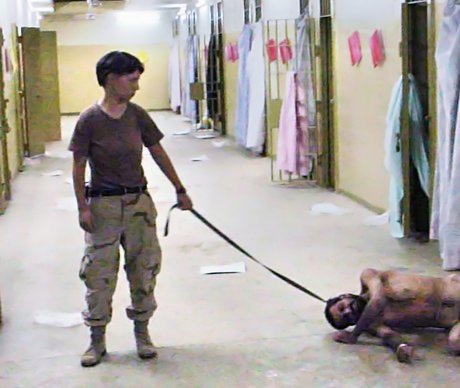
Still, tough as life was for Mikesell, Hatfill, Ivins, and scores of others, here’s an observation that you’ll see nowhere else in a media that’s had a two-week romp through the case: In search of a confession, none of the suspects of these last years, including Ivins, ever had a lighted cigarette inserted in his ear; none of them were hit, spit on, kicked, and paraded naked; none were beaten to death while imprisoned but uncharged with a crime; none were doused with cold water and left naked in a cell on a freezing night; none were given electric shocks, hooded, shackled in painful “stress positions,” or sodomized; none were subjected to loud music, flashing lights, and denied sleep for days on end; none were smothered to death, or made to crawl naked across a jail floor in a dog collar, or menaced by guard dogs. None were ever waterboarded.
Whatever the pressure on Ivins or Hatfill, neither was kidnapped off a street near his house, stripped of his clothes, diapered, blindfolded, shackled, drugged, and “rendered” to the prisons of another country, possibly to be subjected to electric shocks or cut by scalpel by the torturers of a foreign regime. Even though each of the suspects in the anthrax murders was, at some point, believed to have been a terrorist who had committed a heinous crime with a weapon of mass destruction, none were ever declared “enemy combatants.” None were ever imprisoned without charges, or much hope of trial or release, in off-shore, secret, CIA-run “black sites.”
Why not?
2. Why wasn’t the U.S. military sent in?
Part of the reigning paradigm of the Bush years was this: police work was not enough when the homeland was threatened. The tracking down of terrorists who had killed or might someday kill Americans was a matter of “war.” Those who had attacked the American homeland and murdered U.S. citizens would, as our President put it, be “hunted down” by special ops forces and CIA agents who had been granted the right to assassinate and brought in “dead or alive.”
Why then, when acts of murderous bio-terror had been committed on American soil, was the military not called in? Why were no CIA “death squads” — the tellingly descriptive phrase used by Jane Mayer in her remarkable new book, The Dark Side — dispatched to assassinate likely suspects? Why were no Predator unmanned drones, armed with Hellfire missiles, launched to cruise the skies of Maryland and take out Ivins or other suspects “precisely” and “surgically” in their homes (whatever the “collateral damage”)? Why, in fact, weren’t their homes simply obliterated in the manner regularly employed in Afghanistan, Pakistan, Somalia, and elsewhere? (In fact, it seems to have taken the FBI two years after their first suspicions of Ivins simply to search his house and even longer finally to take away his high-level security clearance.)
Once U.S. weapons labs were identified as the sources of the anthrax, why were no special ops teams sent in to occupy the facilities, shut them down, and fly those found there, shackled and blindfolded, to Guantanamo or other more secret sites?
Why, when the administration went to great lengths to squeeze off funding for terrorists elsewhere, was funding for those labs significantly increased?
Why, when those swept up or simply kidnapped by the Bush administration and then discovered to be innocent, were — after secret imprisonment, abuse, and torture — regularly released without apology or reimbursement (if released at all), did the U.S. government pay Hatfill $4.6 million to settle a lawsuit he filed in response to his ordeal?
Why when, according to the Vice President’s “one percent doctrine,” no response was too extreme if even a minuscule chance of a catastrophic attack against the U.S. “homeland” existed, were no extreme acts taken with a WMD killer (or killers) on the loose, possibly in Maryland’s suburbs?
3. Once the anthrax threat was identified as coming from U.S. military labs, why did the administration, the FBI, and the media assume that only a single individual was responsible?
Read as much of the coverage of the anthrax killings as you want and you’ll discover that the FBI has long taken for blanket fact that a single “mad scientist” was the culprit — and, no less important, that that theory has been accepted as bedrock fact by the media as well. No alternative possibilities have been seriously considered for years.
 For instance, it is known that a set of the anthrax letters was sent from a mailbox in Princeton, New Jersey, some hours from Ivins’s home and the Fort Detrick lab in Frederick, Maryland. The question the FBI puzzled over — and the media took up vigorously — was whether, on the day in question, Ivins had time to make it to Princeton and back, given what’s known of his schedule. The FBI suggests that he did; critics suggest otherwise. No one, however, seems to consider the possibility that the lone terrorist of the anthrax killings might have had one or more accomplices, which would have made the “problem” of mailing those letters into a piece of cake.
Is it that Americans, as opposed to foreigners bent on terrorism, are assumed to be unstoppable individualists, loners canny enough to carry out plots by themselves? Does no one recall that the last great act of American terrorism in the United States, the bombing of the Alfred P. Murrah Federal Building in Oklahoma City in 1995, was a crime committed by at least two American “loners”? (The earliest reports in that case, too, blamed Arab terrorists — plural.)
There seem to have been no serious al-Qaeda “sleeper cells” in this country, but how do we know that there isn’t a “sleeper cell” of American bio-killers lurking somewhere in the U.S. military lab community?
4. What of those military labs? Why does their history continue to play little or no part in the story of the anthrax attacks?
In reading through reams of coverage of Ivins’s suicide and the FBI case against him, I found only a single reference to the work his lab at Fort Detrick had been dedicated to throughout most of the Cold War era. Here is that sentence from the Washington Post: “As home to the Army Biological Warfare Laboratories, the facility ran a top-secret program producing offensive biological weapons from 1943 until 1969.” And yet, if you don’t grasp this fact, the real significance of the anthrax case remains in the shadows.
As with the continuing story of nuclear dangers on our planet, the terrors of our age are almost invariably portrayed as emerging from bands of fanatics, or lands like Iran said to be ruled by the same, in the backlands of our planet (some of which also just happen to be in the energy heartlands of the same planet). And yet, if we are terrified enough of loose or proliferating weapons of mass destruction to threaten or start wars over them, it’s important to understand that, from 1945 on, these dangers — and they are grim dangers — emerged from the heartland of the military-industrial machines of the two Cold War superpowers, the U.S. and the USSR.
Put another way, the most conceptually frightening attacks of 2001 came directly from the Cold War urge to develop offensive biological weapons. Until 1969, the Army’s biological-warfare laboratories at Fort Detrick were focused, in part, on that task. Plain and simple. After President Richard Nixon shut down the offensive bio-war program in 1969, the Army’s scientists switched to work on “defenses” against the same. As with defenses against nuclear attack, however, such work, by its nature, is often hard to separate from offensive work on such weaponry. In other words, looked at a certain way, one focus of the Fort Detrick lab, which fell under suspicion in the anthrax attacks by the winter of 2001, has long been putting bio-war on the global menu. In that, it was evidently successful in the end.
There is irony here, of course. In the post-Cold War era, our worries focused almost solely on the deteriorating, sometimes ill-guarded Russian Cold War labs and storehouses for biological, chemical, and nuclear war. It was long feared that, from them, such nightmares would drop into our world. But in this we were, it seems, wrong. The labs with the holes were ours and — what’s more terrifying — the possibilities for leakage and misuse are still expanding exponentially.
5. Were the anthrax attacks the less important ones of 2001?
If you compare the two sets of 2001 attacks in terms of death and destruction, 9/11 obviously leaves the anthrax attacks in the dust. Thought about a certain way, however, the attacks of 9/11, while bold, murderous, televisually spectacular, and apocalyptic looking, were conceptually old hat. It was the anthrax attacks that pointed the way to a new and frightening future.
After all, the World Trade Center had already been attacked, and one of its towers nearly toppled, by a rental-van bomb driven into an underground garage by Islamists back in 1993. The planes in the 2001 assaults were, as Mike Davis has written, simply car bombs with wings, and car bombs have a painfully long history. Even though in their targeting — the symbolic mega-buildings of an imperial power whose citizens previously preferred to believe themselves invulnerable — the 9/11 hijackers offered a new psychological reality to Americans, their most striking and unsettling feature was perhaps themselves. Those 19 men had pledged to commit suicide not for their country, as had thousands of Japanese kamikaze pilots at the end of World War II, or even for a potential country like hundreds of Tamil suicide bombers in Sri Lanka, but for a religious fantasy (behind which lay non-religious grievances). On the other hand, the 9/11 attacks were but a larger, more ambitious version of, for instance, the suicide-by-boat attack on the U.S.S. Cole in a Yemeni port in 2000.
On the other hand, the anthrax mailings represented something new. (The Japanese Aum Shinrikyo cult had attempted to make and use bio-weapons, including anthrax, back in 1990s, but failed.) If the al-Qaeda strike on 9/11 had only simulated a weapon-of-mass-destruction attack, with the anthrax killer, no imagination was necessary. An actual weapon of mass destruction — highly refined anthrax — had been used successfully, then used again, and the killer(s) remained at large, not in the Afghan backlands but somewhere in our midst, with no evidence that the supply of anthrax had been used up.
And yet, even as the Bush administration, the two presidential candidates, all of Washington, and the media remain focused on terrorism in the Afghan-Pakistani border regions, few give serious thought — except when it comes to individual culpability — to the terror that emerged from the depths of the military-industrial complex, from our own Cold War weapons labs. To that, no aspect of the Global War on Terror seems to apply.
6. Who is winning the Global War on Terror?
The answer, obviously, is the terrorists. Just last week, Mike McConnell, the director of national intelligence, made this crystal clear when it came to al-Qaeda. He testified before Congress that the organization “is gaining in strength from its refuge in Pakistan and is steadily improving its ability to recruit, train and position operatives capable of carrying out attacks inside the United States.” In fact, it’s been clear enough for quite a while that the Bush administration’s Global War on Terror has mainly succeeded in creating ever more terrorists in ever more places. And yet, arguably, the anthrax killer or killers have, to date, gained far more than al-Qaeda. Looked at a certain way, whatever the role of Bruce Ivins, the anthrax killings proved to be a full-scale triumph of terrorism.
One theory has long been that whoever committed the anthrax outrages was intent on drawing attention (and probably funding) to further research and development of U.S. bio-war “defenses.” If so, then, what a remarkable success! In the years since the attacks occurred, funding has flooded into such labs, whose numbers have grown strikingly. On September 11, 2001, reports the Washington Post, “there were only five u2018biosafety level 4′ labs — places equipped to study highly lethal agents such as Ebola that have no human vaccine or treatment — a Government Accountability Office report stated last fall. Fifteen are in operation or under construction now, according to the report. There are hundreds more biosafety level 3 labs, which handle agents such as Bacillus anthracis, which does have a human vaccine.”
The few hundred people at work in the U.S. bio-defense program before 9/11 have swelled to perhaps 14,000 scientists who have “clearances to work with u2018select biological agents’ such as Bacillus anthracis — many of them civilians working at private universities” where, according to experts, “security regulations are remarkably lax.” And don’t forget the Army’s own billion-dollar plan to “build a larger laboratory complex as part of a proposed interagency biodefense campus at Fort Detrick.” We’re talking about the place where, as Ivins’s crew was evidently nicknamed, “Team Anthrax” worked and whose labs are reputedly “renowned for losing anthrax.” In these same years, according to the New York Times, “almost $50 billion in federal money has been spent to build new laboratories, develop vaccines and stockpile drugs.” Some of this money was pulled out of basic public health funds which once ensured that large numbers of people wouldn’t die of treatable diseases like tuberculosis and redirected into work on the Ebola virus, anthrax, and other exotic pathogens.
In these years, not to put too fine a point on it, the Bush administration has exponentially expanded our bio-war labs, increasing significantly the likelihood that a new “mad scientist” will have far more opportunity and far more deadly material available to work with. It has, in other words, increased the likelihood not just that terror will come to “the homeland,” but that it will come from the homeland. Thanks to this administration, the terrorists won this round and future terrorists can reap the fruits of that victory.
Bruce Ivins, whatever you did, or whatever was done to you, R.I.P. Your lab is in good hands. And the likelihood is that, almost seven years after the first anthrax envelope arrived, the world is more of a terror machine than ever.
Note on readings: Oddly enough, back in December 2002, as this site was going public, the very first TomDispatch guest writer, public health expert David Rosner, took up the issue of smallpox hysteria, pointing out that the disease was saved from total eradication on the planet by a U.S./USSR agreement “to make sure that the virus that causes smallpox would remain in storage awaiting a new opportunity to terrorize the world. For decades, both countries stored it, distributed it to various research labs and otherwise ensured that this public health victory would be turned into a potential human tragedy.” He added: “Fear of smallpox has played nicely into the overall strategy of the Bush administration to militarize public health.” It’s a piece worth revisiting, as perhaps is “It Should Have Been Unforgettable,” a post I wrote back in 2005 when the anthrax case had long fallen off the American radar screen.
More recently, Glenn Greenwald of Salon.com has done superb work on the anthrax story. In 2007, he wrote a striking column, “The unresolved story of ABC News’ false Saddam-anthrax reports,” on some crucially bad reporting by Brian Ross and ABC, and he followed up after Ivins’s suicide with a piece, (“Journalists, their lying sources, and the anthrax investigation,”) that has more unsettling questions about the anthrax case than any other 16 pieces I’ve seen. It’s a must read. Jay Rosen, at his always interesting PressThink blog, took up Greenwald’s challenge to Brian Ross and ABC on its reporting and pressed the point home in two recent posts, here and here.
Finally, Elisa D. Harris, a senior research scholar at the Center for International and Security Studies at the University of Maryland, had a fine, thoughtful op-ed last week in the New York Times, “The Killers in the Lab” (“Our efforts to fight biological weapons are making us less safe”), which laid out in an impressive way the expansion of U.S. bio-weapons research since 2001.
 The US Starts a Cold War Again