


Still More Trouble for the Lincoln Cartel
September 7, 2004
"[T]o tar the sacrifices of the Confederate soldier as simple acts of racism, and reduce the battle flag under which he fought to nothing more than the symbol of a racist heritage, is one of the great blasphemies of our modern age.”
~ James Webb, former U.S. Navy Secretary
In my LRC article, "More Trouble for the Lincoln Cartel," I noted how such court historians as James McPherson, and court semanticists like Harry Jaffa, have fabricated an "Official History" of the War to Prevent Southern Independence that is often sharply at odds with historical reality. These self-appointed gatekeepers of America’s Official State History do all they can to censor competing views within academe, but their influence is rapidly waning because of the fact that competing views are now widely published on the Internet, and by commercial and "think tank" publishers.
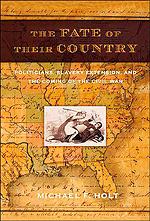
 The latest blow to this Lincoln Cartel is the publication of two books by very highly-regarded authors: Born Fighting: How the Scots-Irish Shaped America, by former U.S. Navy Secretary James Webb; and The Fate of Their Country: Politicians, Slavery Extension, and the Coming of the Civil War, by the distinguished University of Virginia historian Michael F. Holt.
In addition to being a former Navy Secretary, Webb is a former Assistant Secretary of Defense (in the Reagan administration), a filmmaker ("Rules of Engagement"), a highly-decorated Vietnam-era Marine, Emmy Award-winning journalist, and author of six novels. Born Fighting is a history of the Scots-Irish (his people) in America, and it is a fascinating read, along the lines of David Hackett Fischer’s marvelous book, Albion’s Seed. He traces the American journey of the Scots-Irish, who migrated to America in great numbers in the first half of the eighteenth century, and settled mostly in the southern states.
 For centuries, the Scots-Irish have been radical individualists: "To them, joining a group and putting themselves at the mercy of someone else’s collective judgment makes about as much sense as letting the government take their guns. And nobody is going to get their guns" (p. 9). They had very little in common with the English immigrants who settled New England; indeed, these were the descendants of the same British their forefathers had been tyrannized by for centuries. They eventually "became the dominant culture in the South," comprising a very large percentage of the Confederate army, and were typically yeoman who "had no slaves and actually suffered economic detriment from the practice [of slavery]" (p. 18). The Scots-Irish are "a culture founded on guns, which considers the Second Amendment sacrosanct"; are "the very heartbeat of fundamentalist Christianity"; and have had very little contact, to this day, with "America’s elites."
Regarding the issue of the Lincoln cartel, when Webb’s narrative gets to the 1860s he asks the question: Why did his people, who dominated the ranks of the Confederate armies, fight? What were their loyalties? He quotes the historian Wilbur Cash as noting that Confederate soldiers came from a culture that produced "the most intense individualism the world has seen since the Italian renaissance." They never learned to salute as briskly or to become as obedient as their much more compliant Yankee counterparts. Because of this individualistic spirit, Confederate commanders were always much more likely to get their men to carry out orders promptly by flattering or joking with them rather than just barking out orders.
What this suggests to Webb is that "It is impossible to believe that such men would have continued to fight against unnatural odds [the South was outnumbered in adult male population by more than four to one, and in wealth by three to one] — and take casualties beyond the level of virtually any other modern army [70 percent] — simply so that the 5 percent of their population who owned slaves could keep them . . . . Something deeper was motivating them, something that appealed to their self-interest as well" (p. 223).
Webb clarifies one particularly telling fact about the average Confederate soldier: He knew that slave-owners in Delaware, Maryland, Missouri, and Kentucky — and in other union states — were allowed to keep their slaves when the war began. Indeed, when Fort Sumter was fired upon there were more slave states (and more slaves) in the union (eight) than there were out of it (seven). Consequently, "in virtually every major battle of the Civil War, Confederate soldiers who did not own slaves were fighting against a proportion of Union Army soldiers who had not been asked to give theirs up" (p. 223). This fact spoke volumes to the Confederate soldier about the cause of the war and the nature of both Abraham Lincoln and the Republican Party regime.
The Confederate soldier also knew that the Emancipation Proclamation "exempted all the slaves in the North," and in all the areas of the South that were under federal army control at the time. He also understood that the union was voluntary, and that Abraham Lincoln was lying through his teeth when he said it was not in his first inaugural address. They understood, in other words, that the Constitution was on their side. "The Tenth Amendment to the Constitution reserved to the states all rights not specifically granted to the federal government, and in their view the states had thus retained their right to dissolve the federal relationship" (p. 224).
So why did the Confederate soldier fight? Because "he was provoked, intimidated, and ultimately invaded" and "his leaders convinced him that this was a war of independence in the same sense as the Revolutionary War" (p. 225). The "tendency to resist outside regression" was "bred deeply into every heart" of the Scots-Irish, and had been for centuries. That’s why they had to fight.
Michael F. Holt’s The Fate of Their Country poses an even greater threat to the Lincoln cartel. Holt is a Princeton graduate who has taught history at the University of Virginia for many years. He is the author of The Rise and Fall of the American Whig Party (a.k.a., the real "Party of Lincoln"); The Political Crisis of the 1850s; and co-author of The Civil War and Reconstruction.
Professor Holt addresses the question of "what brought about the civil war?" and blames it all on "politics" rather than a moral objection to slavery. He correctly notes that slavery was constitutionally secure in 1861; that neither Abraham Lincoln nor his party opposed southern slavery; that Lincoln supported a constitutional amendment to prohibit the federal government from ever interfering with southern slavery; and that the issue of slavery in 1860 evolved around its expansion to the territories.
Moreover, Holt essentially agrees with my own thesis, outlined in The Real Lincoln, that the reason the North was so opposed to the extension of slavery into the new territories is that it would have been a roadblock to their plan of politically dominating and economically plundering the South.
The only moral argument against slavery extension, one that was articulated by Lincoln, was that stopping the spread of slavery to the territories would somehow lead to its eventual demise everywhere. Exactly how this would occur was never adequately explained, and it makes little sense. As Professor Holt notes, "Modern economic historians have demonstrated that this assumption was false . . ." (p. 27).
"Far more Northerners" opposed slavery extension, writes Holt, simply because they did not want to have to compete for jobs with slave labor. It was economics, not morality, that motivated them. Nor did they want to compete with free black labor: Numerous Northern states, including Illinois, actually outlawed the emigration of black people into their states.
In addition, "Many northern whites also wanted to keep slaves out of the West in order to keep blacks out. The North was a pervasively racist society where free blacks suffered social, economic, and political discrimination . . ." (p. 27). "Bigots, they sought to bar African-American slaves from the West. [Congressman David] Wilmot himself proudly and repeatedly called his measure [the Wilmot Proviso] the "White Man’s Proviso" (p. 27). Most Northerners wanted neither slaves nor free blacks to live among them and they wanted the territories to remain all-white preserves, just like their own states were, for the most part.
Yet another reason why the North opposed the extension of slavery, as I discuss in The Real Lincoln, is that it would possibly have artificially enhanced the congressional representation of the Democratic Party. This was because of the Three-Fifths Clause of the Constitution, which allowed for every five slaves to account for three persons in the census count, for purposes of determining the number of congressional representatives in each state.
And why were Northerners so concerned about blocking the power in Congress of Southern Democrats? Because, says Holt, it would have stood in the way of adopting the Whig economic agenda, which I label "Lincoln’s Real Agenda" in my book. To make his point, Holt cites the Ohio Whig Congressman Joshua R. Giddings (p. 28):
To give the south the preponderance of political power would be itself a surrender of our Tariff, our internal improvements, our distribution of proceeds of public lands. . . . It is the most abominable proposition with which a free people were ever insulted.
Thus, Northern politicians wanted protectionism, corporate welfare, and the giving away of public lands, as opposed to their sale. All of these policies were opposed by Southern Democrats, who correctly viewed them as instruments of plunder at their expense. The tariff benefited primarily Northern manufacturers at their expense, as would federally-financed corporate welfare for roads, canals and railroads. And giving away federal land would have created pressure to raise tariff rates even further, as opposed to funding the government in part with revenues raised from selling the land instead. (Holt also notes that the North favored "a lenient banking and currency policy that ensured cheap and ample credit," i.e., inflationary finance by a central bank — something that also drew sharp opposition mostly from the South).
So when Abraham Lincoln invented the new and ahistorical theory that the union was perpetual, "mystical," and involuntary — and waged total war to "prove" himself right — he did so in order to assure the success of the old Whig economic agenda, and of his own political career. Had he not done so, he would have immediately been considered a failure to his political backers and the Republican Party itself may well have become defunct.
 Holt contends that southern politicians were just as responsible for the war as northern ones were. As he states on the inside cover of his book, "shortsighted politicians [of all parties] . . . used the emotionally charged and largely chimerical [i.e., "wildly fanciful and unrealistic," according to Webster’s] issue of slavery’s extension westward to pursue the election of their candidates and settle political scores, all the while inexorably dragging the nation toward disunion."
But if the quest for money and political power, and not the moral issue of slavery, was the root cause of the war, the South can hardly be held as accountable as the North. Northern politicians were engaged in what modern economists call "rent seeking," an admittedly clumsy phrase. A better phrase would be "plunder seeking." This is the efforts of one politically-organized group to use the coercive powers of the state to have laws or regulations enacted that will impose costs on others for its own members’ benefits. Protectionism would be a classic example of plunder seeking: High tariffs impose costs on all consumers, purely for the benefit of a relatively small — but politically influential — group of manufacturers who are isolated from international competition thanks to the tariff. It is legal plunder, as the French economist Frdric Bastiat famously called it.
 The North was driven by an agenda that would legally plunder the South. They were pure plunder seekers. The South, on the other hand, was comprised of plunder avoiders. They fought for years in the political trenches to avoid being the victims of the northern political plunderers, whose population was more than double that of the South, implying an inevitable Northern domination in the halls of Congress. As Professor Holt demonstrates, slavery extension was one big smokescreen or "chimera" that clouded the real issues at stake in the period leading up to the war.
 Brother, Can You Paradigm?