


Should We Kill the Fed?
April 3, 2009
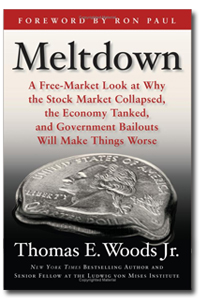 For the financial crisis that has wiped out trillions in wealth, many have felt the lash of public outrage.
Fannie and Freddie. The idiot-bankers. The AIG bonus babies. The Bush Republicans and Barney Frank Democrats who bullied banks into making mortgages to minorities who could not afford the houses they were moving into.
But the Big Kahuna has escaped.
The Federal Reserve.
“(T)he very people who devised the policies that produced the mess are now posing as the wise public servants who will show us the way out,” writes Thomas Woods in Meltdown.
Already in its sixth week on the New York Times best-seller list, this eminently readable book traces the Fed’s role in every financial crisis since this creature was spawned on Jekyll Island in 1913.
The “forgotten depression” of 1920—21 was caused by a huge increase in the money supply for President Wilson’s war. When the Fed started to tighten at war’s end, production fell 20 percent from mid-1920 to mid-1921, far more than today.
Why did we not read about that depression?
Because the much-maligned Warren Harding refused to intervene. He let businesses and banks fail and prices fall. Hence, the fever quickly broke, and we were off into “the Roaring Twenties.”
But, the Fed reverted, expanding the money supply by 55 percent, an average of 7.3 percent a year, not through an expansion of the currency, but through loans to businesses.
Thus, when the Fed tightened in the overheated economy, the Crash came, as the stock market bubble the Fed had created burst.
Herbert Hoover, contrary to the myth that he was a small-government conservative, renounced laissez-faire, raised taxes, launched public works projects, extended emergency loans to failing businesses and lent money to the states for relief programs.
Hoover did what Obama is doing.
Indeed, in 1932, FDR lacerated Hoover for having presided over the “greatest spending administration in peacetime in all of history.” His running mate, John Nance Garner, accused Hoover of “leading the country down the path to socialism.” And “Cactus Jack” was right.
Terrified of the bogeyman that causes Ben Bernanke sleepless nights — deflation, falling prices — FDR ordered crops destroyed, pigs slaughtered, and business cartels to cut production and fix prices.
FDR mistook the consequences of the Depression — falling prices — for the cause of the depression. But prices were simply returning to where they belonged in a free market, the first step in any cure.
Obama is repeating the failed policies of Hoover and FDR, by refusing to let prices fall. Obama, with his intervention to prop up housing prices and Bernanke with his gushers of money to bail out bankrupt banks and businesses are creating a new bubble that will burst even more spectacularly.
The biggest myth, writes Woods, is that it was World War II that ended the Great Depression. He quotes Paul Krugman:
“What saved the economy and the New Deal was the enormous public works project known as World War II, which finally provided a fiscal stimulus adequate to the economy’s needs.”
This Nobel Prize winner’s analysis, writes Woods, is a “stupefying and bizarre misunderstanding of what actually happened,”
Undoubtedly, with 29 percent of the labor force conscripted at one time or another into the armed forces, and their jobs taken by elderly men, women and teenagers with little work experience, unemployment will fall.
 But how can an economy be truly growing 13 percent a year, as the economists claim, when there is rationing, shortages everywhere, declining product quality, an inability to buy homes and cars, and a longer work week? When the cream of the labor force is in boot camps or military bases, or storming beaches, sailing ships, flying planes and marching with rifles, how can your real economy be booming?
It was 1946, a year economists predicted would result in a postwar depression because government spending fell by two-thirds, that proved the biggest boom year in all of American history.
Why? Because the real economy was producing what people wanted: cars, TVs, homes. Businesses were responding to consumers, not the clamor of a government run by dollar-a-year men who wanted planes, tanks, guns and ships to blow things up.
 “The Fed was the greatest single contributor to the crisis that unfolds before us,” Woods writes of today, and “more dollars were created between 2000 and 2007 than in the rest of the republic’s history.”
After 9-11, the Fed kept interest rates low — in one year as low as 1 percent. That money flooded into the housing and stock markets. And in 2008, as the Fed tightened, the bubble burst.
Now the money supply is again expanding, to rescue us from a crisis created by the previous expansion. Of Nicholas Biddle’s Bank of the United States, the great Andrew Jackson was eloquent.
“It has tried to kill me,” he said. “But I will kill it.” And he did.
Should not this creature from Jekyll Island, for all its manifold crimes and sins against the republic, also be summarily put to death?
Patrick J. Buchanan [send him mail] is co-founder and editor of The American Conservative. He is also the author of seven books, including Where the Right Went Wrong, and A Republic Not An Empire. His latest book is Churchill, Hitler, and the Unnecessary War.
The Best of Patrick J. Buchanan
 Striking at the Capitalist Process Itself