


In Defense of Money Grubbing
July 12, 2004
“I like ‘Heatwave’ quite a bit,” says Utah photographer Tom Forsyth. “‘Heatwave’ is a Barbie doll inside a rotisserie oven, lit with an orange glow so that Barbie is basking and baking. Another favorite is ‘Sunbeams,’ where the doll is draped over a Sunbeam mixer with her posterior jutting into the air and the whisks of the Sunbeam whirring closely.”
Describing his art in the Times of London, Forsyth reminded me of another thing that grubbing for money is better than.
“When I hear the word ‘culture’, I reach for my gun,” said Hermann Goering. The German aviator was roasting in hell before Forsyth was even born, so he never had a chance to see ‘Heatwave.’ But had he seen it…and had you been present at the show…you probably would have wanted to duck.
Degenerate, gimmicky and foolish — ‘Heatwave’ is the sort of thing you would expect from European culture, at least from European culture in the 20th century.
Until fairly recently, Americans were too busy grubbing for money to pay attention. Culture was a European import…especially high culture. Europeans were refined, mannered, cultured. New ideas, new styles, new pleasures…all came from Europe along with the immigrants. It was the Paris expositions of 1909 and 1915 where the new "modern" movement made its grand debut…with Marcel Duchamp’s famous urinal displayed as though it were a work of art. Nor was it on the banks of the Hudson that the new, "modern" architecture of Le Corbusier emerged; it was in Belgium. Coco Channel carried no American passport. Nor did Else Schiaparelli.
In politics and philosophy, also, Europe was the hothouse of new, malign developments. There were Marx brothers in the U.S., but the Marx who changed the world was a German Jew living in London. Of course, there were syndicalists, anarchists, socialists, utopianists, too…you could find any kind of ist you wanted in Europe. In America, there were a few ists too…but they were usually lame immigrants always in danger of being rounded up by the cops and shipped back where they came from.
Most Americans were still too vulgar, too shrewd and too innocent to get involved with cubism, collectivism or ironicism. Most important, they were too busy money grubbing. But since then, the world has turned. Now, Americans no longer grub for money — they spend it. And now, Americans come up with the new fashions in the art world. Americans used to mind their own business while Europeans invented new "isms" to justify bossing people around. Now, it is the Americans who have become the world improvers.
“It’s too bad,” Irving Kristol was lamenting Americans’ residual instinct to mind their own business. “I think it would be natural for the United States…to play a far more dominant role in world affairs…to command and to give orders as to what is to be done. People need that.”
Grubbing for money is no longer enough for America’s elites. They want to put Barbie in toaster ovens and Saddam in the dock, rather than risk a “preoccupation with one’s own petty affairs,” as Francis Fukuyama put it in the Financial Times.
Minding your own business is "cowardly," "frivolous," and "decadent," say the neo-conservatives. Besides, it is so much more fun to mind someone else’s. After years of pushing loopy domestic spending programs on the American people, the neo-cons finally wised up. Realizing that trying to reform the guy next door was a waste of time, they decided to reform whole societies on the other side of the planet!
The political genius of this move was revealed in a book by John T. Flynn, written in the 1930s, called As We Go Marching. When you spend taxpayers’ money — or borrowed money for that matter — on domestic programs, you quickly run into conservative opposition. And everyone can see that the programs are a waste of money. But if you squander money on an overseas military campaign the conservatives love it.
And so military spending soars…and the nation embarks on a grand design to bring democracy, capitalism and women’s rights to the tribes of the hindu kush, the Mesopotamian desert, and who knows where else.
The history of efforts to make the world a better place — by force — has many chapters. But few make uplifting reading. Few have happy endings. We give you a bit of one of them…another example of something that grubbing for money is better than:
During the lifetimes of most people reading this…something extraordinary happened. A century and a half after the industrial revolution…three decades after mechanization of agriculture, and long after the use chemical fertilizers and the development of better strains of seed had vastly increased crop yields…the world experienced its worst-ever famine.
“Mao is not a dictator…” wrote Franois Mitterand in the February 23 edition of L’Express, 1961. “The mastery which he exercises is conferred on him by a power over his people which is not produced by the demagogic fanaticism backed by a strong police state of Hitler in Germany nor the cynical energy of Mussolini in Italy…” Mao, said the future president of France, is “humanist…a new type of man…with a vigilant realism.”
That may have been true. But what Francois Mitterand wrote next, after spending three weeks touring China, was a sin and a lie. “The people of China have never been near famine…I repeat, in order to be clearly understood: there is no famine in China.”
Yet, in the winter of ’59—’60…and ’60—’61…Mitterand must have had to watch his step. There were so many corpses of the dead and dying — of starvation — lying around the Chinese countryside he would have tripped over them in almost any direction he took.
“Natural causes,” said the doctors’ reports. They died of heart attacks. Or fever. Or something. Doctors had been ordered not to write down the real cause of death. There was no mass-starvation in China. Mao said so.
Mao was a liar too. Historians and researchers believe about 30 million people died during what was known as the "Great Hunger" in China.
“Natural causes,” said the press in the West, when the famine could no longer be concealed. Bad weather. Drought. That sort of thing. But Mao had managed to do something Mother Nature never could — create a famine throughout all of China.
China is a vast country with several different climates. There are lush, semi-tropical areas in the southeast…and high, cold plains in the northwest. In between, is every sort of climate nature can provide — forests, river basins, steppes and mountains. Until 1959, nature had never been able to produce catastrophes in all of them at the same time. Instead, she merely picked her targets. Small, localized famines were common. Famines that brought starvation to the entire nation were unknown. For that you needed more than nature; you needed man. And not just any man, a man with a vision. A man with a sense of purpose. A man who wanted to improve the world. A man like Mao.
“The masses are slaves,” explained a communist party official, long before Irving Kristol thought of it. They won’t listen or obey if you don’t beat or curse them or deduct their food rations.”
“As the famine worsened,” Jasper Becker explains in Hungry Ghosts, the peasants lost hope. The [communist party] cadres also found that they could only keep order by creating more and more terror. According to Fengyang [province] statistics, 12.5 percent of its rural population — 28,926 people — were punished by one means or another. The report lists the punishments; some were buried alive; others were strangled with ropes; many had their noses cut off; about half had their rations cut; 441 died of torture; 383 were permanently disabled; and 2,000 were imprisoned, of whom 383 died in their cells. Sometimes torture was used to force the peasants to give up their food supplies…sometimes to punish them for stealing food…”
As people in villages died, thousands and thousands of orphans were left to fend for themselves. Others were simply abandoned by parents who couldn’t feed them, but didn’t have the strength or heart to eat them. An official report:
“A lot of children were being abandoned and Zhao Yushu [a local political leader] forbade people to pick them up. He said, the more you pick them up, the more children will be abandoned. Once he said that he had seen a landlord abandon his child so he got the idea that anyone who did this was a bad class element; if a cadre rescued an abandoned child, it meant that he was bad too.
 “The worst thing that happened during the famine,” explained someone who lived through it, “was this: parents would decide to allow the old and the young to die first. They thought they could not afford to let their sons die, but a mother would say to her daughter, “You have to go and see your granny in heaven.” They stopped giving the girl children food. They just gave them water. Then they swapped the body of their daughter with that of a neighbor’s. About five to seven women would agree to do this amongst themselves. Then, they boiled the corpses into a kind of soup. People had learned to do this during the famine of the 1930s. People accepted this as it was a kind of hunger culture. They said: “If your stomach is empty, then who can keep face?”
The poor starving Chinese…preoccupied by their own petty affairs, right up ’til the moment they died.
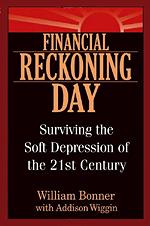
Bill Bonner [send him mail] is the author, with Addison Wiggin, of Financial Reckoning Day: Surviving the Soft Depression of The 21st Century.
 The Myth of Republican Conservatism