


The Last Knight of the Habsburg Empire
July 31, 2009
It is the Golden Age of Victoria and Francis Joseph. Victoria has passed away, but the Victorian light has not much dimmed. There is turbulence, however. Royal Assent to the abolition of the absolute veto rights of the House of Lords is two years into the future. It is some four decades since Walter Bagehot published his thesis about the British monarch only having advisory rights.
But within the confines of the great Austro-Hungarian Dual Monarchy, although not absolute, Francis Joseph reigns supreme. The Great War is five years away. The year is 1909. It is the last day of July. A boy is born a subject of the Emperor Francis Joseph in Tobelbad in Styria. He is Erik Maria Anton Friedrich Ritter von Kuehnelt-Leddihn. He is to provide a link to the days of old like none other.
Today we mark the 100th anniversary of his birth. He was a Knight of the Habsburg Empire, which up until the ravaging of General Bonaparte was known as the Holy Roman Empire. Although not uncritical of it, he vehemently defended the old order, the Habsburgs especially. Ludwig von Mises is said to have been the last knight of liberalism. Erik von Kuehnelt-Leddihn can be said to have been the last knight of the Habsburg Empire.
He was a polyglot and a polymath. His first language was French. German he only started learning when he was five. His multilingualism started early. This author’s first written language was English. The great knight learnt French, the old diplomatic language, as his first language before he even started learning his "own language." He had, as he wrote in his American guide to Europe, a lively memory of the old Dual Monarchy and the Great War. He was nine years old when the war ended and his Emperor was forced to renounce power. He was not only a champion of the old world. He was of that world. And he was to see the atrocities of the 20th century. He said that he first really understood his homeland when he got to spend time away from home. Being at a distance gave him perspective, he said.
 Dr. Erik von Kuehnelt-Leddihn is one of the intellectuals on whose shoulders Dr. Hans-Hermann Hoppe stands for his theories about monarchy, Bertrand de Jouvenel being a notable other. Kuehnelt-Leddihn proclaimed himself to be a monarchist, but he certainly did not believe retaining or restoring monarchy would solve all our problems.
The great polymath settled in Lans in Tyrol, a small village in the hills above Innsbruck, the latter referred to by the late Habsburg biographer Gordon Brook-Shepherd as a monarchists’ nest and the city where the now 96-year-old Archduke Otto had a brief stay at the end of World War II — before the anti-Habsburg regulations were again brought into full force. I regret I never met Kuehnelt-Leddihn. In fact, I never knew of him when he was still alive. I have visited Innsbruck three times in my life. The first time I was a teenager. The second time was in the summer of 1998. The last time was in the summer of 2004, for the Austria Imperial Festival, which sadly has come to a halt.
Even though I had read an article or a few previously at the Mises Institute website, the first half of the year 2002 was when I really discovered the Mises Institute. I discovered it through Internet searching for politically incorrect views on the subject of monarchy and democracy. This was also when I discovered Erik von Kuehnelt-Leddihn and Hans-Hermann Hoppe. How I wish I had known in that summer of 1998 that there was an extraordinary gentleman living along my journey path.
I have since I starting being conscious of the issue, always been friendly towards monarchy, which is perhaps a bit strange since I am not only of upbringing in this new order, but my elementary education was also largely American-based through an international school. This, however, is a long story, and most of it we will have to leave here — possibly for another, future essay.
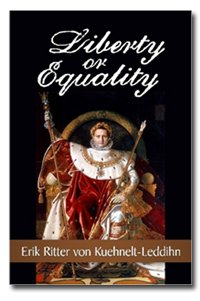 Liberty or Equality: T...
Check Amazon for Pricing.
Liberty or Equality: T...
Check Amazon for Pricing.

I did for a long time subscribe to the belief that absolute democracy and absolute monarchy were equally evil concepts. I had moved away from that belief — or at least I was on my way away from it — when I discovered the Knight of Lans and Dr. Hoppe. My departure — or beginning departure — from said belief was largely due to a monarchy FAQ by a Charles A. Coulombe. I discovered it in the late nineties at the website of a Swedish monarchist friend, whom I had met through a European network of more or less rightist students. Erik von Kuehnelt-Leddihn and Hans-Hermann Hoppe effectively put me off the idea that absolute monarchy and absolute democracy were equally evil.
I now more or less subscribe to one of the many wonderful phrases of the late Knight of the Habsburg Empire:
There are totalitarian and monolithic tendencies inherent in democracy that are not present even in a so-called absolute monarchy, much less so in a mixed government which, without exaggeration, can be called the great Western tradition.
That is not to say that I agree with everything he said.
Amongst the works of this late and great knight are The Menace of the Herd, Liberty or Equality, Leftism, The Intelligent American’s Guide to Europe, Leftism Revisited, Monarchy and War, and The Cultural Background of Ludwig von Mises.
Erik von Kuehnelt-Leddihn was born on the day after my own paternal grandfather. Although I never met the knight personally, reading his books and listening to his online lectures [Mises Institute, ISI], there is little doubt — if any at all — that even they were worlds apart. I suspect it has not only to do with my being a Scandinavian instead of a Continental.
The knowledge recorded in his works is immense. The notes are wonderfully informative. One of them sent me on a research project on the Churchill quote on democracy being the least worse. This even included a mission to the British parliamentary archives in the Victoria Tower. His works give me much inspiration for research, study, and writing projects, for which there are so many ideas and way too little time.
I am indeed sad that I have only seen his grave, and not met him in person. Fortunately, this walking book of knowledge has left behind a number of books, articles, and lectures for all of us to learn from.
There are so many compliments to be found around the web about this great writer. Andy Duncan of Samizdata has said:
You may disagree with what Von [sic] Kuehnelt-Leddihn says about the horrors of democracy, but his writing really is wonderfully entertaining.
As he wrote for many publications, including the Rockwell-Rothbard Report — LRC’s predecessor — and National Review, he wrote for the Norwegian business magazine Farmand, for which also Ludwig von Mises and Friedrich August von Hayek wrote. Their articles appeared in Norwegian. A few years ago I met an old reader of Farmand, and he had much praise for the perspectives that Erik von Kuehnelt-Leddihn had to offer.
 Democracy u2013 The Go...
Best Price: $24.77
Buy New $37.61
(as of 09:25 UTC - Details)
Democracy u2013 The Go...
Best Price: $24.77
Buy New $37.61
(as of 09:25 UTC - Details)
In a letter to the editor in Farmand a reader once commented Kuehnelt-Leddihn’s claim that one could have royals on the wall, but not the Constitution. The reader commented — correctly — that we in Norway once did have our Constitution on our walls. That was a long time ago. In spite of some of us still having one of those old wall copies, it is fair to say that it is no longer the case. Eventually, the King assumed all but a mere formal and psychological role, which ended the role of the Constitution as a check against the King, which again suggests that Kuehnelt-Leddihn in the end was right.
He was a linguist. He spoke eight languages fluently and had a reading knowledge of eleven others. It was, as he wrote, necessary for his research. Indeed, the knowledge and information he displayed would not have been possible without deep knowledge of languages. If one is to achieve knowledge of modern topics, such as computer technology, one can get away fairly easily with only the knowledge of English, but some topics require knowing other languages. I recall visiting museums in Switzerland, where the German was heavy, whereas in the French area it was almost impossible. In the fields into which Erik von Kuehnelt-Leddihn dug, to the extent he did, would have been impossible without a wide and deep knowledge of language and languages.
Now, there is hardly any linear connection between one’s lingual knowledge and the number of languages one speaks or understands. For instances, a person who speaks one of the three Scandinavian languages can easily read the two others. In any case, however, this great linguist’s knowledge of languages is impressive.
When his articles appeared in Farmand, they were in Norwegian, as were those by Mises and Hayek, translated by the editorial staff, I would suspect, but he responded easily to Norwegian comments in English, apparently with no translating help from others.
The Intelligent American’s Guide to Europe, published in 1979, is no ordinary tourist guide. It is an attempt, albeit not without generalizations and lacks, as the author himself admits. He also says that it is a starting point for further research. It is an explanation of Europe to Americans. He tells us that Europeans are ignorant about America, and that Americans are merely misinformed about Europe. The guide was a part of his mission to work for understanding between the English-speaking world and the European Continent. When Europeans talk about American ignorance or misinformation, chances are they are of the more ignorant Europeans of America. Not so with Erik von Kuehnelt-Leddihn, to say the least, and he added that America is the one going around recreating the world, so America, as the hammer, needs to know more about the nail than vice versa.
His European "guide book" is both historical and contemporary. When reading it, one must bear in mind that it was written thirty years ago. Not all information was up-to-date even at that time. He mentions the Governor General of Malta as a contemporary position, a position that was replaced by the position of President in 1974.
 I like that he refers to the Norwegian coronation city as Trondhjem instead of the official misspelling of Trondheim. I would have liked to see more revisionist comments on Norway, but I suppose that is some of the further research the author said he wanted to inspire. He terms the two official languages of Norway Riksmål and Landsmål, which actually are terms for older languages, the former still a living language with its own non-state academy responsible for the dictionary. The "renaming" of Riksmål and Landsmål is something real conservatives might be opposed to, and my oldest great aunt — still living and born in the same year as our great scholar — has always spoken of the two official languages as Kuehnelt-Leddihn did in his European guide. It can be forgiven, and such minor factual problems do not even begin to diminish the encyclopedic nature of the book, or his other works and the scholar himself — for that matter.
This great polyglot was of course concerned about the misuse of terms and words. He railed against the abuse of the term democracy, which I must admit to many years ago having used in one of the rather meaningless ways referred to by the Knight of Lans. He also stressed that democracy answers who governs, whereas liberalism answers how it should be governed.
In a later edition of The Menace of the Herd, which was written pseudonymously and originally published in 1943, there is a short introduction on terminology. It is to explain the use of the term ochlocracy and related terms. The use of these terms had apparently to do with the ongoing war. The author, however, is quoted as saying that an editor who imposed such terms on an author should be executed by firing squad after a breakfast of bread crusts and cold water.
He wrote in The Intelligent American’s Guide to Europe:
The reader has my apologies for the outspokenness of my views, but at least he will soon realize that I do not beat around the bush. I hate to insinuate. I like to say things bluntly, unless I am being ironical; only then do I believe understatements are in order. At this juncture of history it is too late to be fastidiously prudent.
The knight was opposed to the so-called welfare state, which he preferred be called provider state. Not only did he decry the dethronement of monarchs, but also of the father in the family. He explained that a king’s relation to his subjects was like a father to his grown children, whereas the modern state, which is more maternalist than paternalist, he said, can more be compared to the parents of small children, a perversion of the relationship between monarch and subjects.
I have not seen the following explanation in his works, or elsewhere, but I think he would have few problems acknowledging it. Different families have different degrees of freedom, but there is little doubt — if any — that when the public child administration comes in with its social workers everything turns into a nightmare.
Our great linguist also pointed out that the use of the term holocaust has nothing to do with the extermination of Jews. He was a vehement opponent of all forms of totalitarianism, of course, including of said extermination.
Von Kuehnelt-Leddihn was — and is — often referred to as conservative. However, he called himself an Old Liberal. In Leftism Revisited, he referred to himself as an extreme liberal of the far right — not being ashamed of extremism, or of being on the right. Fascism and National Socialism he correctly placed on the left, and the study and rejection of all forms of leftism was a life-long project for this great aristocratic scholar.
In The Menace of the Herd, Francis Stuart Campbell, also known as our great and late scholar rails against capitalism, the Industrial Revolution, and technological progress. This seems to be toned down in later works, and he even talked about Wilhelm Röpke having taken him by the ear and taught him a thing or two about capitalism. Although we should indeed listen when we are told that development of military technology and surveillance technology does not represent progress.
As Professor Jörg Guido Hülsmann noted in Mises in America, Ludwig von Mises enthusiastically endorsed Erik von Kuehnelt-Leddihn’s Liberty or Equality in a letter in 1952. This is perhaps his prime work on the concept of monarchy and democracy, but this theme is highly present in other works as well. Kuehnelt-Leddihn stressed that he did not want to push a monarchy on those United States, but he did want America and Americans to understand. He did, however, not go out of his way to present a counterfactual history scenario of the thirteen colonies remaining in the British Empire with Philadelphia becoming the Empire’s capital. Moreover, he suggested that if the American experiment had been with a genuine mixed government — drawing power from three different sources — instead of the actual republican polity chosen, the experiment might have been successful.
Our polymath presented the American War of Independence as non-revolutionary — as many Americans have too — and not initially anti-monarchical. He pointed out that there was a depiction of the King of France in Jefferson’s Monticello, as well as that the United States Declaration of Independence does not have explicit anti-monarchical rhetoric, only rhetoric against a specific Prince. He told us that American anti-monarchical thought was a later development, influenced — amongst other things — by Mark Twain’s A Connecticut Yankee at King Arthur’s Court.
Our living link from the world of old professed — rightly — that the American Founding Fathers were not democrats, as many Americans have too. This was also something he brought to his European readers. Distinguishing between aristocracy and nobility, the polymath considered the American Republic initially an aristocratic republic. He saw in Andrew Jackson the man who brought democracy to America — or at least to the federal republic. It was not only with Andrew Jackson the American Republic got full-fledged popular elections for the Presidency, but it was also Andrew Jackson who introduced the spoils system. Our scholar of democracy also considered Count Alexis de Tocqueville, who is seen by many as a "friendly critic of democracy," an anti-democrat.
It is so often said that those who know history will reject the concept of monarchy. This great man knew history better than most could ever dream of knowing. He knew very much of the ills this form of government had brought. He knew, of course, also the ills of democracy, and he preferred the former. If you believe the Magna Charta to be the first step towards democracy, you definitely need to study the works of Erik von Kuehnelt-Leddihn, who saw in the Magna Charta an aristocratic check on the powers of the monarch — something very different from putting power in the hands of the people.
One of the many things he mentioned was how the state had grown independent of society. He saw concentration camps as a sign of health, as it showed that there was real resistance. He recommended something resembling the First Reich — the Holy Roman Empire — for the "Germanys" when writing during World War II. Sadly, the victors chose to resurrect democracy and install red tyranny in the East.
Our hero indicated that Franco was a mere military dictator, and that his regime, which saved Jews from the Nazis, was neither National Socialist nor Fascist. He provided a revisionist perspective on the Pinochet regime and colonialism. In his guide on Europe, which was published when Rhodesia was ending, he railed against the United Nations for its policy on "self-determination" — a natural continuation of his critique of American foreign policy, Wilsonian foreign policy in particular. He believed Woodrow Wilson to be one of the five stupidest public figures of the 20th century, quoting Sigmund Freud as saying Wilson was "the silliest fool of the century, if not all centuries" and "probably one of the biggest criminals — unconsciously."
The brilliant scholar, who was an adjunct scholar of the Mises Institute, reminded us that Communism had embraced democracy as an appropriate tool, and he also stressed that we all have become Marxists, in Leftism Revisited, indicating to what extent the Communist Manifesto has been implemented in the "free world."
Our Austrian nobleman spent the wartime years in the 1940s in America, but unlike many other intellectuals, he returned to Europe after the war. However, he traveled a lot to the United States after the war, and he made many friends there. Amongst them was Lew Rockwell, who was a friend of this great scholar for more than thirty years. Mr. Rockwell also served as editor of Kuehnelt-Leddihn’s Leftism at Arlington House. I am pleased every time Mr. Rockwell tells a story at LRC about something he learnt from this great man of Austrian nobility. I am positively envious when I think of all the good memories LRC’s editor must have of his friend.
We tend to see Switzerland as democratic, but the great dissector of leftism tells us that this only goes for a part of Switzerland. He tells us that Switzerland has aristocratic traditions, again distinguishing between aristocracy and nobility. The Helvetic Republic, he tells us, is the source of much that is anti-democratic. In his 1979 European guide he also refers to the Principality of Liechtenstein as a constitutional monarchy, as opposed to a Ruritanian tyranny.
Our extremely knowledgeable knight rejected the excuse that America as a young nation is allowed to make mistakes. As he said, America has had access to the same history to learn from as all other nations. He believed that there is more to history than just simple economics. He also rejected the silly notion that there is meaning to history. He challenged the English-speaking world with its fear of the polyhistor and being a "jack of all trades," whom it saw as an impostor, as our polyhistor, who was no fan of specialization, saw it.
Erik von Kuehnelt-Leddihn was a devout Catholic. He rejected the proletarian status of the Holy Family. He pointed out that initially most of the individual States of the American Republic had religious tests for office or other religious connections for the state, and he maintained that the federal First Amendment was merely a protection against federal discrimination.
Dr. von Kuehnelt-Leddihn contrasted the old world of dreams with the modern world of illusions, critiquing modern man’s lack of imagination when not able to imagine anything better than modern democracy. Bill Buckley told the story of this immensely learned man traveling with 75 books in his hand luggage. After all, he had 75 flights. Of course, he needed one book for each of them.
 In his European "guide book," the Knight of Lans wrote in 1979:
Anyone who lives in Europe with open eyes and ears must often imagine himself to be in a leftist insane asylum.
He deplored how education was being treated, and he rejected the theory that the masses could be educated to be good governors. In his own words:
The notion that, if rightly informed, the man in the street will reach the right decisions, is laughable. The information is so complex and involved that he could never decipher it.
He also wrote:
[W]hat is desperately needed is the return of quality; we must restore minimal government of the highest quality, whereas democracy tends to establish maximal government of the lowest quality.
It would indeed have been interesting to have seen an updated European guide from the same mind now thirty years down the road, with all the decline we have seen in these three last decades. Dr. von Kuehnelt-Leddihn reflected on the prophetic words of Sir Edward Grey a quarter of a century ago, concluding that the lamps would not be lit in his lifetime either. Will they be lit in ours? Or are we too doomed to be quixotic and fight lost causes, which the late knight maintained that the Continentals took pride in — with their uncompromising mindset. Remember though, that what a large minority considers a lost cause will remain so if no one fights for it.
 There are many who have learnt a lot from the late and great Erik Maria Ritter von Kuehnelt-Leddihn, many of whom can learn even more, and there are even more who can learn. A book by this great Austrian can be read many times, and one will come to new insights every single time. We are lucky to have the work that he has put down. His family has great reasons to be proud.
The last Knight of the Habsburg Empire is a great inspiration. There is a gigantic leap from his philosophy of knowledge to the laid back one-minute-attention culture of our time. We may not see someone — for a long time at least — who completely "fills his shoes," but even filling a small fraction will be a good delivery.
We honor him on this day — the centenary of his birth. Let us raise our glasses to his honor — preferably with Kaiser Bier. May he continue to rest in peace!
The Best of Jørn K. Baltzersen
 The Ten Best-Read on LRC for August 2009 Source of readership stats: Google Analytics