


The Old Order vs. the Worship of Modernity, Commonness, and Decline
October 21, 2004
In our times showing one’s underpants is quite common. This phenomenon is observed not only on the street or at the gym, but also at what is supposed to be respectable workplaces. People even pay visits to their customers in this way. Moreover, almost no day goes by without one observing people who are supposed to be grown up, with latch key kid chains either around their necks or — even worse — hanging out of their pockets. These days, observing latch key kids with kids of their own is not uncommon. Companies even use these pathetic latch key kid chains as promotion of their names, and employees willingly wear these latch key kid chains around their necks with company access cards.
I was on my way to celebrate what was ended by Woodrow Wilson’s war to make the world safe for civilizational decline, when I was quietly having lunch at Copenhagen’s Kastrup Airport. All of a sudden someone jumped upon my chair. Nothing serious happened, but my chair must have moved an inch or so. The guy just moved on as if he had done nothing wrong. I assumed he was one of these whose vocabulary does not contain the word sorry — or phrases such as excuse me and please for that matter. There are just too many of this kind in the world. I believe I heard him speaking Norwegian to his company, and knowing that bumping into people without saying sorry — or excuse me beforehand to avoid it — is quite normal at the metro in Oslo, this should come as no surprise. However, common unacceptable behavior is still unacceptable.
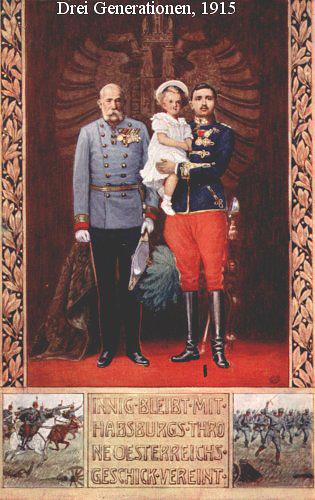
 Courtesy of the Kaiser Karl-Gebetsliga
I was on my way to Innsbruck to celebrate the late Habsburg monarchy. The occasion was the annual Austria Imperial Festival. And there is in fact a lot about the old Danubian monarchy to celebrate. Moreover, the monarchy existed in an order with lots of good traits. Although the political correctness police will still claim that it was the humiliation of Germany at Versailles alone that caused World War II — and that the dethroning of monarchs had nothing to do with it — there is a widespread conception that Hitler would have remained an unimportant historical figure had that old monarchical order remained in place. But even now — with National Socialism, Fascism, and Communism, which crept out of the sewer like rats with the old order gone, defeated — we have still to achieve the level of liberty and free trade we had prior to the lights going out in those July and August days just about 90 years ago.
We’re still stuck with modern Western style democracy. And as professor Hoppe pointed out last month at a lecture in Copenhagen, democracy was viewed at the time of the French Revolution as a form of soft communism. Rockwell told us in Why hate monarchs?:
Unlike our own presidents, who are experts in passing the buck, the monarch tends to take personal responsibility for the fate of his domain. Upending a personal tyranny is much easier because you know whom to blame and whom to overthrow. The classical-liberal tradition was never hostile to monarchs as such; it was government power they opposed, and where the monarch restrained the state, he won their favor.
 Courtesy of the Kaiser Karl-Gebetsliga
If you visit the city museum and archive of Innsbruck, you should find some interesting stuff [1] . You will find the declaration of Franz Josef to his peoples on the declaration of war against Serbia. He stressed that he wanted peace for his peoples, but had decided on war for the honor of his monarchy (u201CEhre Meiner Monarchieu201D). It is known that the Emperor was not enthusiastic about going to war, and that it was his Cabinet that wanted war — i.e., a local conflict with Serbia, not a world war. One can certainly discuss this matter in depth — specifically whether he in this case at an age of almost 84 was capable of protecting his peoples against their politicians, which the Emperor held was the main point of his office. However, there can be no doubt that when the decision was made, Kaiser Franz Josef took the complete responsibility for the action taken.
Moreover, the use of the phrase u201Cmy monarchyu201D tells of a monarchy which — in the Hoppean sense — was a u201Cprivate government.” Franz Josef came to power in 1848, in connection with the constitutional crisis of that year, and after the abdication of Emperor Ferdinand I. This crisis and abdication is just one historical example that Erik von Kuehnelt-Leddihn was indeed right when he in Liberty or Equality said:
The phrase so often repeated in democratic nations insisting that u201Cbad presidentsu201D would incur the wrath of the voters, whereas bad monarchs hold their office for life, stands no critical investigation.
There is little doubt that the Emperor Franz Josef felt a responsibility on his shoulders that was far heavier than the spine of any modern democratically elected politician could have the slightest chance of holding. Their backs would probably break in an instant. The phrases u201Cmy monarchyu201D and u201Cmy peoplesu201D are in the line with the view as the monarch as a father to his subjects as a sort of u201Cgrown up kids.” Well, you might say that since we’re grown ups, we can take care of ourselves. We don’t need to be ruled. We can take responsibility for ourselves and not be ruled. As the nanny state and provider state are both products of the modern democratic state, where u201Cwe are not ruled, but take responsibility for ourselves,u201D I’m afraid it isn’t that simple.
In the city museum of Innsbruck you may also find the declaration of Franz Josef that the King of Italy had u201Cdeclared war against me.” Such a use of words suggests that he was taking his personal responsibilities very seriously indeed. It also illustrates the old conception as wars as something between governments or monarchs, not between whole nations or peoples. Sadly, this war was permanently to end this conception.
The city museum also has some stuff on World War II and the Austrian Anschlu. The Anschlu was approved by plebiscite; the ballots, however, were clearly marked with the preferred option, namely yea, which there were 99.75% of in the referendum. This illustrates how Hitler used popular support as an approval mechanism for his measures. In a way this resembles our modern Western style democracy in the sense that u201Cthe mandate from the peopleu201D legitimizes policies that rulers of old would never have dreamt of. One could also say that this makes the Hitlerite regime a form of democracy. The reference to the masses is not uncommon in leftism.
The museum also exhibits a poster from the proclamation of the Austrian republic, and seeing it gives direct associations to socialism. The soft communism which was brought to us with the dawn of the democratic republican age can only be seen as a victory for socialism. The progressive Woodrow Wilson’s war to make the world safe for leftism brought hard times upon our civilization, and those hard times are yet to end.
I also discovered at the museum that there had been a requirement for bicycle licenses in the period 1869—76. One may wonder whether such a requirement ever would have been abolished in our modern democratic managerial state.
One of Innsbruck’s Habsburg attractions is Ambras Castle. It was the residence of Archduke Ferdinand II, princely ruler of Tyrol. He married a commoner, and hence his children were cut off from ever inheriting the princely seat of Tyrol. This should give today’s royals of Europe something to think about, some of whom seem to have no standards at all when it comes to choosing consorts. Ambras Castle is today a museum, housing armors, personal belongings of the archduke, paintings of Habsburg monarchs and their relatives.
Although Tyrol was officially united with the rest of Austria from the 29th of September 1363 [2] , there was a period with a separate archduke ruling Tyrol until 1665. There even was a period when a widow archduchess ruled due to the heir’s minority. She was Claudia dei Medici, and the provincial museum — the Ferdinandeum — had an exhibition on her when I was there. In 1665 the Tyrolean branch of the Habsburgs died out, and from then on Tyrol was ruled from Vienna.
 I also paid a visit to the Kaiserjgermuseum — the museum of the Imperial Rifles Brigade. The museum houses lots of paintings of Habsburgs and imperial officers, records of Tyroleans lost in war, and other war-related material. A special exhibition on World War I was running when I was there. In the chapel, which houses the records of the lost Tyroleans, there is a painting illustrating the destroyed homeland, referring to the splitting of Tyrol between Italy and Austria. However, the painting and the theme u201Cdestroyed homelandu201D could easily have been referring to the destruction of the Habsburg Empire altogether.
Outside the museum there is a statue of Emperor Franz Josef and a bust of Emperor Karl. However, the most prominent statue at the site is the statue of Andreas Hofer, Tyrolean freedom fighter of around 1809. He is also depicted in the museum. The statue’s caption reads u201CGott, Kaiser und Vaterlandu201D (God, Emperor, and Fatherland). A republican age monument at the University of Innsbruck reads u201CEhre, Freiheit, Vaterlandu201D (Honor, Liberty, Fatherland). I wonder whether those who set up that monument ever thought of the fact that there probably was more honor and freedom in the times when the first two words were u201CGottu201D and u201CKaiser.”
One discovers when visiting Innsbruck that Andreas Hofer is considered to be quite a hero. He fought the forces of the parvenu and usurper Napoleon and the allied Bavarians. A gigantic panoramic mural depicts the fight for freedom of August 13, 1809. The mural is an exquisite work of art. There is a model on the floor next to the 360-degree panoramic painting, and at some points you may have trouble telling the model and the mural apart. The work on the mural was started in late 1895 by academic painter professor Michael Zeno Diemer and was finished in June 1896. The mural covers more than one thousand square meters.
When you arrive at the mural, you’re asked what language you prefer. I asked for English. Much to my surprise I was later given presentations in all three Scandinavian languages, as a group of elderly visitors from Scandinavia arrived. The Norwegian presentation could have something to teach a lot of Norwegians, namely to count correctly in their own language. Norwegian has the same way of counting as the Germans, i.e., one says, e.g., u201Csix-and-ninetyu201D instead of ninety-six. However, according to an act of Parliament in 1951 [3] , kids are taught in school that the right way is the wrong way, and that the wrong way is the right way. The Danes have yet to be made subject to such nonsense, yet when I talk to Danes — when visiting Denmark — at ticket booths, for instance, they tend to pronounce numbers in the wrong Norwegian way. They could be excused because it’s also the right Swedish way. In addition, there are some further complexities in the Danish way of counting. However, these Danes — along with a lot of Norwegians — could have something to learn about the Norwegian language by going to see the mural, in addition to observing an impressive painting.
Every once in a while you get the feeling that commonness, mediocrity, decline, and rudeness are virtues of our times. People are on the first name basis with everyone else. In Norway, the polite and formal form of you has become almost extinct, and — as I mentioned earlier — please is not too common either.
Knowing the formal nature of the cultures of German-speaking nations I expect more from them. To my disappointment, however, during my stay I did sense a tendency of not using u201Cbitte,” which means please, and of using the informal form of you and related pronouns.
When in Innsbruck I saw a couple with a baby. He was unshaven. He had 3 rings in his left ear, 2 rings in his right ear, and no ring on his finger. He bore the baby in straps on his chest. He reminded me of the Norwegian anthropologist Jan Brgger, who in his book u201CEn forsvarstale for mannenu201D — translates to A Defense Speech for the Man — felt sorry for all the babies being carried around at feminist conferences by u201Cmen,” the babies having to stand all those hairy chests.
One keeps on getting these reminders that we indeed have civilizational decline. Well, at the Austria Imperial Festival I would hope it would be better. I started out with a beer in the imperial court yard. One should expect a place like that to have Kaiser, but it didn’t. I had previously visited the Hofburg — the Imperial Palace — and seen the rooms, although this was not Vienna, which I visited in the summer of 1998, the feeling was clearly that Anatole France, the first Nobel Laureate in Literature, was right when he in 1921 said:
For every monarchy overthrown the sky becomes less brilliant, because it loses a star. A republic is ugliness set free.
Saying this just about three years after Wilson’s war to make the world safe for the atrocities of the 20th century, he could hardly be aware of how he beyond his wildest nightmares would be right.
Now, for the festival, a subject of H.M. the King of Norway goes to celebrate the late Habsburg monarchy. Next year Norway will be celebrating the centennial anniversary of the dissolution of the union with Sweden. This is also the centenary of the end of our old order monarchy — sadly so. Through these one hundred years we have gone from King Haakon VII, who was crowned in Trondhjem, and who gave his oath to Parliament by raising his right arm high above his head. King Haakon VII, although he stressed that the politicians of our democracy in the end should have their way, is known to have threatened with abdication at least twice. King Olav V was not crowned. Coronation was abolished in 1908 — a measure to u201Crepublicanizeu201D our monarchy. When giving his oath to Parliament King Olav V raised his arm more like the American presidents on inauguration day. King Harald V, our present King, didn’t raise his arm at all. The next generation picks consorts of the lowest order. The male consort recently appeared on the front page of a gossip magazine [4] with a naked chest and a chain around his neck, telling u201Cthe whole nationu201D about his wanting to commit suicide. Another gossip magazine tells of the said consort doing the housework while his pregnant princess is the family provider. I prefer going to celebrate a foreign old order monarchy.
The festival started on August 11 with a catholic mass. It was originally set up to be in the Hofkirche — the court church. This church houses the empty tomb of Emperor Maximillian I, who reigned from 1490 to 1519. The tomb has a statue of Emperor Maximillian on top of it, and it is surrounded by 28 larger than life statues of other Habsburgs. Maximillian has his own little museum behind Innsbruck’s Golden Roof. What you will be told when visiting here is quite fascinating in this age of the absolute democratic state. The Emperor was forced to leave Innsbruck towards the end of his life because the innkeepers were dissatisfied with the way he handled his debt [5] . Can you imagine in today’s world a federal agency having to leave town because it hasn’t paid its debts? The reason the tomb is empty is not directly due to the Emperor being forced to leave Innsbruck. However, the Emperor did spend the end of his life elsewhere, and when doing so he changed his mind about his remains. The actual tomb of Emperor Maximillian I is hence in Wiener Neustadt, which is close to Vienna, but not part of it. The empty tomb is in a way a symbol of the relative powerlessness of rulers of old.
 Courtesy of the Kaiser Karl-Gebetsliga
Arriving at the Hofkirche for the mass I was kindly asked to proceed to the St. James Cathedral, where the mass would take place. Members of the House of Habsburg were placed in front to the left of the aisle. Three guys dressed up in uniforms marched down the aisle with a banner with a Habsburg eagle. The mass was held in German, and I did not get everything that was said. However, the priest did address the members of the House of Habsburg. He talked about it being 200 hundred years since the proclamation of the Austrian Empire. The Austria Imperial Festival is an annual event, but the specific event this year was this bicentennial anniversary [6] .
Furthermore, the priest talked about remembering u201Cour history.” He talked about forms of government changing through time. He talked about the extreme ideologies of the 20th century. I think the festival is cautious not to make any statements about the wanted return of the monarchy. From what I have understood this is still very touchy. A movement whose patron is Otto von Habsburg cannot officially be a movement for restoration of the Habsburg monarchy, since Otto von Habsburg has denounced his claim to the throne in order to be allowed to enter Austria [7] . However, I would not mind if such a movement existed. An undoing of Woodrow Wilson’s war to make the world safe from democracy’s sounder and more civilized alternatives [8] is long overdue.
I am afraid though that both Erik von Kuehnelt-Leddihn and Hans-Hermann Hoppe are right when they say that the path back to monarchical rule is extremely hard, if not impossible. However, lately we have seen one small example of that the way to more powers to monarchs is possible. The ruling Prince of Liechtenstein, who on August 15 this year transferred powers — without abdicating — to the hereditary prince, increased the princely powers by threatening to move to Austria. It did work. This has been called a return to absolute monarchy, which is absolute nonsense, as Liechtenstein’s Landtag remains in function and the people have a collective constitutional right to abolish the monarchy. Erik von Kuehnelt-Leddihn has pointed out the latter as in conflict with the principle of monarchy [9] . So the Liechtenstein case is not an example of a monarch having powers in his own right. However, it is an example of a monarch increasing his powers. Until lately we have been told that the opposite is almost a law of nature.
After the mass there was a military tattoo in front of the Hofburg. Lots of people were dressed up in old imperial uniforms. Some had the feather hats of the type that one often can see Emperor Franz Josef portrayed with. Horns were blown from windows of the Hofburg. An inspection of the troops was done. The old Kaiserhymne was played. When the tattoo was over the Habsburgs and other VIPs found their way through the entrance to the Court Church and the Museum of Tyrolean Folk Art — Tiroler Volkskunstmuseum. The latter is rather a museum of Tyrolean culture, and you may find rooms of Austrian nobility exhibited there. I highly recommend it. It may provide some balance against the belief that the nobility all lived in palaces.
Well, the official part of day one was over. I went to a restaurant by the name of Kaiserstube, where I had a late dinner. And of course I had Kaiser Bier to drink. The place had pictures of Habsburgs on the walls. I had eaten at the place earlier, but this was my first time when wearing a suit and hat. The latter was, needless to say, put aside during the stay at the restaurant.
 Courtesy of the Kaiser Karl-Gebetsliga
The next day was yet another day for celebrating the old monarchy that was ended by Wilson’s war to make democracy safe from its sounder and more civilized alternatives. It started in the evening with the concert. I arrived in my white tie, tailed tuxedo, and top hat. The doors were opened for me.
After allowing for some time for socializing, the concert started. The host spoke in German, and again I did not get everything he said. As the priest on the previous day he spoke of remembering u201Cour history.” He talked about the proclamation of the Austrian Empire, which was made on August 11, 1804. Kaiser Franz actually wanted to do this on August 10, but since this was the anniversary of the end of the French monarchy — or the arrest of Marie Antoinette, daughter of Empress Maria Theresia — the proclamation was postponed to the next day.
Austria had been an archduchy until this day. The empire had been the Holy Roman Empire. The reason for proclaiming an Austrian Empire was that the Holy Roman Empire was going down. Half of the electors had sided with Napoleon. The host also talked about the creation of the Kaiserhymne. Josef Haydn had been to England, where he had heard God Save the King. He wanted something similar for the Emperor in Vienna. The host also told us about Haydn teasing Napoleon with this hymn.
The concert was quite nice. However, it does have potential for improvement. If one really is to have a celebration of the old order, violations of the dress code such as jeans cannot be tolerated. Moreover, when the conductor instructs an audience which is mainly Austrian to sing the Kaiserhymne, one should expect loud and clear singing, such as that of the audience at the Last Night of the Proms at the Royal Albert Hall in London. Also, the conductor should allow the audience to sing the Otto verse, but of course the audience must first learn to sing the first verse shamelessly. The Otto verse is perhaps too politically incorrect even for this festival? I would also like to see white and red flags being waved all over the hall. Black and yellow Habsburg flags would be even better.
After a short break there was the Kaiserball — the Imperial Ball. White and red banners were hanging down the walls of the ball hall. The ball opened with the Habsburgs and other VIPs present being greeted. People dressed in uniforms marched up to and upon the stage. The dancing started with members of a dancing school, dressed up in costumes. One couple was dressed up as Emperor Franz Josef and Empress Elisabeth. Thereafter, Habsburgs and other VIPs were allowed to dance. Finally, everyone was allowed to dance. Wine made especially for Austria Imperial was served at the table.
I jokingly asked at my table when the monarchy was going to return. A gentleman at my table jokingly responded that it never left. He was both right and wrong about that. Of course, the monarchy no longer has any constitutional or other official role in Austria. Democracy and all its troubles are the order of the day. However, one does get the feeling that Austria is a monarchy. When I did my tour of Austria in 1998 and during my visit to Innsbruck this year I got the feeling that the monarchy in a way is alive. Austrians tend to celebrate their monarchy to a great extent. Back in 1998 the commemoration of the 1898 assassination of Empress Elisabeth in Geneva was noticeable to an extent that if you did not know better, you would think Austria was a monarchy. Monarchical souvenirs and postcards are easily available. Austria is perhaps the republic where the country’s late monarchy is celebrated the most. It is my impression that Austrians are proud of their monarchical past and celebrate it a lot, but when asked if they want it back, the answer is no.
The same gentleman also told me that the Austrian nobility, which still is linked to the Habsburgs through intermarriage, still today controls much land in Austria. He also thought the collapse of the European Union could bring the monarchy back. I discussed the issue of a monarchical return with several others too. The general feeling I had was that they saw monarchy as opposed to democracy. Such conceptions I am afraid are far rarer in countries that have experienced the transition to u201Cmodern European monarchy.” It is also my conception that the Habsburg monarchy maintains marital traditions and is true to the traditions of succession. If the Habsburg monarchy had been transformed into a u201Cmodern European monarchyu201D it may very well have gone the same path as the other u201Cmodern European monarchiesu201D have in these fields. In a way it is good that such a transition did not take place. The Habsburg monarchy is remembered solely as an old order monarchy. In a way I can understand Austrians who do not want the Habsburgs back as an equivalent to the Swedish Torekov [10] monarchy — or something slightly more.
 We were told that the glory of the old monarchy would rise at the ball. Despite everyone standing when the Kaiserhymne was played at the ball’s opening, I frankly had no such feeling. It was not only that Kaiser Otto and Kaiserin Regina were missing on the dance floor — or at the event at all — although their mere presence certainly would have influenced the atmosphere. There was no real royal or imperial atmosphere. The dress code, which was stricter than under the concert, was violated at the ball as well. There certainly could have been black and yellow Habsburg banners hanging down the walls, in addition to the red and white Austrian ones that were there.
When the ball was officially over, it turned into a modern day late night party with the typical music that goes with such parties. This did nothing to improve the feeling of Habsburg atmosphere — rather to the contrary. However, it could be seen as a symbol of the transition to the post-monarchical age, with the decline it represents. My departure from the premises was uplifting though. A gentleman obviously appreciated my outfit when he held that wearing a top hat is the way to go to an imperial ball.
Two days later — on Saturday, August 14 — I attended the Leutasch open air concert. It was promoted as part of the Austria Imperial events, but it was not officially part of it. The European Philharmonic Orchestra, under the direction of Peter Jan Marth, was playing. This orchestra also played at the August 12 concert in Innsbruck. I believe that’s the reason for the connection. It rained continuously that afternoon and evening. However, worse accidents than rain can take place, such as Woodrow Wilson and his doings. I found a peculiar phenomenon that could be related to the events of history that evening. During the break the conductor, who in a way can be seen as monarch, did not have his rod. He was in a way deprived of his authority. During this period there was complete disorder in the orchestra as the members were tuning their instruments. When the rod was returned to the conductor, there was immediate silence. There was order. Then the order left, but it did return. We may also one day be relieved of the troubles of modern democracy.
During my stay in Innsbruck I paid a visit to the town of Hall. The town has a monument erected in 1840 during the reign of Emperor Ferdinand I of Austria. It is to the memory of the meeting of Emperor Franz I of Austria and Emperor Alexander I of Russia. The meeting took place at the site of the monument on October 11, 1822 [11] . The monument states that it is to the memory of successful times. Indeed successful they were in many ways — at least compared to our age of full-fledged democracy. 92 years later the two Empires would be at war against each other — a war that sadly put an end to that old European order.
At the town museum in Hall there was an exhibition to the memory Sebastian Rieger, an Austrian author. He was born on May 28, 1867 and died on December 2, 1953. The exhibition contained two letters signed Otto. One of them was dated October 5, 1953. One of them was cosigned Regina. Both letters contained the term u201Cdie Kaiserin und ichu201D — u201Cthe Empress and I.” I was curious as to whether he meant Regina or Zita, and I inquired about this with the museum staff. The elderly woman immediately expressed in German — without batting an eye — u201COtto is the Austrian Emperor.” Whether Regina or Zita was being referred to could not be determined at the time. But I was satisfied with the fact that this woman probably had a potential of ruining the day of any opponent of the old order.
Hall is most famous for its mint, which has quite a history from before it was shut down by the Bavarians in 1809. These days, central banks have to improve the quality of their notes in order to avoid counterfeiting by others. However, when visiting the Hall Mint Museum you will learn that back in the days of this mint quality had to be improved in order for people to use the currency. In these euro times we are told that this or that currency was the euro of old. We are told this about the sterling, the Austrian taler [12] — actually from which the name dollar is derived — of Hall, and the currency of Napoleon III of France. However, there is little doubt that these comparisons are more than a little dubious. The u201Ceuros of oldu201D are called such because these currencies were used outside the borders of where its coins were minted. Hence, the logic goes, these currencies were more European currencies than national currencies. However, the similarity ends there. The u201Ceuros of oldu201D were widely used currencies because of their reliability, not due to a central decision to replace all other currencies with one. Furthermore, the u201Ceuros of oldu201D were not on the paper standard of today.
Hall is somewhat to the east of Innsbruck. A little further to the east lie Wattens, home of the world-renowned crystal company Swarovski. There is an exhibition center [13] in Wattens and a shop, which could set you back several vacations. Daniel Swarovski was from Georgenthal in Bohemia. The basis of his success was an invention in the field of cutting crystal from 1892. In 1895 he moved to Wattens with his family and established his company. It is hard to argue with the success of this company. The story of Daniel Swarovski tells us of a man who worked to build his own and family’s future, as well as the future of many others. It is an example of a man who did not stay put in the position he was given [14] . All this happened within the Austro-Hungarian Empire. Swarovski moved when he established his company, but he moved within the Habsburg Empire. What opponents of the old order will tell us is that in the old order everything was set up for you, and that there was no social mobility. The story of Daniel Swarovski tells us that it was not necessarily so and that the pursuit of happiness was indeed possible.
After having stayed a while in Innsbruck, having eaten quite some Austrian food, Kaiserschmarrn included, and drunk quite a lot of Kaiser, I did the souvenir shops. I brought a bust of Kaiser Franz Josef I back home. I went through Munich in Bavaria and its Franz Josef Strau Airport. I stayed at a hotel in the middle of nowhere outside Munich. The hotel had shuttle service and a portrait of King Ludwig of Bavaria hanging in the lobby. One is reminded of the German order prior to 1871. How different the 20th century might have looked had that order remained.
I was on an early morning flight on August 18 out of Munich. I was at that time unaware of the annual celebration of the birthday of Emperor Franz Josef in Bad Ischl, a village where Franz Josef had his Kaiservilla — where the declaration of war against Serbia was signed — and where the long-reigning Emperor spent a lot of time. Perhaps I will go next year, when it is his 175th birthday. Perhaps also that will be the theme of next year’s Austria Imperial Festival.
On my flights back home I got hold of the International Herald Tribune. I noticed its section on reports from the past. It featured 1904: King Greets Emperor from August 16. Emperor Franz Josef had arrived in Marienbad that afternoon to formally return the visit paid to him by King Edward the previous year. The King wore the uniform of an Austrian field marshal. The Emperor wore a uniform of a British field marshal. Having experienced this back in 1904 it must have been quite unimaginable that the two thrones just 10 years later would be at war with each other — a war which would be turned into a war to enslave us all on the altar of the great god Demos.
One might ask: was the old order a paradise of liberty? No, it was just the West B.D.
Another noticeable feature of that issue of the International Herald Tribune was the Calvin and Hobbes cartoon. The issue here was u201Cdad approval rating.” One gets a perspective of how ridiculous democracy can be if one tries to apply democracy to a family. The cartoon not only ridiculed the ideology of applying democracy to all facets of life, I also felt it ridiculed the concept of politician approval ratings as such — and perhaps more in general also the whole institution of opinion polls.
On the first Sunday of October this year His Holiness the Pope beatified Emperor Karl. He defied all anti-Habsburg criticism of this planned action. Critics point out that the Emperor never recognized the Republic of Austria — as if recognition of the new order is something good. Emperor Karl tried to end the terrible war that almost all of Europe had been drawn into. Although he attempted a restoration twice, he never risked putting his peoples through civil war. One might say that Emperor Karl was one of those monarchs u201Cwith little oppositionu201D whom Erik von Kuehnelt-Leddihn referred to in Liberty or Equality when he said:
Indeed, the old monarchies were far from being models of perfection. The ancien rgime, if we look merely at its seamy side, was made up of murder, inefficiency, corruption, narrowness, immorality, procrastination, intrigue, egoism, deceit and pettiness and it had long been in need of radical reform when it disappeared. Yet it never promised a New Dawn or a Paradise on Earth and it must be conceded that it relinquished the stage of history with little opposition, almost in the expectation that the bombastically heralded New Experiments were bound to fail. And fail they did!
Emperor Karl is the first male monarch to be beatified since 1588. That’s not many, but again there aren’t many monarchs to choose from. I challenge anyone to find any president, in the list of beatifications and canonizations. Are there even any, or at least more than just a few — other national democratically elected politicians — of whom there must be more than monarchs by now?
I am not a Catholic, but I do respect this institution — at least more than I respect the institution of the Nobel Peace Prize, which was awarded to Woodrow Wilson in 1920 for the year 1919 for his first-degree crime against humanity. Entering a war to remake Europe in one’s own image was obviously admirable to that committee of politicians appointed by the Norwegian parliament — a committee whose mandate from the late Alfred Nobel was to promote peace. Wilson probably prolonged the war. Moreover, he caused lots of post-WWI problems, including Communism, Nazism, Yugoslavia, and the completion of the transition to full-fledged democracy. So much destruction, yet he was awarded a Nobel Peace Prize.
 President Wilson in accepting the prize said this:
In accepting the honor of your award I am moved not only by a profound gratitude for the recognition of my [sincere and] earnest efforts in the cause of peace, but also by a very poignant humility before the vastness of the work still called for by this cause.
Did he really believe what he said?
History presents us with two leaders. We have Emperor Karl, the representative and defender of the old order. He heroically refused to abdicate. He was the archenemy of Woodrow Wilson, crusader of democracy and representative of the new order. It seems Kaiser Karl is the one to be praised in posterity.
If we listen carefully, we can hear a wonderful sound — the spinning of the progressive professor Thomas Woodrow Wilson in his grave.
Today — on Emperor Karl’s feast day — I’ll have a Kaiser to that and to the Kaiser — in a big glass with a Habsburg eagle on it — both brought all the way from Innsbruck.
Long live the House of Habsburg! Gott erhalte und beschtze den Kaiser!
Notes
[1] The texts are all in German, but visually one should have some outcome anyway.
[2] There is monumental fountain — Rudolfsbrunnen — in Innsbruck commemorating the 500th anniversary. It was put up in 1877.
[3] In Norway we have a government agency for u201Cdeveloping the language.” The official languages are u201Cbokmlu201D and u201Cnynorsk.” Democratism has for a long time been the ideology in u201Clanguage developmentu201D in Norway, i.e., the ideology that one man’s language is as good as another’s. This is of course total nonsense. Also, for a long period of time there has been a policy of merging the two languages, but this has now been officially given up. The old official languages u201Criksmlu201D and u201Clandsmlu201D were what we had before politically controlled u201Clanguage developmentu201D became the order of the day. In 1938 u201Criksmlu201D was officially u201Cabolished.” Today we have u201CRiksmlsforbundet,” an organization promoting u201Criksmlu201D and the free development of language. There also is an institution for recording real language development. It is also responsible for publishing dictionaries for u201Criksml.” It is of course not controlled by the government. It is refreshing to read Erik von Kuehnelt-Leddihn’s An Intelligent American’s Guide to Europe‘s chapter on Norway, where he uses the terms u201Criksmlu201D and u201Clandsml.” Also, he uses the name u201CTrondhjemu201D for the old coronation town. The official name is u201CTrondheim,” which is another ridiculous act of Parliament. Refreshing indeed.
[4] If anyone should be in doubt, I do not read these gossip magazines. However, their front pages are hard to avoid.
[5] Also, Emperor Maximillian I was not crowned in Rome. The Doge of Venice would not let him pass.
[6] The web site of Austria Imperial did mention the joining of former countries of the Habsburg Empire in the European Union as an event to celebrate this year as well. However, Carlo Lottieri and Carlo Stagnaro stress that the Habsburg Empire and the European Union are two quite different things. Moreover, I did not notice any mention of this at the festival.
[7] A visible illustration of the Austrian political correctness around this issue in Innsbruck is the list of VIPs at the Goldener Adler (Golden Eagle) Inn. The list contains u201CDr. Otto von Habsburgu201D from 1969, but a prince of Prussia from 1974.
[8] This might perhaps need an explanation. Since 1918 the world has seen alternatives that are worse than our Western style democracies. In the bipolar world one sees our democracies against alternatives such as Communism, National Socialism, a Mugabe dictatorship, and so on. In this bipolar world democracy is the good alternative. In the bipolar world there is no room for any third alternative. Hence, making the stage safe for despotic dictatorships is a way of making the world safe for the sound alternatives to our modern Western style democracy.
[9] He has made a statement on the concept of referendums on monarchy as a principle. He has not spoken to me from Kingdom Come on the Liechtenstein case.
[10] Torekov is the name of the Swedish village where politicians made a compromise back in the 1970’s to u201Ckeepu201D a totally emasculated monarchy, left only with the formal power to appoint envoys. This compromise is known as the Torekov compromise.
[11] Funny that my Let’s Go guide for Austria and Switzerland from 1998 staunchly holds that u201CHall has yet to see any royalties.”
[12] It was originally the Joachimstaler from Joachimsthal in Bohemia.
[13] In addition to the permanent crystal exhibition and other temporary exhibitions, there was a soap replica of the Amber Room, a gift from the King of Prussia to Peter the Great of Russia.
[14] His father did have a small crystal factory, but the leap Daniel Swarovski made was yet immense.
The Best of Jørn K. Baltzersen
 Myths of 'Potent Pot'