The War on (Some) Drugs
June 24, 2011
Recently by Wilton D. Alston: Altruism, the Remix: Still False?
"It may, perhaps, be fairly questioned, whether any other portion of the population of the earth could have endured the privations, sufferings and horrors of slavery, without becoming more degraded in the scale of humanity than the slaves of African descent. Nothing has been left undone to cripple their intellects, darken their minds, debase their moral nature, obliterate all traces of the relationship to mankind…" ~ from the Preface to Narrative of the Life of Frederick Douglass
Although watching it as much as one would like can be tough to do – particularly during the NBA Finals – most libertarians would probably agree that John Stossel's TV show is both entertaining and educational. On a recent show – watched via DVR – Stossel had Dr. Walter Williams as a guest. Williams did not disappoint. His brilliance was breathtaking at points. He provided clear, concise examples. He offered parables and life experience that should have been unassailable. And he provided much of it through a prism that resonated acutely with the life experience of this author.
The subject of this particular show was "The State Against Black People" and profiled how many, if not most, of the programs and policies implemented by the government have decimated the black race over the years. (As an aside, this author does not generally support a statist, collectivist view of any race of people. No race is monolithic. In this case, however, that point of view will be used for simplicity.) The aspect of the show that gives life to this essay happens to be one that Dr. Williams did not specifically focus upon, but one that troubles me greatly, and has for some time – the war on (some) drugs.
Having written on this racist monstrosity many times, both for LewRockwell.com and elsewhere, it should be relatively easy to deduce my stance, but just in case, let me re-state it for clarity: The prohibition of recreational drugs is a means by which the busy-body, and often racist, losers who desire to control America have decimated and continue to decimate that group of people for which they hold the most animosity and the least regard – black men. The drug war is not to protect the children, save the babies, shield the neighborhoods, or preserve the rain forests.
The drug war is a violent campaign against black men and by extension the black family, among many others (not all of them black, by the way); it has been so since it started. Furthermore, almost every prohibition of substances consumed in the United States of America has had as its raison d’être the subjugation of one group (generally some "minority" group – whatever group happens to partake of that substance) to the benefit of one other specific group of statist, power-mad megalomaniacs. (One might be tempted to suggest that this megalomaniacal group is primarily composed of white males, but the current occupant of the White House seems to be dancing to the same music and from all appearances, he likes it. And, he's not alone. So there's that.)
This might be ballsy stuff to say, particular on a website as widely read as this one, but (paraphrasing u2018Rhett Butler') frankly my dear reader, I don't give a damn – the facts and the logic bear this out. By the way, this essay will not focus on proving that the war on (some) drugs has been a failure. It has been, but ample scholarship already illustrates that fact. Two excellent recent examples may be found in Brian Martinez's "The Drug War at 40: Fascist and a Failure" from The Libertarian Standard and Charles Blow's "Drug Bust" from the New York Times. Back to Stossel's show…
One of his guests (a woman whose name escapes me) raised several objections against both the characterization of the drug war as racist and, more generally, drug legalization. What she said amazed me. Just as amazing was that neither Stossel nor any of his guests batted down her baseless and asinine points as the lightweight B.S. that they were. Unfortunately, it is likely that similar, and just as ignorant, points of view are widely held in the U.S. Let us consider that the secondary purpose of this essay. The next time someone presents such tripe as was uttered on that day, you will be armed. (By the way, this piece also will not discuss why legalization of drugs would not, despite the wildest dreams of people like Sean Hannity, result in crack whores taking over the streets. Glen Greenwald has already done that with his exceptional white paper on drug decriminalization in Portugal.)
In summary, here are the two arguments made by Stossel's guest: One, more black men are in prison for drugs because black men abuse drugs more, ergo the war on (some) drugs is not racist. Two, even if drug prohibition was immoral, black men could avoid going to prison if they just didn't abuse drugs so much. (They are free to choose, after all.) No, really, those were her arguments. It is my most sincere hope that there are no regular readers of this website who believe the same banal hooey.
More Users Equals More Inmates?
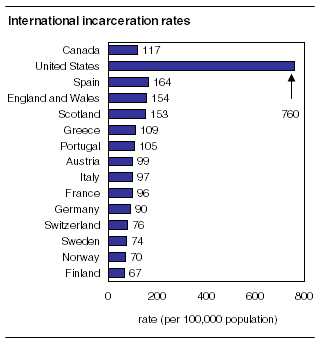
How can one say the drug war is racist? Let us start with some pretty basic numbers: Black people – men, women, and children – compose approximately 12.6% of the population of the United States. Black people – primarily black men – compose approximately 35.4% of the prison population. Anyone not living under a large stone or just arriving to Earth from another galaxy already knows America has a very healthy prison population, as evidenced by this handy chart. (For those not wishing to follow the link, the bottom line is this. The U.S. incarceration rate is over 700 people per 100,000 of population. The next highest rate is either in New Zealand at approximately 168 per 100,000 or Spain at approximately 164 per 100,000, dependent upon who is counting and which chart one examines.)
So putting folks in jail is a hobby for the American State. Putting black folks in prison, well, that's just a bonus! "Amerika" has more people in prison than any other nation on Earth, and the percentage of those people who are black and male is roughly three times the percentage of black people in the general population. Why? Again, Stossel's guest opined that this is because black people commit more drug crimes, and, therefore, get arrested more, convicted more, and incarcerated more. Each of these statements is so ignorant as to be comical, but more importantly, each of them is so cataclysmically incorrect as to be criminal, pardon the pun.
First of all, with the possible exception of crack cocaine, black people do not abuse drugs at a higher level than white people; that is, the absolute number of drug users who are black is lower. Ergo, the assertion is incorrect on its face, as evidenced by this illustrative chart from a study by The Stanford Law and Policy Review.
Here's the thing, though. It is possible (nay, even likely) that black men do get arrested more, convicted more, and incarcerated more. That does not mean that they, in fact, commit more drug-related crime. The available data illustrates rather starkly that for illicit drug use, black people are not leading the parade. (Let us, for the time being, put aside the issue of whether or not any person putting a substance into his own body can ever truly be criminal for the moment, since the overwhelming majority of Americans, and maybe even a few LRC readers may actually believe that the State establishes what is criminal versus discovers it. [Hat-Tip: Richard Marbury])
Secondly, the mathematics of drug distribution and drug production preclude the possibility that a group so small as black males could possibly be responsible at a level to justify their incarceration rate. In other words, drugs like crack and weed are produced in large quantities, but could be manufactured and packaged pretty much anywhere, assuming the raw materials are present. However, the sheer amount that is being produced and distributed suggests a larger operation than could be supported by just black folks. For more "sophisticated" drugs like heroin and cocaine, it seems that the production is almost exclusively off-shore. The finished product is then shipped into the States. Do you reckon there are lots of boats and planes berthed in the Inner City, where the predominant arrests of black males are made? Of course not. Yet, drug warriors continue to target and arrest black men, and ignorant people like Stossel's guest continue to deny that there is a racial component afoot. Notes Blow:
…no group has been more targeted and suffered more damage than the black community. As the A.C.L.U. pointed out last week, "The racial disparities [in drug arrests and prosecution] are staggering: despite the fact that whites engage in drug offenses at a higher rate than African-Americans, African-Americans are incarcerated for drug offenses at a rate that is 10 times greater than that of whites.
Black people, comprising 12.6% of the U.S. population – are incarcerated for drug offences at a rate 10 times higher than that of whites – resulting in 35.4% of the overall prison population. If that doesn't sound like an old-school racist's wet dream, I don't know what does. (Sure, all the black folks in prison aren't there for drug offenses, but the overwhelming majority of people in prison are there for non-violent drug offenses.)
Depending upon from whence one obtains the numbers, the estimated total annual drug trade in the U.S. exceeds $100 billion dollars, at retail. (Taxpayers spend approximately $70 billion a year fighting the war on (some) drugs. Both the drug producers and the drug warriors are getting P-A-I-D. Nice racket, huh?) Does anyone really think that 12.6% of the total U.S. population is buying all those drugs? Oh, please. With roughly 38.9 million people in the entire U.S. black population, if one assumes that fully half of them are drug abusers, and that those blacks account for half of the retail sales of drugs in the U.S., each of them would need to spend over $2,500 per year on drugs. Does that sound reasonable? If the assumptions are modified, say with regard to only the black folks living in cities or only the black folks of a certain age, the numbers get even more ridiculous.
Conclusion
 How is it then that so many black drug "offenders" end up in prison? Those black drug recreational drug users end up in prison because drug prohibition was likely created to snare them (among others, including Chinese immigrants, for example) and has almost always been implemented with that goal in mind. As the Stanford Law Review states, race defines the problem:
Race has been and remains inextricably involved in drug law enforcement, shaping the public perception of and response to the drug problem. [16] A recent study in Seattle is illustrative. Although the majority of those who shared, sold, or transferred serious drugs [17] in Seattle are white (indeed seventy percent of the general Seattle population is white), almost two-thirds (64.2%) of drug arrestees are black. The racially disproportionate drug arrests result from the police department’s emphasis on the outdoor drug market in the racially diverse downtown area of the city, its lack of attention to other outdoor markets that are predominantly white, and its emphasis on crack. Three-quarters of the drug arrests were crack-related even though only an estimated one-third of the city’s drug transactions involved crack. [18] Whites constitute the majority of those who deliver methamphetamine, ecstasy, powder cocaine, and heroin in Seattle; blacks are the majority of those who deliver crack. Not surprisingly then, seventy-nine percent of those arrested on crack charges were black. [19] The researchers could not find a "racially neutral" explanation for the police prioritization of the downtown drug markets and crack. The focus on crack offenders, for example, did not appear to be a function of the frequency of crack transactions compared to other drugs, public safety or public health concerns, crime rates, or citizen complaints. The researchers ultimately concluded that the Seattle Police Department’s drug law enforcement efforts reflect implicit racial bias: the unconscious impact of race on official perceptions of who and what constitutes Seattle’s drug problem . . . .Indeed, the widespread racial typification of drug offenders as racialized "others" has deep historical roots and was intensified by the diffusion of potent cultural images of dangerous crack offenders. These images appear to have had a powerful impact on popular perceptions of potential drug offenders, and, as a result, law enforcement practices in Seattle. [20] (Note: The footnotes shown reflect references in the original piece.)
This author would modify that last sentence to say "law enforcement practices everywhere." The money quote about the war on (some) drugs from Blow's piece might be, "It feeds our achingly contradictory tendency toward prudery and our overwhelming thirst for punishment." Certainly the war on (some) drugs feeds a thirst in the American psyche, but it ain't just for punishment. It reflects the same goals of which the writer spoke in the Preface to Douglass's Narrative – and it appears to be just a strong today as it was back then.
 The Missing Money