


Economics Is Fun
April 26, 2007
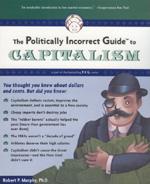 All right, so I’m not exactly the most impartial source when it comes to the Politically Incorrect Guide series of books. But that doesn’t mean I’m not to be believed when I say you should read Robert P. Murphy’s new book, The Politically Incorrect Guide to Capitalism.
Now the first book someone should read on economics is probably still Henry Hazlitt’s little classic Economics in One Lesson, whose short, easy-to-understand text teaches you how to think like an economist. But Robert Murphy’s Politically Incorrect Guide to Capitalism builds skillfully on that indispensable volume, and takes its place among the very few books that beginners simply must read and absorb.
It isn’t just that Murphy gives you an excellent introduction to everything from prices and wages to money, banking, antitrust law, and international trade — things every informed American should know about — though he certainly does. And it isn’t just that he covers topics like outsourcing that would not have been discussed in Hazlitt’s day, though this is also true. Even better is that Murphy not only doesn’t avoid the difficult questions, but he actually seems to relish them.
We all know price controls don’t work, and that taxation discourages production. Ho-hum. But how about explaining why capitalism undermines slavery, why CEO salaries aren’t arbitrary and outrageous, or why road privatization is not only feasible but vastly preferable to what Walter Block calls "road socialism"? Murphy covers them all.
Murphy writes in an easy-to-understand style, and has a gift for choosing just the right analogy. He also has a way of taking what at first glance sounds pretty radical and making it sound like simple common sense.
Take airline regulation, for example. Wouldn’t there be lots of crashes in the absence of federal regulation? Wouldn’t we all have to research the safety records of all the airlines on which we planned to travel?
(Almost) needless to say, nothing of the kind would happen. These objections, in fact, illustrate the almost embarrassing lack of imagination and common sense that develop among the general population whenever people have grown accustomed to state-directed approaches. After a while, no one can imagine how things could be done any other way — and when the rare maverick claims otherwise, all people can do is repeat, in zombie-like unison, the clichés they’ve been taught by their masters.
To the contrary, if people simply insisted on indemnification in the event of a crash, the airlines would have to take out insurance in order to be able to satisfy any claims that might arise. Any such insurance company would have a vested interest in doing (or hiring outside agencies to do) all the regulatory inquiry that makes sense — tracking the age and condition of the planes, the skill level of the pilots, and so on. The airline, seeking the lowest possible premiums (not to mention wanting to avoid the unfavorable publicity that stems from people dying on their flights), would have every reason to want a good safety record.
Ineffective or corrupt private certification would be swiftly punished, as Murphy explains:
The fundamental difference between private "regulators" versus government bureaucrats is that the former will last only if they are effective. If the insurance company’s inspectors, for example, take kickbacks from the airlines and overlook cost-cutting but dangerous maintenance procedures, this corruption will be rooted out after the first plane crash. The insurer will lose hundreds of millions of dollars (certainly more than the total value of the kickbacks), and other airlines will advertise their superior standards and lure away passengers.
When a federal regulatory agency fails, on the other hand, the response of the zombies is that it needs a bigger budget.
In the area of rail transport, a lot of people realize that Amtrak is a loser. "It loses money in every conceivable way — on ticket sales and even on its food and beverage concessions," Murphy points put. He adds that the line between Los Angeles and Orlando lost $433 per passenger. "Your tax dollars would have been saved if the line had been scrapped and Amtrak’s customers given plane tickets instead."
More importantly, though, Murphy shows why Amtrak isn’t just a fluke, and why government enterprise (so called) will inevitably be plagued by arbitrariness and waste. Forget about making government run like a business, as we’re often told — it can’t, and Murphy explains why. Meanwhile, the government officials who benefit from Amtrak, and who are perfectly happy to have the rest of the country subsidize their commute, are not about to pull the plug on the whole scam.
The ongoing debate over free trade has reached a point at which it is very difficult for the average person to figure out the rights and wrongs, the truths and the falsehoods, in all the arguments being offered. In one of the many delightful sidebars generously adorning his pages, Murphy brings home the major protectionist fallacy by quoting from Frdric Bastiat’s famous "Petition of the Candlemakers," in which makers of candles protest the unfair competition of the sun. They call for a law "requiring the closing of all windows, dormers, skylights, inside and outside shutters, curtains, casements, bull’s-eyes, deadlights, and blinds — in short, all openings, holes, chinks, and fissures through which the light of the sun is wont to enter houses, to the detriment of the fair industries with which, we are proud to say, we have endowed the country, a country that cannot, without betraying ingratitude, abandon us today to so unequal a combat."
To be sure, trade restrictions do protect the jobs of those workers who produce the protected item, just as blocking out the sun by law would benefit the candlemakers. At the same time, of course, they make consumers worse off, since the price of the protected item now increases — either because consumers now have to pay more for foreign goods (thanks to the tariff) or for domestic goods (because the tariff on foreign goods makes it possible for domestic producers to charge more). Critics of free trade assure us that this is a trade-off they’re willing to accept — and they intend to make us accept it, too, whether we want to or not.
The great body of consumers are not the only losers in protectionism. The export sector suffers as well. In addition, any firm or industry using one of the "protected" items in its own production now finds itself at a competitive disadvantage. "American car makers suffered when President Bush instituted steel tariffs," Murphy writes. "Federal sugar quotas, which make the U.S. price for sugar twice the world price, similarly drove Life Savers to move its manufacturing to Canada, where it can buy sugar from all over the world."
(Incidentally, Murphy doesn’t just repeat the standard arguments for free trade; he goes on to consider the more fashionable directions that the anti-trade argument has taken in recent years. In particular, he argues persuasively against the current-day argument that the classical assumptions behind free trade and the benefits it was said to hold for all participants are no longer valid in an age of labor and capital mobility.)
The Politically Incorrect Guide to Capitalism is positively filled with interesting insights and little-known facts. Thus, building on an insight of Jane Jacobs, Murphy shows how zoning regulations and "urban planning" by know-it-alls have actually contributed to the prevalence of crime in urban areas. He shows why NASA’s safety record and expensive failures not only shouldn’t surprise us, but should actually be expected. And he discusses the much-touted and totally misrepresented case of California energy "deregulation" — a typical episode in which the effects of phony deregulation, which kept all manner of price caps and regulations in place and may have introduced incentives even more destructive than what existed before, were perversely attributed to the free market!
 Plenty of people carelessly suppose that reading an economics book must be unspeakable drudgery. To the contrary, The Politically Incorrect Guide to Capitalism is great fun, written by a scholar with the ability to produce rigorous scholarly articles as well as to explain difficult concepts in an easy-to-understand way for the general public.
But this book is not just for you. It’s also for all the students in your life, nearly all of whom are being taught in their social studies classes about the selflessness of the American political class and its disinterested commitment to the common good. They’re learning about the workings of our form of government, in which people of good will meet in the public square to cooperate on initiatives to make all Americans better off. And so on and on, direct from somewhere on Mars to their textbooks.
 The world has plenty of zombies as it is. Original thoughts — and lots of them — are the best antidote, which is why Bob Murphy’s book is so important, and so welcome.
 Ron Paul