


Black Gold in the New Gulf
August 26, 2003
What the heck is the United States doing in Liberia? asked Justin Raimondo in a recent article, just around the time that President George W. Bush was visiting the nearby island of Gore in Senegal — the slave trading post which was the door of no return for countless black African slaves shipped to North, South and Central America long ago.
I fear that, in going to this remote hotspot to perform the abject ritual of impossible atonement for the sins of their ancestors, in emotional speeches, U.S. Presidents Clinton (P42) and Bush Jr. (P43) have established a dangerous, hypocritical ( [1] ), and truly time-wasting precedent for the holder of that office.
Let us just hope that P45 or P46, who could well be a woman, makes a sensible choice of outfit when her turn comes to deliver the now requisite speech over the under-floor, upwards-pointing air conditioning vent which reportedly kept Dubya cool while African dignitaries in their flowing and appropriately loose-fitting garments complained about the palpable intrusiveness of the frisking they had to undergo at the hands of the President’ssecurity men ( [2] ).
 Against a backdrop of politically correct self-flagellation by a bemused president who has told us that u201CAfrica is a nation that suffers from incredible diseaseu201D ( [3] ) and the perceived need for a generous spreading of liberal social-democracy, West Africa has all the ingredients for righteous intervention by the empire in its on-going pursuit of benevolent global hegemony.
Liberia, with its warring factions requiring u2018peace-keeping,’ and innocent inhabitants caught in the cross-fire, is the perfect foil for the modern-day blame and atonement game typified by Bush-Clinton in Gore. Add to this the grinding poverty, the appalling disease, military establishments requiring aid (and no doubt training at Fort Benning, Georgia), and a u2018democratic deficit’ to be made good, and you have a field day for the men of good intentions — including, so it seems, P44 hopeful Howard Dean.
It is not hard to fathom that P43 and his entourage, who visited Nigeria and other countries on their recent whirlwind tour of Africa, were really on another mission altogether. For at the end of this rainbow of opportunity for humanitarian interventionists, weapons manufacturers and self-appointed experts in u2018good governance’— lies the glittering prize of all prizes: black oil.
u201CAfrican oil is of national strategic interest to us,u201D said Assistant Secretary of State for Africa and former Scowcroft group member Walter H. Kansteiner III at a January 2002 symposium on African oil held in Washington DC and organized by the Institute for Advanced Political and Strategic Studies (IASPS), the same Jerusalem-based think-tank which in 1996 brought us Richard Perle’s u201CA Clean Break: A New Strategy For Securing The Realm.u201D This organization has been at the forefront of successful attempts to persuade the United States P43 administration that it needs to diversify its sources of oil supply, and move away from the u2018unfriendly’ old gulf (that’s the Persian gulf) to exploit the u2018new gulf’ — the gulf of Guinea in West Africa.
 u201CAfrica…u201D said congressional Sub-Committee on Africa chairman Rep. Ed Royce (R-California) at the same event, u201Cis less of a long-term threat in terms of our dependency on foreign oil. It is very difficult to imagine a Saddam Hussein in Africa… I think African oil should be treated as a priority for U.S. national security post-9/11, and I think that post 9/11 it has occurred to all of us that our traditional sources of oil are not as secure as we once thought they were.u201D (IASPS African Oil Symposium Proceedings, January 2002, p. 5)
 It might reasonably be objected that the only oil that is no longer flowing as smoothly as it once did is Iraqi oil — largely due to the sanctions applied over the last 12 years, the March 2003 Anglo-American invasion and the now sorely-troubled occupation. And as for an African Saddam, perhaps the congressman had temporarily forgotten the depredations of the late, unlamented Idi Amin of Uganda, whom we now learn was an Israeli protg,and his good friend Bokassa of the Central African Republic, both of them u2018half criminal, half clown’ who left u2018in their wakes .. tales of fantastic self-aggrandisement and casual butchery.’
Never mind. The key concepts here are that no-one, just no-one, can be worse than Saddam Hussein, and this was all part of George W. Bush’s steep learning curve: u201CAfrica,u201D the candidate boy George had said in his 2000 election campaign, u201Cdoesn’t fit into the national strategic interests as far as I can see.u201D ( [4] )
It didn’t take long for an assortment of imperial handlers, ranging from members of the Council on Foreign Relations, to Congressmen, some of his oil industry buddies, and the afore-mentioned speakers at the IASPS symposium, to put him right, for two reasons:
- The oil will run out — sooner, as his own advisers warn ( [5] ) or later, as P41’s (his father’s) advisers warn ( [6] ).
- Even if it doesn’t run out as soon as some say it will, the oil supply is u201Cnot secureu201D — too much of it is coming out of the ground in those u2018unfriendly’ Muslim countries (cue Saudi Arabia, Kuwait, Iran and even the sabotage-plagued satrapy of Iraq).
To make it secure and ensure that the gasoline keeps flowing, and just in case there’s more trouble to come in the uncongenial Middle East, the policy is now to cozy up to untapped countries where new technology has made it possible to dig for oil in deeper parts of theocean around them.
There is of course the small matter that many of them are decidedly unsavoury, like Equatorial Guinea — dubbed the u2018Kuwait of Africa’ in Ken Silverstein’s fascinating April 2002 article for The Nation ( [7] ). But that can be overlooked because, together with many of its neighbours in the new Gulf, it is now oil-rich.
Of course, we already foresee a need to protect u2018our oil’ from threats of terrorism. u201CIn the past three years,u201D as then US Air Force Lt. Col. Karen Kwiatkowski informed the symposium, u201Cwe nearly doubled [the number of] our defense attachs in the sub-continent,u201D (IASPS African Oil Symposium Proceedings, p. 26). Rep. Royce expanded on the security theme:
u201CFew Americans really appreciate that Africa is now the third largest source of our [oil and natural gas] imports. The importance of US oil production in the Gulf of Guinea points to developing a strategy to protect this production from terrorism, and this raises critical concerns about the role of the US military in the region and its relations with African militariesu201D (IASPS African Oil Symposium Proceedings, p. 7).
From this point it is but a short step to the US, in Congressman Royce’s words, u201Cexporting security arrangements to protect offshore energy resources in selected ECOMOGcountriesu201D and — who knows? — beginning to pour the concrete for a naval base.
 In the words of Congressman William Jefferson (D-Louisiana) of the same Africa congressional Sub-Committee, u201Cthese [African] countries are not averse to having us forward-place assets there of all sorts, including military assets.u201D (IASPS African Oil Symposium Proceedings, p.25)
Bring on the tiny two-island state of So Tom e Prncipe (this is pronounced roughly as u201CSowng Tomay ee Preenspu201D in Portuguese, but it can be rendered in English as St. Thomas and Prince Islands, and is usually abbreviated to STP in the military jargon).
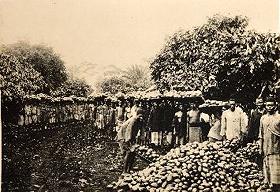 The Cocoa Harvest of So Tom — 1908 c
This impoverished former Portuguese colony of 170,000 inhabitants was known until now mainly for its cocoa plantations — it was at one time the world’s top cocoa producer. Like Gore, it was once also a place of no return for slaves brought from the African mainland to work those plantations, because there was no local labour ( [8] ).
But it is now talked of as another potential Kuwait, and has been earmarked by the imperial strategists as a possible location for the regional homeport of a future US Forces Southern Atlantic sub-command, as proposed in a list of regional security recommendations of the African Oil Policy Initiative Group’s 2002 white paper ( [9] ). That paper goes on to suggest that u201Ca US-Nigerian compact on regional security issues should be established to make the area more secure and thereby more attractive for direct foreign investment.u201D
 u201CSo Tom and Prncipe just signed a joint exploration agreement with Nigeria. Whoever thought about that little place?u201D said congressman Jefferson. u201CBut they are now estimating four billion barrels of oil in So Tom and Prncipe. And that’s just the beginning.u201D (IASPS African Oil Symposium Proceedings, p. 23).
It is just the beginning, but of what, precisely? The historical record shows that the onset of sudden large oil revenues, like lottery prize money, can be a mixed blessing, especially in poor countries. Professor Teri Karl of Stanford University, co-author of the Catholic Relief Services June 2003 report u201CBottom of the Barrel: Africa’s Oil Boom and the Pooru201D ( [10] ) was another speaker at the IASPS African Oil Symposium, and she warned:
u201CAcross the board and across regions, oil over time reduces welfare, lowers growth rates, leads to political instability of oil exporting countries, causes great environmental damage, and also buffers regimes, authoritarian regimes that are violators of rights. This is not a Middle Eastern phenomenon; it’s not an African phenomenon; it’s not a Latin American phenomenon; it’s an oil phenomenon inserted into weak political and economic institutions.u201D
She went on, u201CLet me add one more thing…. There is very powerful statistical evidence linking oil and war. [..] In a series of statistical tests World Bank economists Collier and Huffler show that the most powerful risk factor for perpetuating civil war is the export of primary commodities, particularly mineral commodities.u201D (IASPS African Oil Symposium Proceedings, p.17)
 Recent events seem to attest to the truth of these observations. Last month, STP was the scene of a military coup which temporarily deposed President Fradique de Menezes ( [11] ), apparently brought about by internal competition for the revenue to come from deep-water oil extraction in the oceans around the islands. Existing oil exploration rights are held by ERHC, a Houston-based subsidiary of the privately-owned Chrome Group, which operates mainly in neighbouring Nigeria, but, as reported by BBC News, further licenses to develop the offshore fields are due to be auctioned in 2004. Neither the oil nor the revenue has yet started to flow, yet already there is a scramble for the spoils. The doctrine of pre-emption is indeed pervasive.
To all this there is a small dose of irony. Fradique de Menezes, who was brought home and put back in the saddle by Nigerian President Obasanjo after multilateral negotiations with the coup leaders, is a former cocoa trader. So is US Assistant Secretary of State for Africa Walter Kansteiner ( [12] ).
Meanwhile, President Obasanjo has revealed that Nigeria will henceforth u2018protect’ STP through a joint military pact ( [13] ). US marines have disembarked and some of them are already u2018embedded’ (yes!) with the Nigerian military in Liberia ( [14] ), in operations which, to the apparent chagrin of the neocon Defense establishment, are seen by some as a dress rehearsal for further West African involvements of the humanitarian and nation-building variety.
 All we are missing now is the Hollywood movie version. I can already see that great actor Cuba Gooding Jr. playing the new Top Gun: as he and his girl stroll along a palm-fringed equatorial beach in u2018that poor little place’ So Tom, and the patrol boats and fighter jets roar off into the distance to fight the terrorists, the locals, as in Okinawa ( [15] ) and 63 (or is it 64?) other countries and places around the world, will dutifully service the employment-providing military base. But that’s a story for another time.
Additional Links
- Hector Igbikiowubo: West African Oil Draws Growing U.S. Interest, AllAfrica.com — July 22, 2003
- Eric Margolis: The Lion of Africa Roars, Foreign Correspondent — July 14, 2003
- Martha Honey: Bush and Africa, Counterpunch — July 4, 2003
- Charlotte Denny: Scramble for Africa, The Guardian (UK) — June 17, 2003
- Ken Silverstein: Small Houston company finds a good deal in Africa — Los Angeles Times, May 24, 2003
- International Energy Outlook 2003: World Oil Markets, Energy Information Administration of the US Department of Energy — May 1, 2003
- Jean-Christophe Servant: The new gulf oil states, Le Monde Diplomatique — January 2003
- Kevin Clarke: Our Oily New Friends in West Africa, US Catholic, November 2002
- Stephen K. Boit: Alarming Developments in US-Africa Relations, Profile Africa — November 10, 2002
- Mark Doyle: US eyes African Oil, BBC News, October 9, 2002
- Dena Montague: Africa: The New Oil And Military Frontier, World Policy Institute — September 20, 2002
- Keith Somerville: US looks to Africa for ‘secure oil’ BBC News — September 13, 2002
- Who’s Who at the Institute for Advanced Strategic and Political Studies
Notes and References
[1] Bakari Akil II: George Bush’s Goree Island Speech: Truth or Hypocrisy? — Global Black News, July 14, 2003
[2] John Dickerson: In Senegal, Bush Speaks Against Slavery — Time Magazine — July 9, 2003
[3] John Cochran: Not Out of Africa: Bush Visits Africa u2014 But Why Now? — ABC News — July 8, 2003
[4] Candidate George W. Bush on "Newshour With Jim Lehrer" — PBS, February 2000
[5] Matthew Simmons onPeak Oil and Natural Gas Depletion — transcript of May 27, 2003 speech to Association for the Study of Peak Oil (ASPO).
[6] Strategic Energy Policy Challenges For The 21st Century — Report of an Independent Task Force sponsored by the James A. Baker III Institute for Public Policy of Rice University and the Council on Foreign Relations — April 2001
[7] Ken Silverstein: U.S. Oil Politics in the ‘Kuwait of Africa’ — The Nation — April 4, 2002
[8] The story is told in E. D. Morel’s The Story of Angola and the Cocoa Islands — (extracted from The Black Man’s Burden, Manchester, National Labour Press, 1920)
[9] African Oil Policy Initiative Group (AOPIG): Africa White Paper (PDF file) — 2002
[10] Catholic Relief Services, Press Release: Africa’s Oil and the Poor: No more business as usual
[11] Coup Leaders Hand Power Back To Civilian President —UN Office for the Co-ordination of Humanitarian Affairs — July 23, 2003
[12] Ann-Louise Colgan: Walter Kansteiner, Assistant Secretary of State for Africa — Foreign Policy in Focus — April 2001
[13] Obasanjo reveals military pact with So Tom — UN Office for the Co-ordination of Humanitarian Affairs — August 6, 2003
[14] Robert Burns: U.S. to Add u2018Quick Reaction’ Liberia Force — Associated Press — August 14, 2003
[15] Alexander Cooley and Kimberly Zisk Marten: Lessons of Okinawa — The New York Times — July 30, 2003 (abstract only, purchase required to view)
 Science is the Real Opiate of the Masses