


Vampires, Money, and Economic Cycles
February 19, 2007
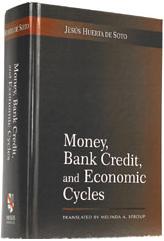 Jess Huerta de Soto has written the ultimate vampire book. He tracks these bloodsucking monsters from the first documentary records in ancient times to the modern apologia for their maintenance at public expense. At last, there is a single book that scientifically explains the origin of vampirism, the magnitude of their drain on society, and proposes a systematic plan for their humane extermination.
De Soto starts out by driving a stake through the heart of the pro-vampire argument: that somehow vampires have legal rights. He goes through old legal arguments and shows that the right of a person to keep their own blood was established in Roman times. Also, he demonstrates that the concept of "fractional-reserve blood banking" violates all logically derived legal codes. Two people cannot both own and use the same hemoglobin molecules in different bloodstreams at the same time.
That’s silly, you say? No one would ever try to establish a system where two or more people owned the same property at the same time? That’s generally true, except where vampires are involved. Now, if you look at the grain industry, the elevator operators don’t try to loan out ten times more grain than they actually have in their bins. The same principles apply in the blood industry; if you make an autologous blood deposit for an operation, they won’t loan your blood to ten different vampires so that it’s gone by the time your operation comes around. But that’s because vampires don’t control the blood storage industry; they control the banking industry.
In Chapter Two, de Soto traces the history of the vampire bank, back into Greek and Roman times. Archaeologists have laboriously dug up the dusty records of many ancient banks. The records have a unifying feature: the banks, from whatever century, were fractional-reserve frauds, and every single one eventually defaulted. And the histories of Athens, Ptolemaic Alexandria, and Rome indeed show the effects of monetary expansion and contraction.
The author points out that one overriding factor pushes bankers into fraud. Of course there is always the desire for short-term gain, but that would generally be overcome by the desire for good reputation and long-term business. The deciding factor is the threat of confiscation by government. Banks with actual precious metal in their vaults were more tempting targets for gangsters like Alexander, Caesar, Herod, Cleopatra, etc. than "banks" which had loaned out their reserves a couple of times over. Fractional-reserve banks offered an opportunity for cooperation with the gangsters, in the form of armed force against depositors who wanted their money back.
The history lesson continues into the late Middle Ages, where we are shocked, shocked to find that the Medici banks were not completely honest. So dishonest were the Italian banks that they caused a decade-spanning economic collapse right before the Black Death.
Then in a bizarre twist we have to suffer through the story of the Bank of Amsterdam and a 150-year period of perfect banking honesty. No panics, no cheating, no economic cycles, just steady economic progress through revolutions, wars, and disasters of every kind. (Don’t worry, it’s the only known example of such length).
Chapters 3—8 could be called "You can’t eat your cake and have it too." You may think a long theoretical explanation of this unnecessary… but go ask your brother-in-law how banks work. He will loudly explain, using his thousands of hours of instruction from TV and the business pages, that the "money multiplier effect" creates prosperity, prevents Depressions, and slices our cake for us. He will also be asking you for large "loans" during the upcoming recession. Let me try to summarize the important points that he needs to know now (while you inform him in advance that you will be making no fractional-reserve loans):
What Your Brother-In-Law Should Know About Fractional-Reserve Banking:
- The economic damage is done during the inflation. Not the recession, the inflation. It’s the inflation, stupid.
Politicians and central-bank bureaucrats like to pretend that only deflation is the bad guy; poor ol’ inflation is totally innocent, even beneficial. They claim to be "experts" at "keeping the boom going," "keeping the economy from overcooling," etc. etc. However, if you look at the flow of real resources, it is easy to see that printing more money doesn’t create more oil, silicon, etc. The economic damage is done the instant the first dollar of freshly printed cash lands in the bank vault and is loaned out to ten different businessmen. The ten newly optimistic entrepreneurs immediately run out and buy things. Now they have those things, and you don’t.
Then the damage is made worse. Not only do they reduce your access to real resources, but the overoptimistic dot-commers (e.g.) now organize those resources for a fantasy economy; an economy much bigger and richer than the real one. This causes them to buy more and different capital equipment than the actual economy wants. Eventually they are all set up to produce products that aren’t in demand, and find that people don’t buy their products. This is called "recession," and is actually the time when the economy repairs itself. The repair process involves devaluation of the misinvested capital resources, and unemployment (which is a devaluation of misinvested human resources).
- (There is no "2." It’s the inflation, stupid.)
BTW, this is where we are today. The Fed has printed piles of money during the Clinton-Bush years. The capital structure contains piles of misinvestments. Now, either there has to be a reduction in inflation, and a recession while we reorganize our resources to produce for the consumers that actually exist. Or the Fed can just keep increasing the rate of the presses and print us into a hyperinflation, like Weimar Germany or Chiang Kai-Shek’s China. If they can’t find businessmen to borrow and malinvest, they can always find politicians ready to launch expensive WMD searches… at least until we run out of nations that don’t have WMDs.
The last chapter of Money, Bank Credit, and Economic Cycles points out that we don’t have to live like this. We don’t let grain elevators lend out ten times more grain than they have, then back them up with tax-supported bailouts. We don’t let vampires run the blood banks. If we didn’t let vampires run the money supply, then systematic malinvestment and recession would be a thing of the past. The cost of wars would be harder to conceal as well. No wonder vampires like fractional-reserve banks.
The book is free online, an anti-vampire service of Mises.org.
 Update on the Empire