


Killing Hitler
July 4, 2006
We are told that the purpose of the Forever War in the Mideast is to promote peace. We are told that the error made by previous U.S. governments is that they did not launch enough pre-emptive strikes on other nations. The most clichéd example is that of Hitler. Oh, if only someone had killed Hitler in 1938, the world would have been spared World War II, the Holocaust, and the majority of evil in the world.
In the age of cheap nuclear weapons, this argument is even more persuasive. A dictator rising to power in Britain or France could reduce U.S. cities to rubble and kill most Americans not familiar with anti-fallout precautions (about 99% of the population). And, of course, there are the already existing autocratic kleptocrats of Russia, China, Pakistan, Israel, North Korea, etc., all of whom receive billions in official and unofficial U.S. aid to assist them in maintaining their nuclear weapon stockpiles without the inconvenience of increasing the level of economic freedom of their oppressed subjects.
Today’s threats have the potential to do far more damage than Hitler. The question is, are we bound to support a policy of pre-emptive wars in order to prevent future Hitlers? Must we bomb France? After all, France actually has WMDs and a history of imperialist expansion into this hemisphere.
Or perhaps the U.S. policy of Aid To Dependent Dictators actually creates more proto-Hitlers each year? Is there another path, a way that doesn’t depend on placing any group of politicians above the law, in the hope that they might protect us from nastier politicians?
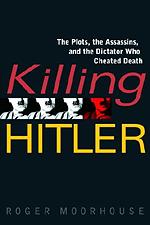 It may be instructive to study the case of the original Hitler. Did governments of the time actually try to remove Hitler? Or did they treat him as just another member of the club, a good ol’ boy engaged in the gentlemanly arts of demagoguery, war, and tax collection? Fortunately, Roger Moorhouse has collected all the attempts on Hitler’s life into one volume so that we can fairly evaluate this question. The book is fairly short for lack of material; in general, governments made no serious attempts to kill Hitler. The stories of the private assassination attempts are more interesting.
In 1938, an ordinary German carpenter named Georg Elser was convinced that Hitler was going to plunge Germany back into war. Elser decided to kill Hitler. He set about his task in stereotypical German fashion, sensibly and methodically.
First, he traveled to Munich for the observance of the November 8 anniversary of the 1923 Beer Hall Putsch, an important Nazi holiday. Hitler was obliged to give a speech at the Burgerbraukeller for these festivities. Elser simply went in afterward and bought a beer. He observed the position of the speaker’s lectern and the structure of the hall. Then he went home and got a job in a quarry that used explosives.
In August 1939, Elser moved to Munich. Every evening he bought dinner in the Burgerbraukeller. After each dinner he hid in a storeroom until the employees left. Then he emerged and worked all night, constructing a hidden cavity in a pillar behind the speaker’s dais. On November 2, 1939, he installed a large homemade bomb. On November 5, he set the timers for the evening of November 8 (remember this is a German bomb, he had a backup timer).
On the evening of November 8, Hitler entered the Burgerbraukeller and gave his speech. Unfortunately, he was an hour early. Due to bad weather, he had decided to use the train instead of displaying his high-tech flair by flying. So he left the hall at 9:07. Elser’s bomb went off exactly at 9:20, not only blasting the lectern but bringing the whole gallery down onto the dais. Instead of killing Hitler and other high-level Nazis, he got only a few low-ranking supporters. (What, you thought this story was going to have a happy ending?)
Elser missed… but not by much. He demonstrated that any individual who put a few months of their time into killing Hitler would have a pretty good chance of success. Unfortunately, as the rest of Moorhouse’s book shows, the major governments of the world never spared as much as one full-time carpenter to kill Hitler. Stalin put elaborate assassination nets in place, but then carefully avoided any harm to Adolf, probably fearing a less destructive leader would make Germany more powerful.
The democratic Allies did no better. The British demonstrated that they could assassinate even the highest-ranking Nazis deep inside Eastern Europe, by killing Reinhard Heydrich. They produced James Bond weapons like the Welrod pistol and distributed them to resistance movements, and assassinated Nazi small fry all over Europe. But though they did a feasibility study ("Operation Foxley") on shooting Hitler at his retreat in the Alps, they too left him strictly alone. On April 25, 1945, the British launched a poorly planned exercise in futility by sending 375 bombers to blast Berchtesgaden. The results were the same as the attacks on Saddam Hussein at the beginning of the Iraq War; the dictator was nowhere nearby.
The American politicians followed the British lead. As the sharpshooting soldier says in Saving Private Ryan, they preferred to spend billions on killing ordinary Germans rather than sending in one sniper to Berlin. (Killing Hitler makes it plain that Hitler drove openly around Berlin until quite late in the war; he would have been no harder to hit than Heydrich).
Governments, whether "democratic" or openly totalitarian, are all driven by the same evolutionary laws. They gain power by maximizing the length and cost of wars.
"War is the health of the State" is a truism because it is true. Governments create and maintain Hitlers; if they remove one it is usually only to install another. (Ask the Poles and the Czechs how much they "benefited" from World War II).
 Private protection companies as envisaged by the Tannehills, L. Neil Smith, or David Friedman, offer a different dynamic for the 21st century. They would be driven by competition and the profit motive to hold down costs and reduce collateral damage to the minimum. They would actually have the means and motivation to remove the genocidal Hitlers and Stalins of the world… and the firebombing Churchills and atom-bombing Roosevelts as well. "Wars" in the 20th century sense of slaughtering children might be eliminated as thoroughly as smallpox.
Taxpayers around the world pay something like trillion dollars a year for "defense." The U.S. taxpayer pays around half the total (possibly a little less if you use more realistic figures for the economic cost of draftees in China et al.). With the possible exception of the Swiss, most of these taxpayers get no increase in personal security for their money. It’s time some entrepreneur stepped up and offered a better deal: "All dictators removed, no tyrant too big or small. We take Visa."
 Blasphemy in Song