


The Coolest Christian Movie Ever
April 1, 2008
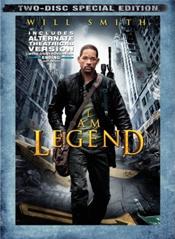 I’ve been meaning to see the "Zombie movie" that many people, especially kids, had been telling me about. I had seen the trailers and it looked rather typically apocalyptic. New York looked intact but no one was there. Will Smith was wandering around trying to find someone, and the plot line seemed obvious. Some bugaboo would emerge that he would fight and blah blah blah.
No thanks.
Well, I watched it anyway, and found it impossible not to watch. The scenes of New York depopulated but otherwise intact are riveting. The acting was great. The viewer shares in the loneliness of the last man on earth. Something about the whole movie just goes straight to the gut.
It turns that this is based on a 1954 novel. It is the third time it has made onto screen. I had not read the book nor seen the other films. What happens is different from what I expected.
A scientist finds a cure for cancer but there is an unexpected result: a virus is unleashed that wipes out nearly all of humanity. Only a few people are immune, among them Robert Neville, who was an official in the New York government who stays behind during an evacuation. He believes that he is the last man on earth.
The people who once populated the city have the virus, which turns them into animal-like flesh eaters who are enormously powerful but regard light as a poison and so only come out at night. They would instantly kill Neville if they found him, but he has calibrated his life so that he only goes out during the day, carefully returning home before the sun sets.
Neville lives off the food that others kept in their houses, and works in a basement laboratory to find a cure for the virus. In seeking the cure, he works from his own blood, which is immune to the disease. Following him from day to day is frightening and fascinating. Indeed, it is terrifying.
The first inkling that this whole movie is a Christian metaphor comes during a surprising flashback scene as Neville says goodbye to his wife and daughter. They pray a Christian prayer together, on screen and with sincerity. This startled me. In fact, I’m not sure that I can remember any major film that employed sincere prayer as a passing moment in a plot line.
The absence of prayer in movies is absurd, once you think about it. What do all people in the world, in all times, do when facing terrible trial and death? They turn to their own faith tradition and seek God. Why do they not do this in movies? Maybe producers consider it a distraction that would only introduce unnecessary controversy. In any case, it works here, making the movie surprisingly believable.
It wasn’t until the next day that I began to piece together the ways in which this wasn’t just a passing reference but a hint to the story behind the story. The next clue comes at the end, and here I will have to introduce the spoiler.
Another person shows up to find Neville, a woman with her child, in the hope of taking him to a Vermont colony of survivors who are living behind huge iron gates. Neville explains that he has to stay in New York to find the cure. He shows her his lab and the mutant specimen he has been testing on. They have a discussion about how it is that she came to find him. She says that God sent her. He blows up in anger and gives the case for atheism: No God would permit a holocaust of billions of people. She, on the other hand, has hope for rejuvenation. Her faith in God is not shaken, and it is she who wins the argument in the end.
Later that day they are attacked by an army of mutants (who found the house because the woman drove to it during the night) and retreat to the lab. There they find that the specimen is improving and that therefore he might have found a cure. In desperation, Neville takes some of the blood of the specimen, which now contains the cure he found by investigation the immunities in his own blood, and puts it in a vial.
He hands the vial to the woman and shows her how to escape. The cure is in this blood, he says. He then gives up his life, blowing himself up with the attacking mutants to spare her. The woman then arrives at the survivors’ compound and hands over the blood. Humanity is saved, thanks to Neville’s sacrifice. He narrator says that the lesson is to always let “the light shine in the darkness.”
So with the blood we have our second clue. The blood in the film, immune from disease and capable of providing the cure, represents the blood of Christ, whose life was sacrificed for the salvation of humanity. Then the pieces begin to fall into place. The mutants represent the humanity that is reprobate, poisoned by the effects of sin. They thrive only in the dark, and live off others, even unto their own personal destruction. Here we find the Christian view of sin.
And the survivors? They are immune. Why? It is not clear, but they must stay away from the mutants in order that they remain safe. Now, in this extreme bifurcation between the saved and the damned, we have not so much orthodox Christianity but an evangelical/Calvinist view. A more traditional view sees the Christian life as more of an ongoing struggle, with no clear separation between the saved and the damned until the last day. Salvation is a process, not a one-time event. Nonetheless, the Christian source of the idea of sin and redemption is clear.
There is another scene in the film in which Neville is doing physical training, doing pull-ups from a bar, the kind that focus on the back muscles. His legs are curled up. The camera pans back to show his arms stretched wide and his amazing physique. I thought at first that this scene was wholly an expression of vanity. In retrospect, it becomes clear: this was a metaphorical representation of the crucifixion pose. Neville is the Christ-like figure who gives his life so that others can be saved. Neville was in New York three years. Christ’s ministry was three years. (I owe this point, added after publication, to a reader.)
At the end, we see the colony of survivors for the first time, living peacefully in a small town. We have an aerial shot of the town. And what dominates the town? A church, with a tall steeple: the faith at the center of their lives.
 Now, to be sure, there is nothing preachy about this film and the metaphor is easily lost on audiences. I could not find reviewers who seemed to notice the fullness of faith in the film, except for smarties who have complained that the ending was changed in order to Christianize the film.
In this case, the complainers are right: the theme is undeniably obvious. The film, as I said, is terrifying, but there is no "bad language" or sex, and it is perfectly appropriate for teens and up. If Christian congregations care about imparting the dangers of sin and the blessings of redemption, they would do well to recommend this film.
Jeffrey Tucker [send him mail] is editorial vice president of www.Mises.org. Comment on the Mises blog.
 Another American War Crime in the Making