


How To Live-Blog
February 10, 2009
If it is precision and analytical rigor in ideas that you want — and you value this more than anything else — you have to turn to the old masters, the tenured professors who have turned over a field a millions times in their heads and explored every angle. You study the great books with patience and care.
That’s not the only way to learn, however. Another way is through sheer reckless discovery and abandon, at your own pace and in your own way. Make your thoughts live and you have a chance to inspire others to do the same.
It’s the same with any field. You can discover music at the conservatory through theory classes taught by masters. Or you can go to concerts and let the living thing itself wash over you and through you, forming impression and emotions and spawning new ways of understanding.
There is a role for both, in my view.
The second, reckless but evangelistic, way to learn and share knowledge is called the live blog. It began with concerts and events. People attend and blog their impressions as they look and listen.
It is a great way to help the writer gain conceptual clarity about an event and its significance. It is also enormously fun for the reader to read. You feel like you are both at the event and that you are touring the impressions of a single person in attendance.
You can do the same thing with a book, and produce something that is really very new, a running account of the progress of the book and your own interpretive response to it. The idea is not to provide a thoroughly accurate account of the contents but rather to document your own response to the content as you read, chapter by chapter or even page by page.
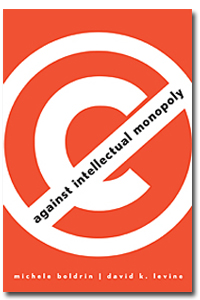 It was my great pleasure to do a live blog of Michele Boldrin and David Levine’s stunning new book, Against Intellectual Monopoly. Even before beginning the live blog, just touring the book gave me thoughts which I wrote up in a series of pieces. Then I began at the beginning to do the authentic live blog.
I must say that it was far more than I bargained for. It is not easy to read well enough to provide a good summary, to find the best arguments and make them in your own way, and to spell out the lessons you take and the remaining questions you have. I found that the entire project completely possessed me for a full two weeks, and I felt a sense of utter collapse after. It was invigorating and challenging and exciting — the intellectual equivalent of boot camp or a two-week mountain hike or a marathon run.
You find that once you commit to doing it, you can’t turn back because it is all public. To give in to laziness or exhaustion is to admit failure to the reader, which you cannot do. So the venue alone inspires you to go the full way. It provides a much-needed discipline to the way we learn. It is also a humbling exercise, since you are not writing as the great expert in a particular area but rather as a student and learner who is getting his or her bearings.
It strikes me that this method of learning (and teaching) has much going for it, and could be used more broadly. It is far better than a book review, for example. Quite frankly, it annoyed the heck out of me when I read other reviews of the B/L book. It was perfectly obvious that the reviewers had not actually read the book. Instead they glommed on to a few points and then riffed off what they already knew to criticize the book.
This is just disgusting, in my view. Disgusting, but I do understand how it is that people come to do this kind of thing. It is tempting to review a book without reading it. Keynes, for example, did this to Mises.
So a live blog is a guarantee against the loathsome practice of daring to pass judgment on a book you haven’t read — a practice that is more common than you might think. A live blog at least conveys to the authors the compliment of taking their book seriously enough to consider it in detail.
 All ideas need that upward motion, that sense of newness, in order that they can compel understanding and inspire advancement. To hear about new ideas from another who is just discovering them, piece by piece, provides just that lift. Live blogging provides that, so I can’t recommend it highly enough.
There is no one way to do this, any more than there is one path to learning or one way of thinking. It will be different with every writer.
Take the challenge! The results are extremely gratifying.
The Mises Institute is offering a free book from its catalog to anyone who is willing to make the commitment to live-blog it in detail — positive or negative. Write me with your suggestion and give a link to the spot on the web where you will blog it.
What’s next on my own list is hard to say. I’m thinking of Guido Hlsmann’s overlooked treasure, The Ethics of Money Production.
Jeffrey Tucker [send him mail] is editorial vice president of www.Mises.org.
 Obama Is Making You Poorer