


Back to Basics on Property and Competition
February 3, 2009
Zeroing in on a topic like “intellectual property” offers a chance to clarify fundamental notions in economics generally. You think you understand something like property rights or the nature of competition — you have studied the ideas for years! — and then a challenge comes along that blows everything up. It’s an opportunity. Time to think and think again.
Is there really property in ideas and, if so, what rules should govern it? Is it really necessary that such property be protected in order that competition be kept fair and just and efficient?
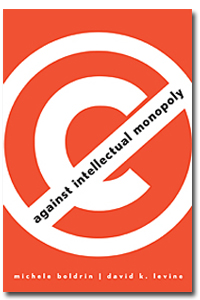
The authors of Against Intellectual Monopoly state at the outset of chapter six that property is a great and indispensable thing. It allows people to own, develop, be creative, profit, and build a prosperous society. Societies without private property stagnate and die.
Property rights are necessary too when there is a limit the number of things in question. But owning a thing doesn’t prevent others from owning other things too. For example: cars. They must be allocated through property rights because there is a potential for conflict if they are collectively owned. But my owning a car doesn’t prevent you from owning a car. There is no coercion involved in the institution of ownership.
The authors make a very important point with regard to ideas. If you have an idea, it is yours. You can do with it what you want. If you share it (sing, speak, broadcast, let others see the products of your ideas), others then have copies of it. They are entitled to do with their copies of the idea precisely what you can do with your idea. They can use it how they want provided they don’t prevent others from doing with it what they want. This is a simple application of the non-aggression principle that governs a free society. Whether it is fashion, language, know how, or whatever, people are free to copy.
Ideas, then, are what Mises calls “free goods”: copies are potentially limitless. They “do not need to be economized.”
“Intellectual property” is the completely wrongheaded idea that, in the words of the authors, someone has the right “to monopolize an idea by telling other people how they may, or more often may not, use the copies they own.” This strikes at the heart of progress because it means not improving what exists but rather prohibiting others from using and improving it.
In the same way that property is good, competition is also good. It inspires people to strive for excellence, and to measure their progress against what others are doing. It allows people to try and fail or try and succeed. It permits people to learn from each other, looking at what others do that is successful and emulating them. This is how society leaps forward from stage to stage: how we went from horses to engines, how plumbing came indoors, how industry took over from agriculture, how the digital came to be.
Competition is predicated on the ability to learn and copy. If you think about it, this is essence of daily life. We watch how people do things and learn from them. We get on the subway and hold the stabilizing strap a certain way. We follow fashion sense. We watch the food network. We listen to our professors and talk to other students. We read and absorb the ideas of articles on the internet. The newly taught person becomes a competitor: the student becomes a professor, for example. The protg is always a threat to the monopoly previously held by the mentor.
What can you copy? Anything and everything. This is not “taking” anything from anyone. The original idea owner still has his. Other people now have their copies, and are free to improve it.
 Commerce is part of this stream of life, and, in fact, learning through imitation and improvement is even more crucially important if we want to sustain a rising population with ever better health and well being at their disposal.
Let’s say I write a book and publish 1000 copies. They are all mine. When I sell one, I now have 999 remaining and the new owner of the one book, in a free society, is free to do with his copy what he wants: use it as a placemat, throw it away, deface it, photocopy, and even republish it. You can even re-republish it under your own name, though that would amount to the socially repudiated vice of plagiarism (vice, not crime). The new copies, which always involve some cost, compete with old copies.
What are the advantages of living under intellectual freedom as described above? The authors list three main ones. 1) The number of copies is more plentiful and that price is thereby lower, which helps consumers. I like this point because it underscorces that IP is really what the old classical liberals denounced as a “producers’ policy” like protectionism or industrial subsidies. It beefs up the bottom line of specific firms at consumers’ expense. 2) The initial innovator still earns money as in the perfume or fashion or recipe industry, 3) “The market functions whether there is one innovator or many — and socially beneficial simultaneous innovation is possible.”
The authors give the example of Mozart and Beethoven, who published without IP but did very well by being the first to market. This is the source of profits. It’s the same today with products such as the iPhone. It was the first-time market, and Apple made a killing, enough of one to have inspired and ratified the initial innovation. Now they are attempting to prolong their period of monopoly profits by considering patents suits against imitators. Society is certainly not better off under these conditions. As the authors say, “the goal of economic efficiency is not that of making monopolists as rich as possible; in fact, it is almost the opposite. The goal of economic efficiency is that of making us all as well of as possible.”
Others generate all kinds of arguments to show that competition doesn’t work. For example, we are told that very high costs are associated with some investments, and so monopoly is required in order for investors to make a profit and thereby have incentive to invest and innovate. The authors cite the cases of shoes and gasoline. Building a shoe factory or an oil refinery plant is a very expensive undertaking, and competition is everywhere. But somehow no one suggests that these must thereby be produced under monopoly conditions. I suggest that reason is that we live and experience competitive conditions in these industries; it is so difficult for people to even imagine freedom where it doesn’t exist.
I recall a story told to me by an economist who was serving as an adviser to a former Soviet satellite state. He advised free labor markets and privatization. Officials objected that this wouldn’t work because people might build plants where there are no workers. He said that people would just move to the places where capital is most profitable for labor. The officials objected that they couldn’t possible allow the freedom for people to live wherever they wanted; this would amount to an intolerable kind of anarchy. They just could not imagine how such a system could work!
 There are advantages to being the first mover in markets, and here is the main source of the innovator’s profits. But there is no reason to freeze the market process right there. In many ways IP represents the same fallacy that antitrust does: it takes a snapshot of the economy in one stage and evaluates it and manufacturers a policy response. Antitrust tries to break up what only temporarily appear to be monopolies; IP attempts to create and sustain monopolies over time. Competition, in contrast, let’s the market work as an undirected and uncontrolled and rivalrous process of discovery, emulation, and creativity.
Will some firm suffer under competition? Of course. “Competition is not a gala dinner,” write Boldrin and Levine, “and getting rid of inefficient firms while allowing efficient ones to blossom is exactly what competition is supposed to accomplish.”
The chapter ends with a hymn to imitation as a social force. These few paragraphs are so important that they need to be the subject of excerpting in total in a Mises Daily. What they imply is something that I believe has been overlooked by classical liberals. It is a foundation of social order. And that gives us three talked about this chapter: property (which gives rise to exchange), competition (a species of cooperation), and imitation (learning through emulation).
Jeffrey Tucker [send him mail] is editorial vice president of www.Mises.org.
 Real Change, Real Stimulus