


Inflationary Depression
April 2, 2009
Peter Schiff Interviews Marc Faber
Dr. Marc Faber runs his own business, Marc Faber Limited, which acts as an investment advisor and fund manager. He publishes a widely read monthly investment newsletters The Gloom Boom & Doom report which highlights unusual investment opportunities, and is the author of several books including Tomorrow’s Gold — Asia’s Age of Discovery which was first published in 2002 and highlights future investment opportunities around the world. Dr. Faber is also a regular contributor to several leading financial publications around the world. A book on Dr. Faber, Riding The Millennial Storm, by Nick Vittachi, was published in 1998. In late February, Euro Pacific President Peter Schiff interviewed the eminent economist Marc Faber by telephone from his office in Hong Kong.
Q: Marc, many thanks for taking the time for this interview from your busy schedule. I’d like to start with some macroeconomic questions, and then talk about some of the investment implications of the larger macro questions. Let’s start with the stimulus and bailout, which is very much on everyone’s mind. What do you think are the long-term effects of the stimulus and bailout proposals on all the Western countries, including the U.S.?
MF: Well, first of all, there are lots of academic studies on bailouts and stimuli; and also on money-printing. And, in terms of fiscal spending, bailouts usually don’t work. When the government sits in and tries to offset sagging private demand with government demand, it usually does not work. This is the pattern we have seen in the past. The long-term effect on the US economy from all the bailouts and deficits is basically that government’s debt will rise very substantially and the balance sheet of the Fed will expand. Many people think that the global recovery will begin in late 2009. I seriously doubt that. I think it will be at least two years from now, worst case maybe 10. And when we do start recovery, interest rates will rise and inflationary pressures will be enormous.
An economy always fluctuates around the trend line. If you try to postpone recession the way the US government has tried to do, then one day you will have a much bigger problem. If you postpone recessions through deficit financing, or through easy monetary policies, then obviously you have very strong debt growth as we have had in the US. Debt as a percentage of GDP has expanded from 130% in 1980 to 360% today. This does not include the unfunded liabilities arising from pensions and from Medicare and Social Security.
The best that the government could have done would have been to take a more severe recession in 2001, and then all the excess that followed would not have occurred. Now, we have an environment where the patient has died; no matter how much stimulus there is, it’s not going to revive the economy.
Q: Does this mean that in the longer term we’re going to see an inflationary environment?
 MF: There is no other way for the US but to inflate. It’s not a desirable policy, and it has in the end disastrous social consequences. But given that we have a money-printer at the Fed and an Administration that wants to expand the role of government as a percentage, the result will be, unfortunately, inflation.
Q: Are we looking at the same kinds of inflation we saw in the late ’70s, or not quite as bad?
MF: My view is that, eventually, we will see a much higher inflation rate than in the ’70s. In the short term, because of the collapsing asset market and increased savings rate in the US, we will see deflationary pressures. But in the long run, we’ll have a much higher inflation rate. That will be negative for US bonds and equities.
Q: Not a pleasant picture. Are there any other bubbles on the horizon?
MF: Basically, we always have bubbles and investment mania in the world. Even in the 19th century, under the gold standard, from time-to-time investment manias and bubbles developed in railroads and in canals and in real estate, just to name a few. Under a fixed monetary, or gold, standard, where the quantity of money cannot be increased indefinitely; there is a natural limit to the scale of the crisis. Usually when there’s a boom in one sector of the economy, you have some kind of deflation somewhere else; that was also the case in the 1970’s. We had a boom in commodities, but bond prices collapsed.
What Mr. Greenspan and Mr. Bernanke have achieved is historically quite unique. They have managed to create a bubble in everything, everywhere in the world: in real estate, equities, commodities, art, worthless collectibles; even bond prices continued to rise as interest rates fell due to the loose monetary policy. Since 2007 and 2008, everything has collapsed. But government bond prices continue to rise, and went ballistic between November 2008 and December 2008, when 10- and 30-year Treasury yields collapsed. So my view would be that this was the last bubble they managed to inflate. From here on, the government bond market will fall. In other words, the trend will be for interest rates to actually go up.
Q: If you were the Chairman of the Fed or the Secretary of the Treasury, what would you recommend now to the Congress?
MF: I think the best move would be to resign, but that aside…
Q: Unlikely.
MF: The problem is that no officials in the US are telling the truth. Let me give you an example: The elderly statesman in Singapore, Lee Kuan Yew, immediately said in last September, “we’re going to face very tough times; we have to tighten our belts to stay competitive.” This is something no president in the US will say: that you have to want for a few years, tighten your belts, and endure some pain in order to safeguard the country’s economic health — for the sake of your children and for the sake of the nation as a whole.
Neither party in the US nor any elected government official dares to tell the electorate how disastrous conditions in the country have become. Ill-conceived policies by the last few administrations, Republicans as well as Democrats, were designed to stimulate consumptions. As a result of these policies, we will now have a period of subpar growth for quite some time. The government’s policy should have been to stimulate capital formation, education, and R&D, and to encourage people to save.
 If I had been Fed Chairman, I would have kept interest rates at a much higher level after 2001. I also wouldn’t have cut interest rates as aggressively as Mr. Bernanke did after September 18, 2007. Don’t forget, low interest rates actually hurt savers. There are a lot of people in America, like retirees, that have money on deposit, and now don’t get much interest on their deposits. So it basically forces them to speculate.
If I were at the Treasury, I would let the financial institutions that overly leveraged themselves and gambled with other people’s money, like AIG and Fannie Mae and Freddie Mac, go bankrupt. You can still protect depositors and the policyholders of these companies. But let the system, through the market mechanism, deal with the problem.
Q: It looks like Iceland’s on its way to bankruptcy. Do you think there are any other countries that are going to be in a similar shape to Iceland? Which countries are vulnerable?
MF: I’m sorry to say I think the whole world is an Iceland. I think we have countries like Britain and Ireland and Switzerland that have problems similar to Iceland, though they’re not as bad as Iceland. Basically, Iceland became a huge hedge fund. They raised money in the international capital market; they then leveraged that money to buy assets all over the world. So, when asset prices stopped rising, banks and institutions in Iceland had a major problem. Banks were some of the worst offenders. They raised money from depositors, and by issuing bonds and certificates of deposit. Then, they gambled on poor investments, believing that markets couldn’t fail. They are children of the bull market. But when asset markets started to turn down, they were screwed. The value of their assets had declined, whereas their liabilities remained at the same level. That’s why so many banks are insolvent.
Q: Can America learn anything from Japanese stagflation, the “lost decade” as many people call it?
MF: I think the Japanese had a peculiar situation. First of all, the stock market in Japan was probably more overvalued than the US market in the year 2000 or in the year 2007. Also, the real estate market was in “cuckoo-land” in Japan. The good thing about Japan after 1990, when the recession hit and a period of no-growth began, is that the typical household never suffered very badly, for the simple reason that prices for assets, things like golf course memberships, nightclubs, housing prices, etc., all went down. So, their salaries didn’t rise any more but stayed at the same level, and everything fell in price — we had deflation. So the typical household actually increased its standard of living.
In the US, the problem is that the household sector is terribly indebted. That wasn’t the case in Japan. In Japan, the corporate sector was indebted and the banks and real estate companies were overleveraged, but not the household sector. And the household sector in Japan still had a savings rate of around 12 percent when the recession started. In the US, the household sector had stopped saving out of current income throughout the 1990s. In 1990, the saving rate was nine percent; then it went to zero. Now, the savings rate will have to go up. The household sector will realize that savings out of illusory asset price gains, like stocks and real estate, are not permanent; and therefore, if we want to have money for retirement, we have to save money from current income. And that has, of course, a negative short-term impact on the economy.
 Q: Marc, I’d like to ask you now a few investment questions. I assume that your investment philosophy flows directly from your economic point of view. If you were a US-based investor with a five-year investment horizon, how would you allocate your assets now, and might you make a change with them in a year or two?
MF: It would depend obviously on the cash flow of that particular investor, his risk profile, if he has real estate or a pension account, or is he well-insured and this and that; so there are many different factors to consider.
Q: Let’s assume he owns his own home, he’s not overly leveraged, and he has a job.
MF: In general, I don’t like stocks. The Japanese market, as an example, is at the same level it was in 1981. So it’s 30 years behind. If the US just went down to the level of 1990, the S&P would be at 300. It indicates that the Asian markets are at either 20 year lows or 30 year lows. The dividend yields on Asian stock markets is about three times the bond yields in those countries. Relative to the US, Asia is quite inexpensive. So I think that, yes, emerging economies will be a place to look, and I would allocate probably now, ten to 20 percent into emerging economies.
Also, the commodities have totally imploded. The shares of mining companies and exploration companies and resource producers have also totally collapsed. Since November 21st, however, some stocks like Freeport-McMoran and Newmont have roughly doubled in price. They’re not quite as attractive as they were two months ago. And I would still own some gold, say ten percent in gold.
Q: Now, would that be in physical gold, or would that be in an ETF, or individual mining companies?
MF: The mining companies are cheaper than physical gold, but the mining industry has its own set of problems. I would own physical just as insurance, because we cannot trust central bankers anymore — every person has to be his own central bank. I have a negative view of the US dollar in the long run, as I expect a revival of inflation. To some extent, I think real estate will protect you; in particular, I would prefer to have real estate in the countryside, rather than in the city.
Q: Would you consider, as a US investor, real estate overseas? I know there are some REITs in Singapore and in Australia that have a terrific yield.
MF: Yes, these yields will come down because they will have to cut the dividends. But say in Singapore you have REITs that yield 15 percent. So even if they cut the dividend, I think they will still be good, because the bond yield in Singapore is less than two percent. Even at five percent yield, in what I would consider a very solid currency in a very solid country, REITs would still be attractive. Singapore is probably the richest country in the world, everything considered.
Q: Global equities ten to 20. So that adds up, if you figure about 20 percent for resource stocks, to about half of the portfolio. Would you have the rest of your money in cash?
MF: Yes, in cash.
Q: Which currencies?
MF: Well, in the short term, I think the US dollar is okay. But obviously at some point it won’t be okay. But right now, I don’t see how the US dollar will totally implode.
Q: Do you prefer the Asian markets in general over the US markets.
MF: I ought to have mentioned this before: in Asia the valuations are more compelling, because the markets are back to 20 year lows or 30 year lows, and because the dividend yield is three times the bond yield. We have in Asia a lot of companies that serve the domestic markets. They produce cigarettes or beer or food. They’re not going to be affected that badly by the global slump. The valuation of the stocks may be affected, because obviously there is liquidation; but I think that their fundamentals are sound, and that they’ll survive under any environment; and that you will make money, and in the meantime, you’re receiving the high dividends.
Q: In general, would you say that dividends in Asian companies are more sustainable than yields with US companies?
MF: As I said about the Asian REITs, they will probably have to cut the dividends. But if you produce, say, food in Thailand, I don’t see that the global recession would have a huge impact on food sales in Thailand. It would have some impact, but not huge; so these dividends are relatively safe in many cases.
Q: In terms of commodities, do you prefer any sector over another? Agriculture or energy or metals or…
MF: Well, I think that oil is now again at a relatively low level and I would probably play the oil market by buying oil exploration companies. And I think agricultural commodities have come down a lot again, and maybe there are some opportunities there. But as I said, I’m not an expert on each commodity. I think sugar is quite attractive at this level. The problem is for the individual to play the commodity markets if he doesn’t have a commodity-trading account and he can’t buy and sell, he gets stuck because he has to stay the course. And so for individuals the best way to play commodities is to buy a good mining company, a good oil company, or a good exploration company, or just physical gold. I don’t believe that individuals are very successful at investing in commodities and commodity-related structure products.
Q: Okay, Marc, I think this would wrap it up, but I’d like to ask you one question. If you had to leave one message with our readers to take away from all this, what would that be? What would be the big takeaway for them?
MF: We live now in an environment of very, very high volatility, because on the one hand you have the private sector that has tightened lending conditions, and wealth has been destroyed, and households will save more and be more prudent financially than they’ve been; in other words, credit or liquidity is tightening.
Then on the other hand you have these clowns in government that think that they can solve any problem. As Mr. Geithner said recently, “we know how to fix the problems.” Well if he knew so well how to fix the problems, why did he let the problems happen in the first place? He was the New York Fed Chairman when the conditions were created! And Mr. Bernanke was the Fed Chairman since, I think, 2005, and he was the architect of this ultra-expansionary monetary policy. They have no credibility at all, and in my opinion they’re going to make matters worse. And the worse the economic conditions will become, the more Mr. Bernanke will throw money at the system; and that will lead to huge volatility in the market. You can have rebounds in individual stocks, and in whole markets, of 30 percent in one month, then they can drop 20 percent in a month; don’t forget, between November and the end of the December, the 30-year Treasury ran at 20 percent; and from its peak at the end of December it dropped 20 percent.
There is huge volatility and the same will happen in equities. And that’s why I think it’s very difficult to make long-term predictions. When you have a perfect free-market, it’s difficult to predict the future. But when you have a market that is disturbed by government manipulations and money-printing, it’s impossible to make any predictions.
Q: Well said.
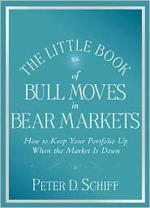
Peter Schiff is president of Euro Pacific Capital and author of The Little Book of Bull Moves in Bear Markets and Crash Proof: How to Profit from the Coming Economic Collapse.
 Mexico Doesn't Have a Drug Problem