


Vitamin C Helps Prevent Heart Disease
August 15, 2005
How Much Longer Can Modern Medicine Ignore Evidence That Vitamin C Prevents Heart and Blood Vessel Disease?
by Bill Sardi by Bill Sardi
How much longer can modern medicine ignore a growing body of evidence that vitamin C supplements are effective in preventing arterial disease and could replace statin cholesterol-lowering drugs?
In early July the New England Journal of Medicine published a report showing that oxidation (hardening) of cholesterol particles {LDL and lipoprotein(a)} increases the risk of arterial disease by 14 times (that’s 1400%!). [New England Journal Medicine. 353:46—57, 2005] The report drew widespread attention in the news media.
Subsequently I wrote the editor of the New England Journal of Medicine and pointed out that a study conducted in 2004 by researchers at the Department of Food Science and Institute of Comparative and Environmental Toxicology, Cornell University, Ithaca, New York, showed that Vitamin C concentrations in LDL cholesterol, which can be achieved by taking vitamin C pills, are capable of inhibiting oxidation of LDL cholesterol by about 75%. [J Agriculture Food Chemistry 52: 6818—6823, 2004]
Furthermore, research conducted by researchers at the National Institutes of Health last year found oral vitamin C can achieve blood serum concentrations three times higher than previously thought possible, in the range of what the Cornell researchers reported. [Annals Internal Medicine 140:533—7, 2004]
This evidence confirms what Linus Pauling and Matthias Rath proposed over a decade ago, that vitamin C can prevent heart and blood vessel disease. [National Academy Sciences 87: 6204—07, 1990]
Letter goes unpublished
For unknown reasons, major medical journals and the news media are ignoring these reports. The editor of the New England Journal of Medicine said he couldn’t publish my letter because of limited space. It’s not like this is a trivial matter, the lives of millions of adults are on the line. But this trusted medical journal had no space to air an important issue.
Long known that vitamin C lowers cholesterol
Before the first statin cholesterol-lowering drug (Mevacor) was approved in 1987, it was widely reported in medical journals that ascorbic acid reduces cholesterol in animals.
[Annals N Y Academy Science 258:410—21, 1975; Atherosclerosis. 24:1—18, 1976; Experientia 32:687—9, 1976] But a subsequent study conducted in 1983 in humans dismissed the idea. [J Lipid Research 24:1186—95, 1983]. However, this study was flawed in that low-dose vitamin C was employed and high blood concentrations were not achieved throughout the day as previously recommended.
Repeated doses needed
In 1982 researchers at the Institute of Preventive and Clinical Medicine in the Slovak Republic, advised that "In every form of high cholesterol therapy, an adequate vitamin C supply should be ensured in doses capable of creating maximal steady-state levels of ascorbate in human tissues." [J Lipid Research 24:1186—95, 1983] Their advice was overlooked and the stage was set for the introduction of more toxic ways to lower cholesterol by use of drugs that interfere with liver function.
Evidence that vitamin C halts sudden cardiac death
Even if it can be argued that vitamin C doesn’t sufficiently lower cholesterol, University of North Carolina researchers have shown that chronic vitamin C deficiency “severely compromises collagen deposition and induces a type of plaque morphology that is potentially vulnerable to rupture.” It is unstable arterial plaque that is attributed to more than a half-million sudden-death heart attacks that occur annually, mostly to males who have normal or low circulating cholesterol levels. [Circulation 105: 1485—90, 2002]
More documented evidence
In July of 2004 the British Medical Journal published a breakthrough report which showed that narrowing of blood vessels at the back of the eyes precedes the onset of high blood pressure by 10 years [British Medical Journal 329: 79, 2004]. Subsequently London optometrist Sydney Bush, PhD, D.Opt, wrote a letter to the editor saying for years he had been prescribing vitamin C to his patients with these same changes at the back of their eyes and had photographically documented reversal of artery disease. [British Medical Journal 23 July 2004; 25 Nov 2004] The medical profession has hardly taken notice.
More evidence accumulates
 Yet another report claims vitamin C is as effective as statin drugs in preventing the first step in atherosclerosis, a condition in which fats collect under the inner lining of damaged artery walls, eventually narrowing or blocking arteries and obstructing blood flow.
Researchers at the Post Graduate Institute of Medical Education and Research in Chandigarh, India, reporting in the European Journal of Clinical Nutrition, indicate peroxisome proliferators-activated receptors (PPARs) are involved in inflammation which is the initiating factor in artery disease.
Here’s the shocker — while statin cholesterol-lowering drugs reduce gene-controlled activation of PPARs, vitamin C does this equally as well! The researchers said their laboratory experiment "provides incontrovertible evidence to support the view that both statins and vitamin C have identical effects on the expression of genes coding for PPARs." Moreover, vitamin C concentrations required to produce this preventive effect are "well within the permissible dose of this vitamin." [European Journal Clinical Nutrition 59: 978-81, 2005]
The prospect of vitamin C therapy
 The prospect of using vitamin C to prevent atherosclerosis, which is far less expensive and problematic compared to statin drugs, would be welcomed by many patients, especially those who experience toxic side effects from the drugs. Oral vitamin C could act like a statin drug to lower circulating cholesterol levels, prevent unstable plaque involved in sudden-mortal health attacks, and prevent the first step in arterial disease.
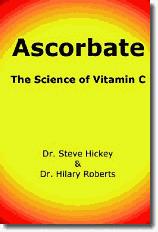
Since vitamin C is a water-soluble vitamin, oral dosing should be repeated throughout the day as recommended by Steve Hickey and Hilary Roberts in their book Ascorbate: The Science of Vitamin C ( www.lulu.com/ascorbate ) Spreading the dose of vitamin C throughout the day also minimizes the occurrence of transient diarrhea.
Cranberries as a companion to vitamin C
Of further interest is that Cornell University researchers report that molecules in cranberries, called polyphenols, also inhibit the oxidation of LDL cholesterol. One-hundred grams (100,000 milligrams) of cranberries are equivalent to 1000 milligrams of vitamin C or 3700 milligrams of vitamin E in countering LDL cholesterol oxidation. [Life Sciences 77: 1892—901, 2005] Normally cranberries provide 0.3% polyphenols, but cranberry extracts typically provide 7.0% polphenols and a new type of concentrated cranberry extract (CRAN-X) yields 30 percent polyphenols, making it at least equally as capable of inhibiting LDL cholesterol oxidation as an equal amount of vitamin C. Furthermore, cranberries have potent anti-adhesion factors that help prevent bacteria and cholesterol from sticking to artery walls. [Phytochemistry July 28, 2005; Critical Review Food Science Nutrition 42: 301—16, 2002]
Stonewalling continues
With all of this evidence, health authorities continue to stonewall the public and even earnest physicians regarding the promise of vitamin C for cardiovascular disease. Even after an analysis of nine studies by National Public Health Institute, Helsinki, Finland involving 293,172 subjects over a 10-year period, which found that the use of vitamin C supplements providing 700 milligrams or more of ascorbic acid, reduces the relative risk of coronary heart disease by 25 percent [American Journal Clinical Nutrition 80:1508-20, 2004], health authorities continue to deny that vitamin C could possibly be of value.
For example, a report in the July 2005 Journal of the American Medical Association said that "… there is currently no basis for recommending that patients take vitamin C or E supplements or other antioxidants for the express purpose of preventing or treating coronary artery disease." In 2004, the AHA Nutrition Committee similarly concluded that "At this time, the scientific data do not justify the use of antioxidant vitamin supplements for cardiovascular disease risk reduction." [Journal American Medical Association Volume 294: 351—358, 2005] The lack of adequate peer review and candid reporting by health authorities is alarming.
News media opts out
If the news media were monitoring and reporting on advancements nutritional medicine, public health authorities would be challenged to respond and their shell game in regards to vitamin C would be revealed. But the news media appears to be bought off.
Trudy Lieberman, writing in a recent issue of the Columbia Review of Journalism, suggests the news media is in league with the pharmaceutical industry to avoid reporting negative news about drugs because of its reliance upon the advertising dollars. In 2004 the big five TV networks received $1.5 billion in advertising revenue from pharmaceutical companies. Drug advertising in printed news media is also significant: Time magazine $67 million; Newsweek $43 million; The New York Times, $13 million.
This may explain why landmark reports regarding vitamin C, published in peer-reviewed medical journals, are being ignored by the news media. It appears millions of American lives are at avoidable risk for heart disease and sudden mortal cardiac arrest as the news media attempts to guard a $9 billion statin drug market.
 An Argument for Self-Governance