


Used by the State, Even in Death
June 1, 2012
Recently by Mike (in Tokyo) Rogers: Rock and Roll and a Reason Why American Musicians No Longer Capture the World’s Imagination?
My father died last year. One of the last wishes of this retired career marine father was to have a burial at sea in the tradition of the military.
He told me upon his death bed, "The only important things in my life were the US marines, your mother and you kids."
I wasn't pleased at all with this decision for a military burial as I do not believe that the US military really "takes care of its own" at all. One need just look at all the military veterans who are homeless or had their bodies and ashes dumped in landfills for evidence of this. But it was my father's life and death and, since I no longer live in the USA, it was difficult for me to try to convince my father and remaining family that we should have a quiet family-only ceremony like we did for my mother.
I was hoping for a small and respectful burial at the same place my family sent my mom's ashes back to the sea at the peaceful and oh so serene Japanese temple that was surrounded by blue skies, mountains and nature on the coast of Kyushu, Japan. That was a ceremony whose hallowed silence was punctuated only by the sound of the waves crashing on the rocks and the birds overhead; the only other sounds were the sobs and cries (along with hugs) amongst the four of us remaining relatives in attendance.
That ceremony, to me, represented reverence and respect for the dead; a tranquil and close family affair just for us. Not one surrounded by strangers, with a military band blasting out marching tunes with no immediate family present.
Nevertheless, my father believed that he wanted to be thanked for his service to his country. In spite of my voiced hesitation, he had the full support of my militarist cheerleading state-worshipping brother. I was out-voted and a military-style burial at sea was decided.
Interestingly enough though, and as is par for the course for Leviathan, it took six months for the funeral proceedings to take place. Even though my father died in September of 2011, his burial was in March of 2012. In an curious twist of fate and timing, I received a DVD video of my father's burial at sea over the Memorial Day holiday.
Unfortunately, the video was painful to watch. The fact of the matter is that, in my opinion, the video wasn't so much a ceremony and tribute to my father who "fought for his country;" it was, in fact, a video of a ceremony that celebrated the American military machine; it was an orgy for the glorification of the State and US militarism.
Even though I shed a tear for my father, I'm sorry to say that the video of the ceremony nearly disgusted me.
In the background of the video, dubbed in music played the national anthem, the Marine Hymn and, even more in line with bargain-basement "celebration" quality of the proceedings, a country song was overdubbed that included the singing refrain, "I'm glad to be an American. Where I can be free."
I wondered, "Is this really reverence for a dead soldier and his family?"
Before you folks who are family of the military dead are too quick to judge my criticism, listen to this: I also received the US flag that was supposedly used in the video for my dad's ceremony. Unfortunately, and pardon my politically incorrect language, but even a blind man can see that the flag I received isn't the one used in the video of the burial ceremony. The one I have in my possession is twice the size of the one that was used in the video. Am I supposed to have some sort of emotional tie to this flag? What does this flag have to do with the one used in my father's ceremony besides both probably being manufactured in China?
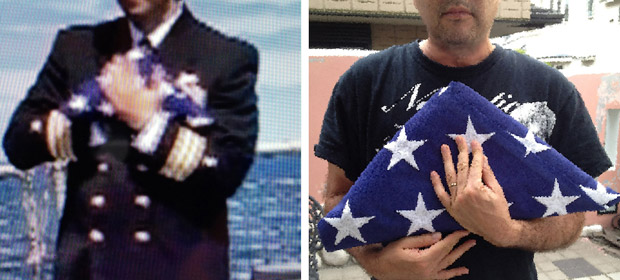 Sorry, folks. These are different flags.
Or is the purpose of this flag that I was sent a continuation of the state-sponsored propaganda and use of the dead to influence the thinking of the living? Is this another token that is supposed to make the owner of the flag "proud to be an American" too?
It doesn't make me proud at all.
I'm sorry. Dad, I love you and I am proud of you, but you didn't go to war in Korea to protect our freedoms; you went to war over there to further US economic interests and the US empire. That you never figured that out in your lifetime is sad. But, I hope that you are in a better place and have had the chance to speak directly with a former US marine general by now.
That my still very much alive university educated brother is too dim to see it today in all American militarism is a testament to the power of the American propaganda machine and brainwashing by the mass media. That I write this is merely a warning to American people to wake up.
In Japan, the old order before World War Two told people that they went to war in China and Asia to bring peace and to fight for the emperor. In the USA, the old – and current – order tell people that they go to war to be free and to protect American freedoms.
These things are all lies.
In this regards, the Japanese are decades ahead of the average American; they figured out long ago that the propaganda was a lie. The average American still buys this trash hook, line and sinker.
My father was duped this way in life and now in death. My living relatives also believe this. It is sad that, in life and in death, my father is still used as a tool of the state…
Of course, from this short missive, I will expect to get the usual hail of criticism and hate mail claiming that I disrespect the military or their service. That I, a person with no experience in battle, are using the sacrifices that these men and women made "protecting my freedoms" so that I may make these claims.
To that I say, "Poppycock!"
In response to the anticipated storm of hate mail, I'd like to borrow the words of another famous American statesman and true patriot whose experience in battle rivals my own: "Bring it on!"
The Best of Mike (in Tokyo) Rogers
 Do We Face This Immense Evil?