


The Economics of Discrimination
July 12, 2003
This speech was delivered at the Georgia State University School of Law in Atlanta, April 1994.
The Fabian Society of Great Britain held to three central doctrines of political economy. First, every country must create its own form of socialism. Second, socialism imposed slowly is more permanent than the revolutionary sort. Third, socialism is not likely to succeed in Western countries if it appears undemocratic or authoritarian.
Using this formula, the Fabians achieved their dream in Britain. They used labor unions to socialize the workforce, the state to nationalize basic industries, and social insurance schemes to collectivize the property that was left. In addition, they relied on soft-planning, a government-run medical industry, and middle-class income redistribution to build the state sector. It was still socialism, however, and it nearly destroyed the country.
According to the Fabian formula, the American form of socialism would also need to be different from the Bolshevik model. If you understand this, you can understand the essence of American politics from at least the 1960s.
In the early days of the Clinton administration, White House aides visited Daniel Patrick Moynihan’s Senate office to explain their proposal for so-called empowerment zones. These are sections within major cities targeted for a mass dumping of welfare dollars and business subsidies. When Moynihan heard the plan, he exclaimed: “That sounds Fabian!” The New York Times reported that Clinton’s aides assumed he meant this as a compliment.
No one, certainly not the Clintons, could win the presidency of this country on a program of revolutionary socialism. If the opponents of property and markets are to succeed, they must create a peculiar form. It must be well suited to political and demographic conditions that are distinctively American.
We have little reason to fear nationalized industries or comprehensive planning. Labor union power is on the decline. Americans bristle at any hint of direct controls over production decisions. Environmental socialism has probably peaked. And fully socialized medicine failed last year because of massive public resistance to such a step-up in government power.
We don’t have British socialism. We don’t have the British style. But we do have a problem with socialism. It takes many forms, but the form I’d like to concentrate on today relates largely to labor markets and the rights of business.
First let’s get our terms straight. One sort of property is private. That means it is owned by private individuals and should be controlled by them. This type of property is the basis of all market exchange.
Another kind of property is public property. The term is a misnomer, of course. Public property is sometimes the least accessible to the public. Yet we know what this term means: property owned by the state. It is not subject to market conditions. No individual can choose to use it or to sell it as he sees fit.
But U.S. political culture has created a third and far more insidious type of property. It is called commercial property. It includes all private and public property used for exchange in the free market. Included in this category is most everything but private homes and clubs, and secretive government bureaucracies. This means that the following institutions are so-called commercial property: hotels, restaurants, bookstores, manufacturing plants, computer retailers, universities, and so on.
Being classed in this way subjects this form of property to a variety of civil rights laws. When examined from a philosophical standpoint, such laws are nothing more than the legal right to trespass. A qualified individual may demand service against the will of the owner. He may demand to be hired, or not to be fired, against the will of the owner. He may demand a higher salary or a promotion, against the will of the owner.
If the free market embodies the idea of contract, civil rights embodies what Barry Smith has called the spromise. A spromise commits a third party to act against his will. As the owner of the business, you may wish to stop paying an employee and terminate his employment. Civil rights say you may not, without the permission of the government.
Civil rights, and the right of trespass it implies, is a major part of American socialism, a carefully tailored product indeed. It is designed to fit with America’s excessive devotion to the ideals of democracy and equality. It is designed to exploit the demographic heterogeneity of America’s population. And its implementation relies on America’s traditionally sanguine view of centralized executive power.
We could argue about when American socialism first took root. Many say it began with the Great Society. Others trace it to the New Deal. There’s a good case to be made for tracing it to the Lincoln presidency, which dramatically centralized power in an imperial executive. That period also provided a test run for inflationary monetary policy and income taxation, two institutions that the Progressive Era entrenched, and which provide the fuel for American socialism today.
The symptoms of American socialism are easy to identify. They appear in legislation like the Americans With Disabilities Act, the limitless amendments to the Civil Rights Act, the Community Reinvestment Act, and all manner of interference with the freedom of association.
In addition, regulatory agencies issue tens of thousands of regulations each year to manage the private lives of citizens and the conduct of private business. Of all the menacing federal agencies, the socialism I am speaking about has been expertly practiced by the Department of Housing and Urban Development, the banking regulators at the Federal Reserve, and the bureaucrats at the Equal Employment Opportunity Commission.
The result has been tyranny. Civil rights lawsuits are shutting down businesses daily. Many potential capitalists decide not to open businesses for fear of the government’s equality police.
Small companies routinely do anything within the law to avoid advertising for new positions. Why? Government at all levels now sends out testers to entrap business in the crime of hiring the most qualified person for a job. Pity the poor real estate agent and the owner of rental units, who walk the civil rights minefield every day. If any of these people demonstrate more loyalty to the customer than to the government, they risk bringing their businesses to financial ruin.
The restaurants Denny’s and Shoney’s, two great examples of capitalism in action, know all about this. In the last two years, they were both hit with class-action suits alleging discrimination. It didn’t matter that the plaintiffs’ cases were all trumped up, and the specific cases cited were patently fraudulent. For example, one plaintiff found a foreign object in her hashbrowns, and claimed it was put there on grounds of race. Both companies decided to settle out of court, establish extensive quota programs, pay off all plaintiffs, and set up new minority-owned franchises. They did so not because they were guilty, but because the so-called justice system is stacked against them.
Just recently, 99 white male troopers in Maryland collected $3,500 each in back pay on grounds that they had been discriminated against in promotions. I don’t doubt that they were, but I’m suggesting a more peaceful solution. Let’s return all decisions about hiring, firing, promotion, and access to the market. That means getting the government and the courts out of the business of enforcing equality once and for all.
But that solution is nowhere in sight. The courts enforce an egalitarianism that tolerates no acknowledgement of differences among people. This denies the obvious. People do differ radically in their talents and weaknesses, their determinations to succeed, their mental facilities, their attitudes and character, their physical abilities, their environments, and their physical makeup. Moreover, these differences appear not only in individuals but also appear systematically among groups.
Men as a group, for example, are different from women as a group. Northerners are different from Southerners. Californians are different from Texans. Catholics are different from Baptists. Blacks are different from whites. Immigrants are different from natives. The rich are different from the poor. These differences should not be denied, but celebrated, for they are the very source of the division of labor.
Yet our central government attempts to stamp out all these differences by forcing individuals and businesses to act as if they did not exist. The primary means has been the criminalization of our most serious secular sin: discrimination. There can be no actions in American life — save the decision of whom to marry — that discriminates on the grounds of any number of criteria as defined by the government. If anyone commits this sin, he can forget the confessional or forgiveness. The heavy penance is cash handed over to the government and the special interests, with half going to the lawyers who arranged the transfer.
To see just how serious the government takes this sin, and how absurd are the results, consider disabilities law. Most people think of the Americans With Disabilities Act as a law forcing public and private facilities like courthouses and shopping malls to accommodate wheelchairs and the like. In fact, the Act is much broader. Since the ADA went into effect, less than one-quarter of the ADA-related complaints filed with the federal government concern such public and private facilities. The vast majority relate to employment.
Tens of thousands of such complaints, which are threatened lawsuits, have been filed with the EEOC. For example, a Florida district appeals judge was caught shoplifting a remote control, so the Florida Supreme Court dismissed him from the bench. He says this violates the ADA, which indeed it does, for he stole the device because he was depressed that his son was getting bad grades.
Mental illness is protected under the Americans With Disabilities Act. You cannot fire or refuse to hire a person who is “otherwise qualified” by the government’s standards. What is official mental illness? The EEOC suggest we consult the Diagnostic and Statistical Manual of Mental Disorders. According to the DSM, protected symptoms include “confused thinking,” “consistent tardiness or absences,” “lack of cooperation or inability to work with co-workers,” “reduced interest in one’s work,” and “problems concentrating.”
Before the ADA, these were reasons for booting a person off the payroll. Today, they bestow rights against employers, rights that sane people do not have. Nor does it count when, as a result, ADA-afflicted businessmen experience symptoms of DSM mental illness themselves: “anxiety, fear, anger, suspicion.”
The authors and enforcers of the ADA are not concerned with quadriplegics. Their goal is sinister to the core: removing the last vestiges of employers’ legal rights, and replacing them with civil rights, which trump all considerations of private property. Just as landlords no longer have an effective legal right to evict non-paying tenants, so employers cannot shop for the best workers. In this subtle form of socialism, nearly everyone has a veto over the free choices of capital owner. The workplace is ruled by a victimocracy.
Unlike the Clean Air Act and similar bills, the ADA is not industry specific. It affects every business in the country with 15 or more employees, forcing owners and managers to pretend that the physically, mentally, and emotionally disabled (and “disabled”) are identical to the non-disabled, and to spend to make it so.
Say you’re a small businessman, barely alive thanks to regulations and high taxes, and a man who can’t see applies for the job of office manager. You cannot turn him down on that ground, even though the job requires some reading, for that would violate his civil rights. You have to hire another employee to read to him. If you hesitate, you pay back wages and, thanks to the Civil Rights Act of 1991, massive damages.
If a supermarket manager refuses to hire a bum to ring the cash register, he can be taken to court. A sales manager may prefer salesmen who can remember customers’ names and preferences, not to mention his own products, but discrimination against those with low IQs or the memory impaired is not allowed.
If a thousand-mile stare makes you uneasy, you’re out of luck, for this is no longer a chilling quirk, but a certified disability. Would you rather not hire a nightwatchman with a history of drunkenness? If he’s not on Four Roses today, he’s on your payroll. For this reason, drunkards are daily suing for their right to go off on a toot and not be kicked off the payroll.
Say the applicant is a dyslexic with a history of drug addiction who not only has trouble reading, but can’t learn or reason well thanks to minor brain damage. If he applies, you have to hire him, and make what the government calls “necessary accommodations.”
The public accommodations provisions of the ADA are nothing to shake a stick at. A man in a wheelchair, for example, sued for the right to coach third base on a Little League baseball team. A girl with a steel walker sued for the right to skate during prime hours at a skating rink. A blind man sued for the right to be a firefighter. People of low intelligence are suing for more time to take tests. On and on it goes.
In each of these cases, businesses and other organizations usually settle out of court. They find that’s cheaper than taking the case to trial. But the settlements themselves have caused a wealth loss, which is vast and growing. And with the ADA, there is no way to comply, because there is no way to prepare for every possible contingency, every possible lawsuit, every possible government trick.
Businesses can try to escape some of this by requiring certain abilities in a written job description. But they must be able to show, in a court of law, that the requirements are essential to the job. Businesses do not always know ahead of time what a person will be required to do. So they look for qualities like character and attitude. But these are unquantifiable, and therefore, to the government, irrelevant. As you can tell by visiting any government office.
One way the ADA is enforced is through the use of government and private “testers.” These actors, who will want to find all the “discrimination” they can, terrify small businesses. The smaller the business, the more ADA hurts. That’s partly why big business supported it. How nice to have the government clobber your up-and-coming competition.
How could this nutty and dangerous legislation have passed? In Washington, D.C., economics has always taken a backseat to special interest lobbying. But when something is labeled civil rights, especially when it harms small businessmen and tramples on the freedom to exclude, it flies through Congress. Only four people in the Senate voted against the bill. Editorially, not even the Wall Street Journal spoke out against it when it mattered.
The ADA illustrates an important point about anti-discrimination law. Contrary to myth, rules against discrimination never create a level playing field. Forbidding one form of discrimination must necessarily compel another form of discrimination.
If an owner is forbidden to discriminate in hiring on grounds of sex or race, the government can only discover a violation of the law by looking at who is hired. This compels active discrimination against people on grounds of their sex or race. It is a zero sum game, where one person’s winnings come from another’s losses.
Still fewer are willing to speak openly about what has happened to the banking industry in the last few years. Once upon a time, the credit rating was the primary means by which bankers and other lenders assessed creditworthiness. But this is under assault today. Along with other institutions essential to the functioning of a free market, sound credit standards are being sacrificed on the political altar.
The operative test of a bank’s political correctness is its Community Reinvestment Act (CRA) rating. The ratings, mandated by Congress and the Bush administration in a bill affixed to S&L bailout legislation in 1989, categorizes lending by race, sex, and income level. Using nebulous CRA requirements, regulatory control, and the threat of merger rejection, government officials exercise remarkable control over the lending policy of banks.
Last year, for example, Shawmut National Corp. of Connecticut wanted to acquire New Dartmouth Bank of New Hampshire. The Federal Reserve Board, which must approve all bank acquisitions, foiled Shawmut’s plans in a split vote.
The banks were not undercapitalized. The proposed merger did not violate anti-trust law. There were no allegations of fraud. Instead, Shawmut was under investigation by the Department of Justice for violating fair lending laws. In the first decision of its kind, the Federal Reserve thwarted the acquisition on those grounds at the behest of the Department of Justice. I guess that’s part of the price for retaining its “independence.”
Shawmut never admitted guilt. But the bank had to spend a minimum of $960,000 on rejected minority applicants. With claims averaging $10,000 to $15,000 per plaintiff, the final price was much higher. In addition, Shawmut was forced to set aside $85 million in loanable funds solely for privileged applicants.
Shawmut is not even allowed to attach a risk premium to interest rates on loans given to questionable applicants so long as they are privileged by government. Instead, it must make these loans at below market rates, therefore subsidizing them with other depositors’ money.
When Fleet Financial Group, New England’s largest bank holding company, fired 3,000 people and reduced its operating expenditures by $300 million, the business pages featured the story. But the media did not out who has downsized the institution. One month before the layoffs, Fleet had suffered a similar shakedown.
A Boston “community activist” and self-described “urban terrorist” named Bruce Marks heads a group called the Union Neighborhood Assistance Corp. He began making noise when Fleet was planning to buy the failed Bank of New England. Marks noted that Fleet wasn’t directly backing loans in Boston’s Roxbury, Dorchester, and South End. Instead, to comply with the CRA, it subsidized other mortgage companies that lent at higher rates. Marks convinced some people who held these mortgages that they were being ripped off.
Marks then got local reporters, always anxious for a new victim, to make a fuss about the matter. After “60 Minutes” ran an attack, Fleet agreed to stop purchasing loans from third-party lenders in the inner city. That, of course, wasn’t enough. Marks and his Union wanted Fleet to make the loans itself — and give the Union cold hard cash.
Over two years, Marks’s band of brigands disrupted luncheons, breakfast meetings, press conferences, and speeches. Once Marks and his Union members burst into a hearing of the Senate Banking Committee where they filled the room and sang gospel songs. It was the kind of display that makes corporate big shots cower, politicians swoon, and regulators cheer. In the end, Fleet had to give Marks a cool $140 million.
Fleet also agreed to set aside $7.2 billion in loans for “low-income” borrowers, plus another $800 million in programs and payoffs for other “inner-city borrowers.” Fleet was attacked for loansharking, but the real sharks were those who looted the bank vault with the permission of government regulators.
Studies that purport to show discrimination rarely look at individual loan applications. Instead, they consider only carefully selected neighborhoods. Typically they fail to count minorities living in predominantly majority areas. And they look only at the lending record of banks and S&Ls, and not other mortgage lenders. However flawed, the studies always make a splash in the dangerous waters of politics.
Another voice added to this cacophony of credit confusion is Ralph Nader’s. Nader likes to cite a now-famous 1992 Boston Federal Reserve study by Alicia Munnell, then director of research and now Clinton’s assistant Treasury secretary for economic policy. It was supposed to adjust for more factors than any other study and still recorded a 6-point lending gap, a 17% versus 11% turndown rate by race.
Peter Brimelow of Forbes was the only one to call her bluff. He confronted her with the fact that her data also revealed identical default rates, which, he pointed out, implied a racially impartial application of standards of creditworthiness.
When confronted with the implications of this data, she collapsed. “I do not have evidence,” she admitted. “No one has evidence,” she continued in her own defense. Her admission hasn’t stopped her from continuing to make the charge, and from ordering changes in the way banks make loans.
What’s at stake here is not fairness in lending. Everyone acknowledges as an empirical fact that whites on average are more eligible for credit than blacks on average, just as Asians are more eligible than whites. What’s at issue is the transfer of the welfare function from fiscal policy to banking policy. The pool of loanable funds has become a convenient substitute for direct welfare benefits.
Tens of billions have been doled out to satisfy civil rights groups who cry discrimination. This has an industry-wide chilling effect. It scares banks negotiating reorganizations and freezes up available capital that deserving families need in purchasing new homes.
Civil rights socialism in banking wastes scarce resources and punishes achievement and responsibility. It harms the very groups it claims to help, by driving away market-specific solutions. Rechanneling funds makes the economy operate less efficiently and rightly angers property owners and depositors.
In a similar way, civil rights lawsuits alleging some kind of racial and sexual discrimination are shutting down businesses every day.
Let’s return to the Denny’s and Shoney’s cases of judicial aggression. Flagship, Denny’s parent company, was forced to settle a pile of litigation, including two class-action lawsuits — pushed by a combine of the Justice Department, the NAACP, and a bunch of liberal lawyers — for a total payout of $54 million. The Oakland, California, law firm that handled the largest suit got $8.7 million.
More than 4,300 people signed up as anti-Denny’s plaintiffs. The New York Times even published an 800-number to dial up and try your chances at some of the loot. Of the thousands of cases of alleged discrimination, news accounts and plaintiffs’ lawyers focused on two of the supposed worst incidents, which supposedly prove the perfidy of Denny’s. In Annapolis, Maryland, in May of 1993, six Secret Service agents were assigned to President Clinton’s security detail for a speech in that city. They entered the local Denny’s restaurant at noon.
Several media outlets said the agents were “refused a table.” The charge was a lie, made possible only because of the lack of accountability in civil-rights suits. The president was speaking nearby, meaning the restaurant was crowded. The agents were seated. The agents were served, but late.
Everyone has experienced late service, even watching someone who came in after us getting their food before we’ve ordered. Yet at the first sign of delay, agent Robin Thompson marched up to the waitress and demanded the food. The waitress said it was on the way. Thompson demanded to see the manager. He was on the phone. The highly paid gun-toting Secret Service agent was yelling, and the waitress is alleged to have rolled her eyes after he left. This was one of the charges that grew into a nationwide class-action suit.
On that very day, Denny’s had settled another suit in California alleging discrimination for $34.8 million, including $6.8 million for that California firm. A federal judge claimed he had to wait for a table, and that diners chanted racial epithets at him.
Regardless of the facts, how is this Denny’s fault? It’s one of the peculiar aspects of civil rights laws under commercial property.
As part of the settlement, Denny’s had to hire a full-time civil rights monitor, introduce a system of private spies to ferret out any internal “discrimination,” run re-education programs for all non-minority employees, turn over a set number of franchises to minorities for free, and put a hostile person on its board of directors. As part of the same suit, the NAACP pressured Denny’s to spend at least $1 billion to find and hire minority managers and turn over restaurants to them.
Why couldn’t Denny’s have told the agitators to hit the road? In a word: fear. Business can no longer risk taking these cases to trial. Even huge settlements like these are likely to be less expensive.
The cost to the overall economy is incalculable. How many companies will refuse to go public for fear that it makes them easy pickings for liberal lawyers? How many people, shocked by the gross unfairness of this ruling, will choose not to expand their businesses? How many potential entrepreneurs will be turned off from business altogether? When whole businesses are looted, the country is not safe for free enterprise.
We cannot have free labor markets so long as we don’t have the freedom to hire and fire. It is as essential that women’s health clubs be allowed to exclude men as it is for Korean restaurants to be able to hire and promote only Koreans. These are the rights and privileges that come with private property. If we limit them, we destroy markets and replace them with civil rights socialism.
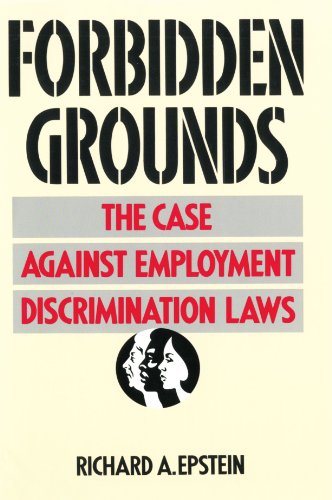 Forbidden Grounds: The...
Best Price: $9.98
Buy New $39.97
(as of 10:41 UTC - Details)
Forbidden Grounds: The...
Best Price: $9.98
Buy New $39.97
(as of 10:41 UTC - Details)

In Forbidden Grounds, University of Chicago law professor Richard Epstein refutes some of the myths of civil rights. Epstein points out an obvious fact that somehow goes unnoticed: anti-discrimination laws intervene in the freedom of contract, the legal right to use one’s own property as one sees fit. Additionally, there is no reason to think that such legal restrictions generate any social benefit.
Epstein uses the methodology of the Chicago School, whose theory of welfare attempts to derive social utility mathematically. But the question can also be approached, and far more effectively, from the deductive standpoint of the Austrian School.
Free exchange produces the highest social utility, since both parties benefit to the maximum extent possible, or the exchange would not have taken place. If the most-preferred choice on a person’s rank of preferences is outlawed as discriminatory, maximum benefit is denied to him.
Consider this example. John is an employer who wants to hire Jim, and Jim wants to be hired. This is probably because John values Jim’s labor, but it may also be because they are old college buddies. Jane wants the job too, but she is passed over, and she thinks the exchange between John and Jim injures her right to partake in the exchange.
In the free market, it is not enough to assert your right to be hired; Jane would have to offer some conditions of exchange to make herself relatively more attractive to John than is Jim. For example, Jane could lower the price of her labor to make it more competitive. If Jane’s labor is of no value or even negative value to John, then she would have to consider an apprentice relationship or possibly even offer a negative wage, that is, pay John to let her work. Or she could just give up and take a job somewhere else at what she regards as her true market worth.
No matter how the transaction ends up in this free market — whether John hires Jim or Jane — two parties are definitely better off, and the non-participating third party no worse off than he or she would be otherwise. We cannot know by how much John and the hired employee are better off, since utility is purely subjective and cannot be added and subtracted. We can only know that with voluntary market arrangements, and a free-floating wage system in this case, social utility is maximized no matter who is hired.
But say that Jane is passed over, and demands that the government step in on the grounds that John should not be allowed to discriminate in favor of Jim. Compelled to do so, John hires Jane, even though her services are less in demand and Jim, whose services are more in demand, is left out in the cold.
Under this compulsion model, John is coerced into hiring someone he prefers less, Jim is forcibly shut out of the exchange, and only Jane gets her way. We cannot know mathematically how much Jane benefits from the exchange. We can only know that in this example she would not have been hired in the absence of government intervention, and that when she is hired by force, John and Jim are made worse off. The lower-valued labor has been employed over the higher-valued labor. We can definitely say that overall social utility in this three-person economy is diminished.
Civil rights laws force a similar outcome. They compel exchanges that would not have taken place under a voluntary system. We can thus immediately cut through the claims of civil rights supporters that anti-discrimination laws guarantee rights, but do not themselves discriminate. By their own logic, civil rights laws compel discrimination.
The language of Title VII of the 1964 Civil Rights Act seems innocuous, but it is enough to bring serious harm to the social order and the free market. The law reads: “It shall be an unlawful employment practice for any employer to fail or refuse to hire or to discharge any individual, or otherwise to discriminate against any individual with respect to their compensation, terms, conditions, or privileges of employment, because of such individual’s race, color, religion, sex or national origin.”
The Civil Rights Act ostensibly did not allow government to change the private pattern of employment. The assurances of Sen. Hubert H. Humphrey (D.-Minn.) were especially powerful: “Employers may hire and fire, promote and refuse to promote for any reason, good or bad, provided only that individuals may not be discriminated against because of race, religion, sex or national origin.”
On another occasion, Humphrey made a famous promise: “If the Senator can find in Title VII…any language which provides that an employer will have to hire on the basis of percentage or quota related to color, race, religion, or national origin, I will start eating the pages one after another…”
But the authors of the law did not state their aims openly; they opted for a more subtle form of egalitarian behavior control. The civil rights legislation did not explicitly outlaw certain market outcomes, but only made actionable certain subjective states of mind: people cannot discriminate “on the basis of" or “on the grounds of" some physical attribute. It is not the action itself which is made illegal, but the motive.
Let’s say that Congress is disgusted by the number of divorces in the nation. It concludes that many result from shotgun marriages. So it decides to pass the following law: “All marriages contracted by parties under the age of 26 must be based on love, not mere infatuation.” The law is actionable in court, and enforced by a $5,000 penalty.
What happens? Does the divorce rate go down? Perhaps, but not because young marriages are more loving. It is because people decide to play it safe. They wait until the age of 26 to get married.
What’s being outlawed here is not an action as such, but a motivation. But to keep the motivation from being detected, people change their behavior. For this same reason, antidiscrimination law has led to quotas. For fear of the government, people change their behavior.
To illustrate further how civil rights laws are logically inseparable from reverse discrimination, quotas, and government control of labor markets, consider this additional thought experiment. Say a Catholic requests a job, but is told: no Papists need apply.
In announcing his policy, the employer reveals his motivation for not hiring the man. The government then passes a law making such a motivation illegal, so the employer knows he must hide his true feelings. He assures the authorities that he has had a change of heart about Catholics, whom he now regards as deserving of equal rights. Then he rejects a long series of applicants on the grounds that he doesn’t like the look in their eyes. But it turns out that all the rejected applicants were Catholics. Even so, he assures the authorities, that is not why they were rejected.
The trouble for the authorities is that the employer seems to be fulfilling the language of the law — he is no longer discriminating “on grounds” of a person’s belonging to the Catholic Church — yet Catholics are still not being hired in this person’s firm. Allowing the situation to continue would defeat the purpose of the law, since there would have been no point in its having been passed if it were only going to produce the same result.
Predictably, the authorities conclude that he is still engaging in illegal discrimination. They further conclude that in the future he will be evaluated in terms of how many Catholic employees he has hired and promoted, and fined heavily and perhaps jailed if he does not comply. To comply, the employer realizes, he must reject non-Catholics in favor of Catholics. In effect, he has been forced to establish de facto hiring quotas. Catholics now have privileges and non-Catholics are discriminated against. We can’t expect any other outcome.
But what if it turns out that the reason the employer disliked Catholics, though he had never thought about it before, was that most Catholics do indeed have a funny look in their eyes? In other words, he was using their Catholicism as a proxy for other behaviors he found unattractive.
In fact, the Catholics he discriminates against may have many traits that link them besides their religion: unassimilated ethnicity, hard-to-understand accents, chips on their shoulders, or whatever. These traits do not have to apply to every Catholic; they need only apply to the ones he has known. In fact, they need not apply even to a majority of those he has known. Because all economic decisions take place on the margin — that is, he makes choices among several seemingly desirable ends — he has only to find one characteristic that falls along group lines to make his discriminatory decision rational.
So the authorities must either outlaw discrimination on every possible ground that links Catholics together as a group, or they can specify that only certain criteria are legal in decisions to hire, fire, pay, and promote. Furthermore, these criteria must be distributed relatively evenly among Catholics and non-Catholics. Given the tendency of groups to have much in common that will be marginally job relevant, or else they would not be considered a group in need of protection, this could be difficult.
Say the authorities choose the criterion of education as a worthy hiring standard. If, over time, it turns out that education is not distributed evenly among Catholics and non-Catholics, the authorities must select a new criterion. Or they could claim that educational institutions are guilty of discrimination, and enact draconian controls over them. If the differences persist, the authorities will have to undertake increasingly extreme measures to bring about the desired result.
Whatever path is taken, to the extent that the original form of discrimination was rational and pervasive, the authorities will be forced to seek a near-total takeover of the labor markets to ensure “fairness” for Catholics. A law mandating “religion-blind” hiring must be enforced as “religion-conscious” hiring if it is to have any effect. This follows from the simple act of forbidding discrimination on grounds of religion.
There is no rational ground on which to exclude civil rights laws from the same sort of analysis. Their goal was not a level playing field; that was already in place in the labor markets. The goal was to redistribute wealth through government from one group to another group, and to enhance government control over the labor markets.
Civil rights laws, moreover, may actually increase discrimination. Employers forced to pay or promote people out of fear of the government will tend to avoid hiring them in the first place. And those who do get hired under such circumstances will be the cream of the labor pool, further marginalizing the least skilled and least experienced.
There is good reason to question the alleged policy ideal of sameness throughout the economy. Consider living arrangements. Good sense tells us that retired people sometimes want to live in adult-only complexes. Running, yelling children can pose a physical danger or just get on older people’s nerves. So Congress passed a law in 1988 that makes it illegal to discriminate in housing against families with children, even though such discrimination can be perfectly rational.
Civil rights law is one of the paths to socialism because it overthrows the freedom of association and the employers’ freedom to choose. How crucial are these to preserving prosperity, freedom, and civilization itself? We’ll find out if the central government succeeds in stamping them out entirely.
If we are ever to reverse our current course, we must pay closer attention to the wisdom of Edmund Burke, Alexis de Tocqueville, Lord Acton, Helmut Schoek, Bertrand de Jouvenal, Ludwig von Mises, Murray N. Rothbard and all the others who have taught that liberty and equal outcomes are incompatible goals. One always comes at the expense of the other. For a variety of reasons, this lesson has been forgotten in our times.
The free-market economy has a record like no other of offering economic advancement for everyone no matter what his station in life. However, it does not offer equality of result or even equality of opportunity. The free market offers not a classless society, but something of much greater value: liberty itself.
No reform of these laws will get to the root of the problem unless it is the repeal of all civil rights laws.
We are all familiar with Joseph Schumpeter’s paradoxical prediction that socialism would win out over capitalism. We also thought that the events of 1989 disproved him. In light of our present situation, let’s revisit Schumpeter.
The capitalist or commercial society, he says, is defined by two elements: first, private property in the means of production; second, regulation of the productive process by private contract, management, and initiative. By Schumpeter’s definition, we only have capitalism in the first sense. We have private property, but no longer can we govern the productive process by private contract, management, and initiative. The government exercises veto power over all matters of economic management.
By socialist society, he further writes, he means an institutional pattern in which the control over the means of production is vested with a central authority, or as a matter of principle, the economic affairs of society belong to the public and not to the private sphere.
 Which does our society most closely resemble: Schumpeter’s commercial society or Schumpeter’s socialist society? Whatever our answer, we know where the trend line is pointing.
We need to reevaluate Schumpeter’s famous prediction about the U.S.: “It is only socialism in the sense defined in this book that is so predictable. Nothing else is. In particular there is little reason to believe that this socialism will mean the advent of the civilization of which orthodox socialists dream. It is much more likely to present fascist features. That would be a strange answer to Marx’s prayer. But history sometimes indulges in jokes of questionable taste.”
The Best of Llewellyn H. Rockwell, Jr.
 The Union Army Code of Conduct, 1861-1865