


The 10 Commandments Question
August 30, 2003
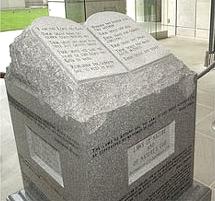 The 5,300-pound monument to the 10 commandments in the Alabama supreme court, and the federal order to remove it on “constitutional” grounds, has led to a state-wide hysteria.
Those celebrating its forced removal say it’s about separating church and state, and thereby preventing the descent of the state into theocracy. Meanwhile, Roy Moore, the chief justice who put the monument there, says the controversy is “about the acknowledgment of God. We must acknowledge God because our constitution says our justice system is established upon God.”
Now, I live in Alabama, and I can tell you that this is not true. The justice system is not established on God. It is established by politicians and bureaucrats on the principle of loot. Those who live off the loot would be very pleased for you to believe that their system is ordained of God. That would help immunize them from criticism.
In fact, if I wanted to be dictator of Alabama, my first act would be to institute dispensationalist Christianity as the state religion, and mandate a monument of the 10 commandments in every government office. There are plenty of people who would take the bait. After having bamboozled the population with religion, I could pretty much do what I wanted.
The politically unsophisticated evangelical voter tends to confuse symbolism with reality. These are the same people who would fight to the death for the government’s phony-baloney money to say “In God We Trust” and for the pledge to the government to continue to say “One Nation Under God.” Some people will believe anything so long as it is intoned in the right theological language.
It was for this reason that liberation theology was such a brilliant innovation. The socialists took a demonic ideology that calls for an end to property ownership and the family, and christened it with religious faith. So long as socialism was an atheistic creed, it didn’t make the advances it might have in Latin America. Once baptized, socialism gained new converts.
So it is with statism in Alabama. Wrap a despotic system of justice in the Bible and you have a package that sells well among those who lack the critical capacity to distinguish between symbols and reality. It is also true on the national level, as when George Bush invokes the Prince of Peace to justify his daily slaughter of innocents in Iraq and Afghanistan.
There are other reasons not to warm up to the 10 commandments in the court house. The version Moore chose is a sectarian one promoted by Calvinist and fundamentalist Protestants, but rejected by Catholics, Lutherans, and Episcopalians. (The difference has to do with whether the first commandment should be split into two parts to seem to justify iconoclasm.)
Why are secular elites also so focused on stripping public spaces of symbols like the 10 commandments? Why do they hate them so? The reason is exactly what the evangelicals suspect: just as God says thou shalt not worship other gods, the secular elites want no competition for their claim to god-like status, even if such competition exists only in symbolic form.
The 10 commandments monument is an aggressive statement that there is a higher law — a law higher than the state — to which all are obligated to submit. The power elite cannot abide such claims. Right and wrong are to be determined by the rulers and no one else.
Thus it is not theocracy that the opponents of Moore fear, but rather anything that challenges the sovereignty of the managerial state. They say they want separation of church and state but what they really want is for the rule of the state and its laws and morality to enjoy overarching and undisputed authority. No other authority — not even the 10 commandments — can be permitted.
What is really at issue in the narrow question of whether the monument should stay or go is a conflict over authority: is God and His immutable and transcendent standards of justice the final authority, or is it the central state? But in the end, it is the broader question that is more important, namely, who decides?
The conflict is easily resolved by a simple tool cooked up hundreds of years ago: federalism. This is the one principle at work that hardly anyone wants to talk about. The very core of the constitutional system is that it permits divided power. The states created the central government to serve the states, not the other way around. According to the constitution, so long as the states have republican forms of government (not monarchies), they govern themselves.
The architects of the constitution would have been aghast to see a federal judge telling a state supreme court that it cannot display the 10 commandments. To do so is an obvious and absurd violation of not only the 10th and 1st amendments, but the whole spirit of federalism that Lord Acton called the unique contribution of the American system.
Federalism is a means of peace. It recognized and codified the universal desire for self-government over outside imposition. It was supposed to protect the citizens against something everyone in all times despises: namely, dictatorial rule by outsiders. In this sense, there is an analogy between those protesting the removal of the 10 commandments in Alabama and Iraqis working to get out from under the military dictatorship of an imperial army of foreigners. Whether anyone else thinks their particular cause is right or wrong, the real point is that Alabamians and Iraqis ought to be permitted to govern themselves. For this reason, Ed Crane at Cato is wrong that “the federal court that ruled the display of the 10 commandments had to be removed from a government building was on solid constitutional grounds.”
What if Iraqis desire an Islamic theocracy? What if Alabamians make the 10 commandments the official law of the land? Some people may like the result and others may not. Self-government does not solve all conflicts, but it does bring them down to a manageable level. It is up to Iraqis and Alabamians to determine their own futures. Above all, the principle of decentralization prevents the greatest evil in all of human history: the unleashing of the consolidated Leviathan state on unwilling subjects.
The Best of Llewellyn H. Rockwell, Jr.
 Bush Foreign Policy Made Simple