


I wish to propose a salubrious anarchy, a deliberate renunciation of fealty to country, society, and government, an assertion of independence from folly and moral decay. Permit me to offer a taxing political idea: When a society ceases to be worthy of support, it is reasonable to withdraw support. The time, I submit, has come.
Here I do not mean to urge crime or counsel treason, but to suggest quiet renunciation of the national disaster. Ask yourself how much of American life pleases you. The schools are run by fools to manufacture fools, government grows more intrusive by the day, and culture is determined by the triple cloacae of New York, Hollywood, and Washington. Freedom withers, not only in the ominous encroachment of police powers, but in the loss of control over schools, church, hiring, daily life. We are no longer our own. The United States is not the country we are told it is, and not the country it was.
How to escape? The beginning, and the most difficult, is a moral distancing. Those who care must disentangle themselves from the cobweb loyalties and factitious duties with which we have been unconsciously encumbered. From childhood we learn patriotism, that one must vote, that if our way is not perfect it is at least best, that we must support anything however bad because we were were born in a particular place. Why?
Let me suggest that one owes loyalty to one’s family and friends, to common decency, and to nothing else. Render under Caesar what you must, keep what you can, and swear allegiance to nothing. Here I do not mean just the government, but the zeitgeist, the miasmic fetor of trashy culture, the desperate consumerism, the entire psychic odor of a society in decomposition.
Begin with things so fundamental as seldom to be reflected upon. For example, do not imagine that you are under an obligation to marry, or to have children, or to raise them as the government requires. Procreate if you choose, but only if you genuinely want to procreate. It is not your job to perpetuate a civilization that is daily less deserving of perpetuation.
But: never let the government have your children. Once they are had, your responsibility is to them. Teach them at home. Better yet, go abroad. Other countries do not force you to pay for an academically retrograde moral cesspool and then to drown your children in it. You might be astonished to know Argentina, for example.
Ask not what you can do for your country, but what it can do for you—you ought to get some of your taxes back.
Do not tie yourself to…anything. The price of freedom is poverty: freedom grows as your needs diminish. Less apothegmatically, if you believe that you need a vast house in a prestigious suburb, then you will need a lucrative job to pay for it. Having tied your psychic contentment to such an abode you will also believe that you need impressive cars and will therefore be tied to a retirement system and, bingo, the door of the trap falls. This, we are told, is the American Dream. I fear it has become so.
I lived years ago in a second-hand house trailer in the woods. I do not know what it cost, or would cost today, but perhaps fifteen thousand dollars. It was perfectly comfortable, warm in winter, air-conditioned in summer. Mornings were blessedly quiet unless you regard birdsong as noise. A brick barbecue provided a place to produce ribs and drink bourbon and water. A couple of companionable dogs rounded out the ensemble. They had the run of the trailer, as was right.
Now, living in a trailer is to the consumerist sensibility simply too degrading and so…I mean, my god, how could you face the neighbors? (There weren’t any.) But aside from damage to a servile dependent vanity, what is the drawback? A couple of hundred dollars buys a remarkably good stereo, music is free, libraries are good, and I for one am more comfortable in jeans and tee shirt than in Calvin and Klein trappings.
When your expenses are few, your susceptibility to economic serfdom is small. You do not need to work miserably in a pointless job for a boss you would gleefully strangle. Yes, you need money. The first principle is never to work in a job that you cannot afford to quit. This means avoiding any job with a retirement, of which you will become a prisoner. The second principle is to work at something portable that you can do independently and, preferably, without capital. Retirement? Save.
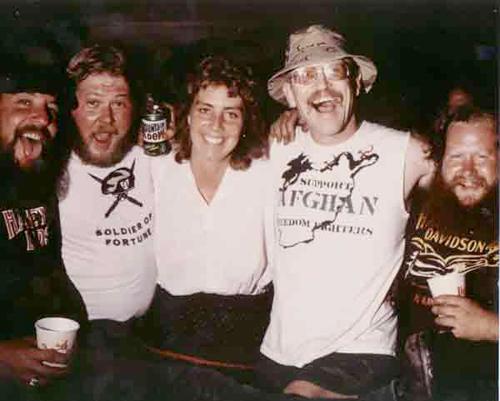 Party at the offices of Soldier of Fortune in Boulder, a long time ago. Byron the Enforcer, Reggie Hoolahan, Mary, Bob Brown, Mouse. Proof positive that elegance and happiness are not indissolubly linked.
Dentistry pays well but requires pricey equipment, and it is not easy to build a clientele. An automotive mechanic is always in demand and the employer will usually provide the tools. Writing is a serviceable gig and can be done from anywhere. Many varieties of technicians readily find jobs. Remember that white-collar work, aside from tending strongly to entangle you, gets boring. Get a commercial-diving ticket, take a serious course in the repair of marine diesels, and spend your life in the Pacific.
Here again the obstacles are fear, inertia, and vanity. If you come from a family on the suburban-death track, the thought of being a mere mechanic or dive-shop owner or what have you may be disturbing. "Don’t I need a college degree to hold my head up?" Look at the universities, at what they have become, and ask the question again. (Anyway, respectable in whose eyes? Your own are the only ones that count.)
Finally, work the system. The government, if you let it, will take roughly half of your income, give much of it to useless bureaucrats, much to various forms of welfare, use much to bomb countries you may have no desire to bomb, and much to force upon you services, such as horrible schools, that you do not want. The central question regarding government is whether you can take more from it than it takes from you. It is much better to receive than to give. Live cheap, work only as much as you like, enjoy life, and keep your taxes down.
You will still read of the rot and running sores of a declining culture, but it will bother you less. These things are your problem only to the extent that you feel yourself to be part of the society that produces them. Don’t fight the government, as it will win. Don’t try to reform society, because you can’t. Laugh at it. Live well. Read much.
Fred Reed is author of Nekkid in Austin: Drop Your Inner Child Down a Well.

