


Left and Right Against War
October 1, 2009
"Ours is a world of nuclear giants and ethical infants. We know more about war than we know about peace, more about killing than we know about living."
~ General Omar Bradley
"Canada must be ours [say the war hawks]. We have nothing to do but to march into Canada and display the standard of the U.S., and the Canadians will immediately flock to it."
~ Rep. Samuel Taggart, 1812
The United States of America has historically been addicted to war, an addiction that persists today more than ever with a vast "national security" apparatus, over 700 military bases, and a nation torn between those who believe in military intervention for humanitarian causes and those who extol war as a way of maintaining the country’s worldwide hegemony. Now we are faced with endless wars in the Middle East as the drums are beating for war against Iran in Washington, Jerusalem and western European capitals.
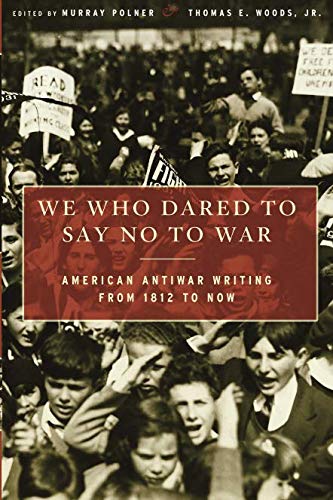
Several years ago Thomas Woods, Jr. asked me to collaborate with him in a book we titled We Who Dared to Say No to War: American Antiwar Writing from 1812 to Now (Basic Books, 2008). We intended to portray a broad American antiwar tradition often absent from classrooms, films, television and the new media. Tom is a libertarian and conservative and I a left-liberal and believer in nonviolent activism. We differ on some things but not on our opposition to our nation’s reliance on war and conquest (as well as our mutual support for civil liberties).
We have no illusions that our book can deter contemporary warmakers or outwit the fabrications and manipulations of governments and propagandists past and present. We were (and are) instead motivated by the hope that arguments for war might be critically examined, as the men and women of different political persuasions we include in the book did in their time. To quote from our introduction, we intend the book to be "a surprising and welcome change from the misleading liberal-peace/conservative-war dichotomy that the media and our educational establishment and popular culture have done so much to foster."
During our efforts to find appropriate and effective essays, speeches and documents, I turned to Americans who had shaped my own thoughts about war: Randolph Bourne, the physically handicapped prophet who died far too young (at 32) but memorably wrote that "war is the health of the state"; Robert A. Taft, bitterly assailed as an isolationist — in truth, he was very suspicious about military interventions — who rightly condemned the undeclared entry into the Korean War, where some 38,000 GIs died, many more were wounded in body and mind and several million Korean civilians killed, saying "the President has no right to involve the United States in a foreign war"; Russell Kirk, the founder of postwar American conservatism, urging "a policy of patience and prudence" against "preventive war" and decrying how "a handful of individuals…made it their business to extirpate the populations of Nagasaki and Hiroshima"; and a man I proudly voted for in 1972, George McGovern, who publicly excoriated his pro-war senatorial colleagues by describing each of them as "partly responsible for sending 50,000 young Americans to an early grave." "This chamber," said this onetime World War II bomber pilot unforgettably, "reeks of blood," adding Edmund Burke’s cautionary words: "A conscientious man would be cautious how he dealt in blood."
 The Left, The Right an...
Best Price: $7.33
Buy New $40.00
(as of 07:55 UTC - Details)
The Left, The Right an...
Best Price: $7.33
Buy New $40.00
(as of 07:55 UTC - Details)

Unsurprisingly, we found that the arguments used for war today are the same ones that have been employed in all our wars. We begin with Daniel Webster’s speech in December 1814 after the War Hawks (a term coined during America’s aggressive war to capture Canada) urged a draft: "Where is it written in the Constitution," he asked, "in what article or section is it contained, that you may take children from their parents, and parents from their children, and compel them to fight the battles of any war in which the folly of the wickedness of Government may engage it?"
For the U.S. government’s war of aggression against Mexico in 1846—48 we include (among numerous others) the abolitionist William Goodell, who called President Polk’s invasion a "war for slavery." In another selection then-Representative Abraham Lincoln denounced the Mexican War, calling Polk’s war message "the half-mumbling of a fever dream" and Polk a "bewildered, confounded, and miserably perplexed man."
Before the U.S. entered World War I, Eugene Debs, the Socialist labor leader, spoke truth to power: It is "the working class who freely shed their bloods and furnish the corpses." Debs received a ten-year prison sentence for that speech. Senator George Norris, the progressive Republican from Nebraska (the Midwestern states once had many such Republican politicians) who condemned U.S. entry into WWI and their advocates, likewise condemned war profiteering: "Their object in having war and in preparing for war is to make money."
That, incidentally, isn’t a problem that has gone away. Think of contemporary war profiteers who have made so much money in Iraq and Afghanistan, while a threatened war with Iran promises untold riches as well. Add to this the hysteria generated during the Cold War, a frenzy which consistently and deliberately exaggerated Soviet military capabilities while frightening many Americans. (See, for example, the declassified documents released in September 2009 by George Washington University’s private National Security Archive.)
 We Who Dared to Say No...
Best Price: $2.50
Buy New $14.75
(as of 08:10 UTC - Details)
We Who Dared to Say No...
Best Price: $2.50
Buy New $14.75
(as of 08:10 UTC - Details)
These are tough words, echoed by so many men and women (Helen Keller, Jane Addams, Jeannette Rankin, Rep. Barbara Lee, Gold Star mothers, etc.) whose words we sought to rescue from obscurity. Had we more room we would also have written about the military decimation of our Native American tribes and the habitual interference in the affairs of Caribbean and Central American states.
What we learned in writing this book was that lies, deliberate manipulation of patriotic feelings, scare tactics, a compliant, often indifferent media, and bribery of legislators kept and keeps the war machine oiled and too many decision makers in clover. Virtually everything heard in the past is still heard today. We quoted William Jay’s observation after the invasion of Mexico: "We have been taught to ring our bells, and illuminate our windows and let off fireworks as manifestations of our joy, when we have heard of great ruin and devastation, and misery, and death, inflicted by our troops upon a people who never injured us, who never fired a shot on our soil and who were utterly incapable of acting on the offensive against us."
And we concluded, "Everything we’ve seen recently, we’ve seen before. Time and again."
In the end, I have personal favorites: William Graham Sumner, an irascible Yale academic who opposed the Spanish-American and Philippine-American wars and the nation’s growing appetite for imperial conquest and world power; Marine Commandant David Shoup, who said of our Vietnam adventure, "Let’s Mind Our Business"; and W.D. Ehrhart, a combat Marine veteran of Vietnam, who enlisted at age 18 and years later told students at a Pennsylvania school, "I am no longer convinced that what I owe to my country is military service whenever and wherever my government demands it…if I owe something to my country, my country also owes something to me…it owes us the obligation not to ask for our lives unless it is absolutely necessary." Then there is Howard Zinn, WWII bombardier turned pacifist, who argues, "We need to refute the idea that our nation is different from, morally superior to, other imperial powers of world history" and instead "assert our allegiance to the human race, and not to any one nation." Libertarian Lew Rockwell writes, "Do we reject war and all its works? We do reject them." Especially moving is the contribution of Andrew Bacevich, a Vietnam War veteran, Boston University professor, and father of a son killed in Iraq, whose distressing "I Lost My Son to a War I Oppose; We Were Both Doing Our Duty" is unforgettable.
Our book will not change the course of history. Still, it reflects our mission, our passion: to encourage debate and discussion, in our nation’s classrooms as well as among our compatriots, now drowning in a mass culture that celebrates trivia — "amusing themselves to death" in the late Neil Postman’s incisive words. Tom Woods and I would like to encourage an alternative patriotism that goes not abroad every few years to seek and destroy real and imagined "enemies" while sacrificing a new generation of our young.
 Precious Metal Coinage