


The Coldest Winter
September 24, 2007
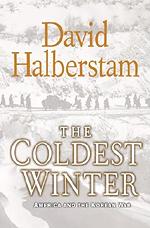
Review of David Halberstam’s The Coldest Winter: America and the Korean War (Hyperion, 2007)
When David Halberstam died in an automobile crash on his way to interview the old New York Giant Quarterback Y.A. Tittle for yet another of his sport books he had already turned in his "Korea book," as he called it, to his publisher. Officially titled The Coldest Winter, this is by far his finest work, told with verve, insights and penetrating portraits of the suffering of GIs and junior officers. In it, he turns a sharp light on the personalities who transformed this fierce and unwinnable "police action" where 38,000 Americans — many of them reluctant draftees — were killed, not to mention several million Koreans and the many Americans wounded in body and mind. Called our "forgotten war," the constitutional issues it raised and the continual use of American combat forces everywhere casts an ominous shadow throughout the book. "The century’s nastiest little war," as the military historian S.L.A. Marshall wrote, it opened the door to Joe McCarthy’s populist demagoguery and the toxic climate it created and the rise of the powerful China Lobby that wanted to "unleash" Chiang Kai-shek’s exiled army and reconquer the Chinese mainland.
Only five years after the end of the "Good War," North Korea and the dictatorial ideologue Kim Il Sung — distrusted by Mao and mocked by Stalin and Douglas MacArthur — ("Where is Kim Buck Tooth?" he laughed on one of his rare trips to Korea soon after he asked his aides, "Any celebrities here to greet me?") — pleaded with the Soviet and Chinese dictators to allow him to invade the South and finish off a low-key Korean civil war. After all, Secretary of State Dean Acheson had inexplicably omitted South Korea from the American defensive perimeter in the Far East. Kim finally received reluctant approval from Beijing and Moscow, neither of whom trusted him or his military. Then, without asking for Congressional ratification, and against the advice of some of his military advisors, Harry Truman decided the time had come to draw a line against what he believed to be a simple case of Communist aggression and fight a "limited war," but always careful lest the Chinese and Soviets intervene too. On June 30, 1950, U.S. ground forces, initially consisting of poorly trained service troops and officers living comfortably in Japan, were suddenly thrown into combat with an enormous loss of life.
As they always do, Americans rallied around the flag. It was what the libertarian scholar Llewellyn Rockwell, Jr. described as that "mysterious thing called nationalism, which makes an ideological religion of the nation’s wars." There were virtually no protests other than pacifists such as Dorothy Day and the Catholic Worker and the principled Senator Robert Taft. Having just smashed the Nazis and Japanese it seemed that America’s military machine was unstoppable. Communism had to be stopped by any means necessary, or so the popular mantra went in those years. Even so, as the war dragged on fewer and fewer Americans rallied to the war, if they cared at all. "Korea would not prove a great national war of unifying singular purpose, as World War II had been, nor would it, like a generation later, divide and thus haunt the nation," writes Halberstam. "It was simply a puzzling, gray, very distant conflict, a war that went on and on, seemingly without hope of resolution, about which most Americans, save the men who fought there and their immediate families, preferred to know as little as possible."
Because Truman had stubbornly and foolishly refused to ask Congress for a declaration of war, "the opposition was off the hook in terms of accepting responsibility for America’s response." As a result, the more protracted the war became, the more it became a political war whose legacy contributed to further poisoning American political life. It certainly helped give rise to the fabrication about domestic enemies and the media "stabbing our troops and the country in the back," a distortion first spread by the unrepentant and defeated World War I German General Erich Ludendorff, repeated after Vietnam and which will surely be heard again when and if the Iraq War ever ends.
Halberstam delineates the stunning blunders and character defects of the major actors. Stalin, the cruel cynic, finally gave Kim his approval to cross the 38th Parallel but also warned him never to expect help from Soviet troops. “If you should get kicked in the teeth I shall not lift a finger," Stalin told Kim, though obviously hoping to keep the U.S. bogged down in an unwinnable war if the Chinese were to become involved. Mao had nothing but contempt for Kim and the North Korean military but once MacArthur ordered his troops to the Yalu River border with China, Mao dispatched 300,000 "volunteers" to fight Americans (the South Korean military having largely collapsed, much like the South Vietnamese military in the seventies). Kim and South Korean strongman Syngman Rhee surely deserved one another. Halberstam tells us that General John Hodge, who had once led US troops in South Korea, loathed Rhee. As the military historian Clay Blair wrote, Hodge despised Rhee as "devious, emotionally unstable, brutal, corrupt and wildly unpredictable." Still, Rhee was America’s man until he unwisely sought to subvert the truce finally signed in July 1953.
Halberstam never loses sight of the war and his crisp and readable text is filled with examples of the courage of ordinary soldiers and marines, obviously a reminder of what he witnessed in Vietnam. If he sophomorically seems to glorify Generals by always referring to them by their nicknames (Lightning Joe Collins, Dutch Keiser, Al Gruenther, etc.), he does name feckless senior officers who he insists failed their troops.
No officer was more incompetent, concludes Halberstam in his provocative appraisal of General Douglas MacArthur, the all-powerful proconsul in Japan and commander of forces in the Far East. (Max Hastings, the highly-regarded British military historian, blamed MacArthur for the WWII defeat in the Philippines: [He] "abandoned his doomed command on Bataan, and escaped to safety with his own court, complete even unto personal servants, and made good the claim that his own value to his country surpassed that of a symbolic sacrifice alongside his men.")
During the Korean War MacArthur flew into Pyongyang after the First Cavalry had reached the city. The very critical Halberstam then notes: "He did not spend a night in Korea; in fact he did not spend the night there during the entire time he commanded." In fact, he remained in Tokyo, bunkered down with his politicized generals, and did not return to Korea until two weeks after the Chinese struck. His military intelligence was "doctored" by his obsequious staff; moreover, his goal now was to invade China.
Why China? Again, Halberstam quotes Max Hastings: "It will never be certain how MacArthur’s affronted personal hubris influenced his attitude toward the Chinese, how far he became instilled with a yearning for crude revenge upon the people who had brought all his hopes and triumphs in Korea to nothing." General Omar Bradley was far less forgiving. He wrote about his fellow General that his "legendary military pride had been hurt. The Red Chinese had made a fool of the infallible u2018military genius.’ " His only recourse, Bradley went on, was to revenge himself by initiating "an all-out war with Red China and possibly the Soviet Union, igniting WWIII, and a nuclear holocaust," much like today’s American ideological fanatics who are promoting what they call World War IV in the Middle East, consequences be damned.
What MacArthur did after the successful landing at Inchon led his supporters to believe the war had reached its end. He triumphantly told his troops the mission was accomplished and predicted they’d be home by Christmas. And then, defying orders from Washington, he sent his troops north to the Yalu, a move cheered on by the China Lobby and the capital’s home front warriors. This challenge to the President’s authority set up a profound constitutional clash between an elected President and the general with a Napoleonic complex. When Truman fired him, MacArthur returned home to a nation he barely knew with his eye on the White House. Huge crowds lionized him and Truman was widely excoriated until it became clear that other than urging war with China and possibly the Soviet Union, MacArthur had little to offer the country.
By disobeying orders from Washington to cease and desist doing whatever he pleased and then winning support among politicians and the press, Halberstam crowns this marvelous book by writing, "…domestic politics had now become a part of national security calculations, and it showed the extent to which the American government had begun to make fateful decisions based on the most limited of truths and the most deeply flawed intelligence in order to do what it wanted to do for political reasons, whether it would work or not." He then rightly cites Lyndon B. Johnson and George W. Bush as two recent prime examples of presidential arrogance and ignorance that has led to so much chaos and bloodletting in their wars.
Luckily, Washington finally sent General Mathew Ridgeway to Korea and while ostensibly subordinate to MacArthur, he reorganized his forces so that at least an unsatisfactory deadlock might finally be reached. It was Ridgeway, a general’s general in Halberstam’s admiring treatment, who famously and memorably said of the men who served under him, "All lives on a battlefield are equal and a dead rifleman is as great a loss in the eyes of God as a dead General. The dignity which attaches to the individual is the basis of Western Civilization, and this fact should be remembered by every Commander."
 The Pro-Death Foreign Policy of Pro-Lifers