


Questioning Greenspan
July 28, 2005
Questions for Greenspan
by Rep. Ron Paul, MD by Rep. Ron Paul, MD
The famed question and answer sessions between Congressman Ron Paul and Fed Chairman Alan Greenspan before the House Committee on Financial Services, 1997—2005.
7/20/2005
RON PAUL: If, indeed, this is your last appearance before our committee, Mr. Greenspan, I would have to say that, in the future, I’m sure I’ll find these hearings a lot less interesting.
But I do have a couple of parting questions for you. Keynes, when he wrote his general theory, made the point that he has tremendous faith in central bank credit creation because it would stimulate productivity.
But along with this, he also recognized that it would push prices and labor costs up. But he saw this as a convenience, not a disadvantage, because he realized that, in the corrective phase of the economic business cycle, that wages had to go down — which people wouldn’t accept, a nominal decrease in wages, but if they were decreased in real terms, it would serve the economic benefit.
Likewise, I think this same principle can be applied to our debt. To me, this system that we have today is a convenient way to default on our debt — to liquidate our debt after the inflationary scheme.
Even you, in the 1960s, described the paper system as a scheme for the confiscation of wealth.
And, in many ways, I think this is exactly what has happened. We have learned to adapt to deficit financing. But in many ways, the total debt is not that bad because it goes down in real terms.
As bad as it is, in real terms, it’s not nearly as high.
But, since we went on a total paper standard in 1971, we have increased our money supply essentially 12-fold. Debt in this country, federal debt, has gone up 19-fold — but that is in nominal dollars, not in real dollars.
So my question is this: Is it not true that the paper system that we work with today is actually a scheme to default on our debt? And is it not true that, for this reason, that’s a good argument for people not — eventually, at some day — wanting to buy Treasury bills because they will be paid back with cheaper dollars?
And, indeed, in our lifetime, we certainly experienced this in the late 1970s — that interest rates had to go up pretty high and that this paper system serves the interests of big government and deficit financing because it’s a sneaky way of paying for it.
At the same time, it hurts the people who are retired and put their money in savings.
And aligned with this question, I would like to ask something to dealing exactly with gold, is that: If paper money — today it seems to be working rather well — but if the paper system doesn’t work, when will the time come? What will the signs be that we should reconsider gold?
Even in 1981, when you came before the Gold Commission, people were frightened about what was happening — and that’s not too many years ago. And you testified that it might not be a bad idea to back our government bonds with gold in order to bring down interest rates.
So what are the conditions that might exist for the central bankers of the world to reconsider gold?
We do know that they haven’t given up on gold. They haven’t gotten rid of their gold. They’re holding it there for some reason.
So what’s the purpose of the gold if it isn’t with the idea that some day they might need it? They don’t hold lead or pork bellies. They hold gold.
So what are the conditions that you might anticipate when the world may reconsider gold?
MR. GREENSPAN: Well, you say central banks own gold — or monetary authorities own gold. The United States is a large gold holder. And you have to ask yourself: Why do we hold gold?
And the answer is essentially, implicitly, the one that you’ve raised — namely that, over the generations, when fiat monies arose and, indeed, created the type of problems — which I think you correctly identify — of the 1970s, although the implication that it was some scheme or conspiracy gives it a much more conscious focus than actually, as I recall, it was occurring. It was more inadvertence that created the basic problems.
But as I’ve testified here before to a similar question, central bankers began to realize in the late 1970s how deleterious a factor the inflation was.
And, indeed, since the late ’70s, central bankers generally have behaved as though we were on the gold standard.
And, indeed, the extent of liquidity contraction that has occurred as a consequence of the various different efforts on the part of monetary authorities is a clear indication that we recognize that excessive creation of liquidity creates inflation which, in turn, undermines economic growth.
So that the question is: Would there be any advantage, at this particular stage, in going back to the gold standard?
And the answer is: I don’t think so, because we’re acting as though we were there.
Would it have been a question at least open in 1981, as you put it? And the answer is yes.
Remember, the gold price was $800 an ounce. We were dealing with extraordinary imbalances, interest rates were up sharply, the system looked to be highly unstable — and we needed to do something.
Now, we did something. The United States — Paul Volcker, as you may recall, in 1979 came into office and put a very severe clamp on the expansion of credit, and that led to a long sequence of events here, which we are benefiting from up to this date.
So I think central banking, I believe, has learned the dangers of fiat money, and I think, as a consequence of that, we’ve behaved as though there are, indeed, real reserves underneath the system.
7/21/2004
The CHAIRMAN. The gentleman from Texas, Mr. Paul. Mr. PAUL. Thank you, Mr. Chairman. Good morning, Chairman Greenspan. Yesterday’s testimony was received in the press as you painting a pretty rosy picture of the economy. You have already remarked a second time on one statement you made that I would like to comment on again, because I think my colleagues should pay close attention to it: And that is your statement that corporate investment in fixed capital and inventory has apparently continued to fall short. The protracted nature of this shortfall is unprecedented over the past 3 decades. The proportion of temporary hires relative to total employment continues to rise. I think that is very, very significant and probably should be taken in the context of the rosy picture of the economy. Also, at the end of your statement, you make a comment about inflation in the long run, which I entirely agree with. And that is, it is important to remind ourselves, you say, that inflation in the long run is a monetary phenomenon. However, you sort of duck the issue on the short run, that various factors affect inflation in the short run, and yet I think monetary policy is pretty important in the short run. And our temptation here and too often with central banks is to measure inflation only by Government measurement of CPI, where the free-market economists, from Ricardo to Mises to the current free-market economists, argue the case that, once a central bank interferes with interest rates and lowers them below the real rate, that investors and others do make mistakes, such as overinvestment and now investment over-capacity, excessive debt, and speculation. And, therefore, I think that we should concentrate more on the short run effects of monetary policy Over the last several months, you had been hit by two groups. One half is saying that you are raising rates too fast, and the other half says you are way too slow. And of course it begs the question of whether or not you are really right on target. But from a free-market perspective, one would have to argue that you can’t know and you don’t know, and only the market can decide the proper money supply and only the market can decide the right interest rates. Otherwise, we invite these many problems that we face.
As the economy slowed in 2000, 2001, of course, there was an aggressive approach by inflating and lowering the interest rates to an unprecedented level of 1 percent. But lo and behold, when we look back at this, we find out that manufacturing really hasn’t recovered, savings hasn’t recovered, the housing bubble continues, the current account deficit is way out of whack, continuing to grow as our foreign debt grew, and consumer debt is rising as well as Government debt. So it looks like this 1 percent really hasn’t done much good other than prevent the deflating of the bubble, which means that, yes, we have had a temporary victory, but we have delayed the inevitable, the pain and suffering that must always come after the distortion occurs from a period of time of inflating. So my question to you is, how unique do you think this period of time is that we live in and the job that you have? To me, it is not surprising that half the people think you are too early and the other half think you are too late on raising rates. But since fiat money has never survived for long periods of time in all of history, is it possible that the funnel of tasks that you face today is a historic event, possibly the beginning of the end of the fiat system that replaced Brenton Woods 33 years ago? And since there is no evidence that fiat money works on the long run, is there any possibility that you would entertain that, quote, ”We may have to address the subject of overall monetary policy not only domestically but internationally in order to restore real growth”? Mr. GREENSPAN. Well, Congressman, you are raising the more fundamental question as to being on a commodity standard or another standard. And this issue has been debated, as you know as well as I, extensively for a significant period of time. Once you decide that a commodity standard such as the gold standard is, for whatever reasons, not acceptable in a society and you go to a fiat currency, then the question is automatically, unless you have Government endeavoring to determine the supply of the currency, it is very difficult to create what effectively the gold standard did.
I think you will find, as I have indicated to you before, that most effective central banks in this fiat money period tend to be successful largely because we tend to replicate which would probably have occurred under a commodity standard in general. I have stated in the past that I have always thought that fiat currencies by their nature are inflationary. I was taken back by observing the fact that, from the early 1990s forward, Japan demonstrated that fact not to be a broad universal principle. And what I have begun to realize is that, because we tend to replicate a good deal of what a commodity standard would do, we are not getting the long-term inflationary consequences of fiat money. I will tell you, I am surprised by that fact. But it is, as best I can judge, a fact.
2/11/2004
The CHAIRMAN. The gentlelady’s time has expired. The gentleman from Texas, Mr. Paul. Mr. PAUL. Thank you, Mr. Chairman. Welcome, Chairman Greenspan. I certainly was pleased that you brought up the subject of deficits, because deficits obviously do cause a problem and you mention that deficits may eventually cause interest rates to go up. But I also would like to suggest that deficits alone are not the problem, because whether you borrow the money or tax the money out of the economy, deficits still put pressure on the capital market. So deficits alone are not the problem. It is big government. It is big spending and the amount we spend here that really, really counts. But you said the deficits could — future expectations of deficits could raise interest rates and I certainly would agree with that. But we also must remember that future expectations of the inflation rate and the future expectations of the value of the dollar also can raise interest rates. And those caused by monetary policy. And therefore, the pressure or the emphasis or the blame for high interest rates that will come can’t be put on the deficit alone. It has to be put on those who manage monetary policy.
Also, you warned on page seven that the printing presses won’t run indefinitely. You use the word ”indefinitely.” and that is good because if they do run this fast indefinitely, we all know what will and can happen. So that is good that eventually you will turn the printing presses off. But for now you said you can be patient, and that means we will just let the money flow and see what happens, which I think is a risky proposition. But you mentioned the condition of protectionism. You are worried about protectionism, which I think is characteristic in all societies that destroy their currency, and especially when you have a fluctuating fiat currency. People yield to the temptations of protectionism. But once again, there are different ways of bringing about protectionism. There are the tariffs. But there is also the competitive devaluations and the exchange rate of the dollar, which is a reflex of monetary policy. But my question is related a little bit to the wording of indefinitely and being patient because they are arbitrary. They are subjective. And in January your report, FOMC report omitted two words, two words that were subjective, and that was ”considerable period.” and I find very interesting, and also very alarming, the amount of clout, the amount of power that we as a nation and we as a committee have allowed to get into the hands of one or two individuals or a committee. From the time the market was up to the release of that report the stock market lost $250 billion as a reflection of the concern about the dropping of two words. Frederick Hayek was fond of saying that the managed economy was in danger because it was based on a pretense of knowledge, that certain things the economic planners don’t know and, for instance, he would agree with me that we don’t know, you don’t know, the Congress doesn’t know what the overnight rates ought to be, yet we reject the marketplace. But it is part of the system. And I understand that. But doesn’t it ever occur to you that maybe there is too much power in the hands of those who control monetary policy, the power to create the financial bubbles, the power to maybe bring the bubble about, the power to change the value of the stock market within minutes? That to me is just an ominous power and challenges the whole concept of freedom and liberty and sound money.
Mr. GREENSPAN. Congressman, as I have said to you before, the problem you are alluding to is the conversion of a commodity standard to fiat money. We have statutorily gone onto a fiat money standard, and as a consequence of that it is inevitable that the authority, which is the producer of the money supply, will have inordinate power. And that is one of the reasons why I have indicated because of that, and because of the fact that we are unelected officials, it is mandatory that we be as transparent as we conceivably can, and remember that we are accountable to the electorate and to the Congress. And the power that we have is all granted by you. We don’t have any capability whatsoever to do anything without the agreement or even the acquiescence of the Congress of the United States. We recognize that and one of the reasons I am here today is to endeavor to convey why we are doing what we are doing. And I will continue to do that, and I am sure that all of my colleagues are fully aware of the responsibility that the Congress has given us, and I trust that we adhere to the principles of the Constitution of the United States more so than one would ordinarily do.
The CHAIRMAN. The gentleman’s time has expired.
Mr. PAUL. And I agree with you that the responsibility is here in Congress.
2/12/2003
Mr. PAUL. Thank you. Welcome, Chairman Greenspan. I have a question relating to the speech that you gave at the Economic Club in New York in December, because you introduced your speech with three paragraphs dealing with gold and monetary policy. And you made some very pertinent points about gold, indicating that from the year 1800 to 1929, the price levels were essentially stable under gold. And after we got rid of the gold restraint on the monetary authorities, prices have essentially increased by over tenfold since that time. But you follow that by indicating that inflation, when it was out of control in 1979, monetary policy changed direction and they were able to take care of inflation, more or less conquer inflation, and that now you are more or less not concerned about inflation, that your concern really is about deflation. And it was interesting that you brought up the subject of gold, of course, and there is a lot of speculation as to exactly why you did this and what this means. But my question deals with whether or not we should forget about inflation, whether or not this has been dead and buried. Federal Reserve credit for the last 3 months has gone up at the rate of over 28 percent. Inflation is a monetary event, so therefore we have monetary inflation. The median CPI is almost going up at twice the rate as the CPI, close to 4 percent. The Commodity Research Bureau Index is going up, in the last 15 months over 35 percent. Gold is up 36 percent over 18 months or 15 months. Oil is up 60 percent. So we have a lot of inflation. And we have medical care costs skyrocketing, housing costs going up, the cost of education going up, the cost of energy going up. And to assume that we shouldn’t be concerned about inflation, all we can do now is print money. I would suggest that this is what we have been doing for 3 years, the monetary authorities. You have lowered the discount rate 12 times, and there is still no sign of good economic growth. So when will you express a concern about an inflationary recession? Because that to me seems like our greatest threat, because that has existed before. We even had a taste of it in the 1970s. We called it stagflation. So I would like you to comment on that as well as follow up on your comments on just why you might have brought up the subject of gold at the New York speech. Mr. GREENSPAN. First of all, we have not lessened our concerns about inflation. Indeed, our general presumption is that we seek stable prices, and stable prices mean no inflation nor deflation. The reason I raised the issue of gold is the fact that the general wisdom during the period subsequent to the 1930s was that as we moved to an essentially fiat money standard, that there was no anchor to the general price level. And indeed, what we subsequently observed is, as you point out, a very marked increase in general price levels, indeed, around the world as we removed ourselves from commodity standards, and specifically gold. I had always thought that the fiat money system was chronically and inevitably an inflation vehicle, and indeed, said so repeatedly. I have been quite surprised, and I must say pleased, by the fact that central bankers have been able to effectively simulate many of the characteristics of the gold standard by constraining the degree of finance in a manner which effectively has brought down general price levels. The individual price levels to which you allude are certainly correct. I might say the gold and the oil issue are clearly war-related and not fundamental, but we still are looking at the broadest measures of average inflation, and the best statistics that we have still indicate very low inflation with no evidence of an acceleration. That does not mean, however, that we believe that inflation is somehow inconceivable any time in the future. We will maintain a considerable vigilance on the issue of inflation, and are looking all the time for evidence of an emergence of inflation, which at this particular time we do not see. But that does not mean that we believe inflation is dead and that we need not be concerned about it. We will continue to monitor the financial system as best we can to make certain that we keep prices stable. They are stable now, and we hope to be able to continue that indefinitely into the future.
7/17/2002
The gentleman from Texas, Dr. Paul.
Dr. PAUL. Thank you, Mr. Chairman. Welcome, Chairman Greenspan. I have listened carefully to your testimony, but I get the sense I may be listening to the chairman of the board of Central Economic Planning rather than the Chairman of a Board that has been entrusted with protecting the value of the dollar.
I have, for quite a few years now, expressed concern about the value of the dollar, which I think we neglect here in the Congress, here in the committee, and I do not think that the Federal Reserve has done a good job in protecting the value of the dollar. It seems that maybe others are coming around to this viewpoint, because I see that the head of the IMF Mr. Koehler, has expressed a concern and made a suggestion that all the central bankers of the world need to lay plans for the near future to possibly prop up the dollar. So others have this same concern.
You have in your testimony expressed concern about the greed factor on Wall Street, which obviously is there, and you implied that this has come out from the excessive capitalization, excessive valuations, which may be true. But I think where you have come up short is in failing to explain why we have financial bubbles. I think if you have fiat money and excessive credit, you create financial bubbles, and you also undermine the value of the dollar, and now we are facing that consequence.
We see the disintegration of some of these markets. At the same time, we have potential real depreciation of the value of our dollar. We have pursued rampant inflation of the money supply since you have been chairman of the Federal Reserve. We have literally created $4.7 trillion worth of new money in M-3. Even in this last year with this tremendous burst of inflation of the money supply, it has gone up, since last January, over $1 trillion. You can’t have anything but lower value of that unit of account if you keep printing and creating new money. Now, I would like to bring us back to sound money, and I would want to quote an eminent economist by the name of Alan Greenspan who gives me some credibility on what I am interested in. A time ago you said, ”in the absence of the gold standard, there is no way to protect savings from confiscation through inflation. There is no safe store of value without gold. This is the shabby secret of the welfare state that tirades against gold. Deficit spending is simply a scheme for the hidden confiscation of wealth. Gold stands in the way of this insidious process. It stands as a protector of property rights.” But gold always has always had to be undermined if fiat money is to work, and there has to be an illusion of trust for paper money to work. I think this has been happening for thousands of years. At one time the kings clipped coins, then they debased the metals, then we learned how to print money. Even as recently as the 1960s, for us to perpetuate a myth about our monetary system, we dumped two-thirds of our gold, 500 million ounces of gold, on to the market at $35 an ounce, in order to try to convince people to trust the money. Even today, there is a fair amount of trading by central banks in gold, the dumping of hundreds of tons of gold, loaning of gold, for the sole purpose of making sure this indicator of gold does not discredit the paper money, and I think there is a definite concerted effort to do that. My questions are twofold relating to gold. One, I have been trying desperately to find out the total amount of gold either dumped and sold on the markets by all the central banks of the world, or loaned by the central banks of the world. This is in hundreds and hundreds of tons. But those figures are not available to me. Maybe you can help me find this. I think it would be important to know since all central banks still deal with and hold gold, whether they are dumping or loaning or buying, for that matter. But along this line, I have a bill that would say that our government, our Treasury, could not deal in gold and could not be involved in the gold market, unless the Congress knows about it.
That, to me, seems like such a reasonable approach and a reasonable request, but they say they don’t use it, so therefore, we don’t need the bill. If they are not trading in gold, what would be the harm in the Congress knowing about handling and dealing with this asset, gold? Mr. GREENSPAN. Well, first of all, neither we nor the Treasury trades gold. My impression is that were we to do so, we would announce it. It is certainly the case that others do. There are data published monthly or quarterly which show the reported gold holdings in central banks throughout the world, so you do know who holds what. The actual trading data, I don’t think is available, although the London Gold Exchange does show what its volume numbers are, and periodically individual central banks do indicate when they are planning to sell gold, but they all report what they own. So it may well be the case that you can’t find specific transactions, I think, but you can find the net results of those transactions, and they are published. But as far as the United States is concerned, we don’t do it.
2/27/02
Mr. PAUL. Thank you, Mr. Chairman.
Welcome, Chairman Greenspan. I wanted to start by referring to a speech you gave in January at the American Numismatic Society where you spoke profoundly about monetary policy and said that central bankers have had relative success over the past decades, and it raises hopes that the fiat monetary system can be managed in a responsible way. So I think you’re still at the point of hoping that this system will work. I maintain that the jury is still out on whether or not fiat money will work over the long-term.
And then you followed it up by saying, in case it didn’t work, and I don’t know whether you had tongue-in-cheek or not about this, but you said that we might have to go back to sea shells and oxen as our medium of exchange.
And then you reassured everybody that the discount window would have an adequate supply of oxen. Chairman Oxley, if we get to this point, which I suspect we will someday, I ask you that we have hearings to debate the issue of what medium of exchange we have before the Fed starts using oxen as a medium of exchange.
Chairman OXLEY. Are you referring to the Chairman here?
Mr. PAUL. Yes, I hope that you will at least consider that. But I think it is an important point and I want to relate that to the Enron issue, because in many ways, I think the system that you have been asked to manage is similar to being asked to manage an Enron system. Because Congress is notoriously in favor of deficit spending, we’re currently expanding the national debt at $250 billion a year, and we have nearly a $6 trillion debt.
Now we create that debt by buying votes. We spend a lot of money. Then the Federal Reserve comes in and they buy that debt in order to maintain the interest rate that they think is the right interest rate. And they take that and use it as an asset. You put it in the bank. You call this debt that we created an asset, and you use it as collateral for our Federal Reserve notes. So that’s a pretty good scheme, and I think in the moral terms, as well as the economic terms, it’s very similar to how Enron operates. I’m not convinced the system works very well because a lot of people here praise you for the adequate amount of liquidity and that’s what inflation is: create more money, lower interest rates. Every time you ask for liquidity, and every time you ask for lower interest rates, you’re asking for inflation of the money supply. I think that what we fail to do is to ask about the cost. Do we ever concern ourselves about the people who have had two-thirds of their income removed because they happened to be savers and living off interest? We gouge them with inflation, the loss of purchasing power, and taxes. A lot of people in this country have suffered from this particular system.
Now the analogy I would like to draw is something you said in your testimony on page 13, and you have mentioned several times now that Enron may be a good lesson, and I think it is. And I’m not for more of this regulation by SEC. I think you’re correct that derivatives provide a market tool that is worthwhile, but you also said the Enron decline is an effective illustration of the vulnerability of a firm whose market value largely rests on capitalized reputation, with very little on no physical assets. That’s exactly what our monetary system is all about, and that’s why I believe the dollar is vulnerable. We in Congress do not have a responsibility to run Enron. Some other government has the responsibility to deal with fraud. We have a responsibility to the dollar, and I think that’s what we fail so often to address around here.
In addition, you said that Enron provides encouragement that the force of market discipline can be counted on over time to foster a much greater transparency. That’s exactly what the market does with money. If you look at the rapid and the sudden devaluations of the fiat currencies around the world, such as what happened to us in 1979 and 1980, that was the market coming in and forcing vulnerability and transparency on us. Now gold gives you a hint as to what’s happening. Gold has sent a mild message in this past year. In spite of the fact that central banks and others continually sell and loan out gold and push the price of gold down, there is a message there.
So I would ask you, can you see any corollary whatsoever on what you’re asked to do in running our monetary system to that which Enron was involved in?
Mr. GREENSPAN. I hope there are fundamental differences. First, dealing with essentially a fiat currency, what it is that we are doing is that the currency is granted value by fiat of the sovereign, as it is said in the textbooks. The issue there is that in years past, there has been considerable evidence that fiat currencies have been mismanaged in general, and that inflation has been too often the result. What I was mentioning in the speech that you were referring to is the fact there is some evidence that we’re learning that lesson, learning how to manage a fiat currency. I’ve always had some considerable skepticism about whether that in the long run can succeed, but I must say to you that the evidence of recent decades is that it has been succeeding. Whether that continues is a forecast which I can’t really project on.
The Enron situation is essentially one in which there was an endeavor to imply that earnings were much greater than they really were, that increasing debt was hidden. I can think of no reason to have done what they did with their off-balance sheet transactions other than to obscure the extent of the debt they had, and what essentially was squandered in that process was the reputational capital which they had succeeded in achieving over a period of time. And I don’t perceive that anything that we are doing as a Central Bank involves anything related to that. I hope that where we need to be transparent and indicate what we are doing we do so, and we do so except in those areas where it, as I mentioned to you previously, inhibits the ability to actually function as a Central Bank.
But as I say in summary, I hope your analogy is inappropriate.
Mr. PAUL. I guess we’ll all keep hoping.
7/18/2001
Dr. PAUL. [Presiding.] You mention about the Keynesian approach to economics of a few decades ago, believing that they could eliminate the business cycle; and your conclusion is, really you can’t, because you can’t control human nature. And I agree that you can’t control human nature and I agree that human nature and subjectivity is very important.
But I would also argue that businessmen are human beings and enjoy human nature — they are rational humans, and they react in a rational way to interest rates and the signals they get from you and the Federal Reserve. And therefore, when interest rates are artificially kept low, they will do precisely what they have done; they generate to overcapacity. And, of course, in a recession, this has to be liquidated and we are now in that stage. It doesn’t surprise the hard money school that we are in this phase of liquidating this overcapacity, and it should be; but we would also argue that the Fed may be doing exactly the wrong thing.
Everybody criticizes you. Nobody comes to you and says, ”Oh, Mr. Greenspan, you print too much money; you generate too much credit; your interest rates are too low.” But the argument from this other school is saying that, precisely the opposite. It says that because, in the past, you manipulated interest rates, you have caused the boom, therefore, you have made it a certainty that we would have a recession. And literally, by quickly resuming the inflation, the debasement of the currency, that sometimes works and sometimes it doesn’t work and that we are now in a period where it isn’t working.
It didn’t work in Japan, and this is part of human nature too, or the way the businessman responds. One time he responds the way you want and the next time he does not. So, is there a possibility that you recognize that maybe interest rates were manipulated in the wrong direction, and maybe if we had to live with a fiat currency, it would have been better, since 1990, to take the average rate of the overnight rate and just make it 4.5 percent, just left it there, rather than doing this and causing all these gyrations?
I would like you to comment on this, these ideas about monetary policy, in the hopes that maybe we can avoid what we in the hard money school see as a very serious problem and one that could get a lot worse, where we do not revive our economy, just as Japan has not been able to revive theirs.
Mr. GREENSPAN. Mr. Chairman, so long as you have fiat currency, which is a statutory issue, a central bank properly functioning will endeavor to, in many cases, replicate what a gold standard would itself generate.
If you take the period in the United States where the gold standard was functioning as close as you can get to its ideal, which would be from probably 1879 probably through the turn of the century, you had a number of business cycles in that period. And in many respects, they had very much the same characteristics that we just observed in the last couple of years: the euphoria that builds up when the outlook improves and people overextend themselves and the markets shut them down.
Well, what shut down the market was the very significant rise in real, long-term interest rates in 1999, and in that regard, that is the way a gold standard would have worked. So I would submit to you that the presumption that if you have a hard currency regime, you will somehow alter human nature any more than a fiat currency one will, I will suggest that that does not happen.
I certainly agree with you that if we would just pump out liquidity indefinitely, the distortions that would occur in the system would be very difficult to pull back together. I submit that is not what we do, and indeed, I would argue that given the fact that we have a fiat currency and that is the law of the land, we do as good a job as one can do in the context of the issues that you raise.
2/28/2001
Mr. PAUL. Thank you.
Welcome, Mr. Chairman. In the last few weeks, you have received a fair amount of criticism and suggestions about what to do with interest rates and the economy, and I think that is going to continue, because I suspect that we are moving into what you call — you do not call it a ”recession,” but a ”retrenchment.” I guess that may be a new word.
But anyway, there will be a lot of suggestions as to what you should do, and I do not want to presume to make a suggestion, what interest rates should be, but I would like to address more the system that you have been asked to manage, because in many ways I think it is an unmanageable system, and yet it is key to what is happening in our economy. We have a system that you operate where you are continuously asked to lower interest rates.
I would like to remind my colleagues and everybody else that when you are asked to lower interest rates, you are asked in reality to expand the money supply, because you have to go out and buy something. You buy debt. So every time somebody says, ”lower the interest rates,” they say ”inflate the money supply.” I think that is important.
You had a little conversation before about the money supply, and conceded it is important, but you admit you don’t even know what a good proxy is, so it is very difficult to talk about the money supply. I am disappointed that we don’t concentrate on that, talk about it more, even to the point now that we are — that you no longer make projections. I think this is admission almost of defeat.
There is no requirement for you to say, well, we are going to expand the money supply at a precise rate, so we are past that point of a tradition that has existed for a long time. But I think it is an unmanageable system and it leads to bad ideas and bad consequences, because we concentrate on prices, which is a consequence of the inflation of the money supply. Therefore, if a PPI is satisfactory, we neglect the fact that the money supply is surging, and doing a lot of mischief. Therefore we say, ”Well, maybe if we just slow up the economy. If we slow up the economy, it is going to take care of the inflation.”
I think we are really missing the point. You did mention a couple of words in your testimony today that I thought were important acknowledging that there are problems in the economy that we have to address. You talked about ”excesses” and ”imbalances” and the need for ”retrenchment.”
I believe what is important is that we connect the excesses and the imbalances to the policy that you operate, because I think that is key. Instead of being reassured that the PPI is OK, if we would have looked at the excesses, maybe there would have been an indication that there was a problem in the overspeculation in the stock market.
But here we have a monetary system that creates a speculation where NASDAQ goes to 5,000, and then we have a lot of analysts telling us it is a good buy, yet you now are citing the analysts as saying there is going to be a lot of growth. I am not sure which analyst you are quoting, but I am not sure that would be all that reassuring. But I think we should really talk about the money supply and what we are doing.
In 1996, you expressed a concern about ”irrational exuberance in the stock market,” and I think that was very justified. But since that time, the money supply measured by M3 went up $2.25 trillion. The stock market, of course, has soared. I see the imbalances as a consequence of excessive credit. The system has defects in it.
You are expected to know what the proper interest rate is. I don’t think you can know it, or the Federal Reserve can know. I think only the market can dictate the proper interest rate. I don’t think you know what the proper money supply is. You admit you don’t even have a good proxy for measuring the money supply. Yet that is your job, and yet all we ever hear is people coming and saying, ”Mr. Greenspan, if you want to avert a downturn, if you want to save us, just print more money.” That is essentially what this system is doing.
Now, the one question I have, quickly, is your plan that you mentioned in the Senate about using other securities like State bonds and foreign bonds, and others in order for you to buy more debt to monetize. I think it is ironic with a $5.7 trillion national debt, we are running out of things to buy.
Mr. GREENSPAN. Just remember that of that $5.7 trillion, a very large part is held in trust funds of the United States Government, so that the net debt is really $3.5 trillion, of which the Federal Reserve owns more than $500 billion.
Mr. PAUL. Could it be an advantage to make some of that marketable, rather than going out and buying municipal bonds, foreign debtor-state bonds?
Mr. GREENSPAN. No, because — I don’t want to get into the accounting processes here, but if you are dealing with a unified budget accounting system, all of that debt is intragovernmental transfers and essentially is a wash. You have to have external securities to affect the economy.
What we were discussing in the remarks with respect to what the Federal Reserve is looking at is what type of securities we could use for so-called ”repurchase agreements” which are collateralized. In other words, when we engage in an open market operation through a repurchase agreement, what we have now is Federal Government securities as collateral. The question is, if we don’t have them, what other kinds of collateral would we use? We are therefore talking about, for example, State and local securities.
But the crucial issue there is that to the extent that we use securities which are more risky than the Federal Government’s, we basically just take more collateral to offset that. So we can maintain the same degree of risk. And what we are trying to evaluate is various different types of securities which we can employ solely for the purpose of protecting the transaction from default.
7/25/2000
Dr. PAUL. Thank you, Mr. Chairman.
Mr. Greenspan, I have a couple of questions today. One is a general question. I want to get a comment from you dealing with the Austrian free market explanation of the business cycle. I will lead into that, as well as a question about the productivity statistics that are being challenged in a few places.
But first off, I would like to lead off with a quote that I think is important that we should not forget about our past history. ”Every new era in our history”-and we have had several — ”has been based upon the exaggerated enthusiasm and the inflationary forces set in motion by some single new industry or industrial activity.” This was written by Businessweek in 1930, a couple of days after the crash.
Also, I would like to remind my colleagues about surpluses, and I know we look forward to all the surpluses. First, that portion of the national debt we pay the interest on is still going up. So there is a question about if we have true surpluses. But even if we did, I would like to remind my colleagues that we were, as a country and as money managers, reassured in the 1920’s that our surpluses in the 1920’s would serve us well, and it did not predict what was happening in the 1930’s.
Basically, the way I understand the Austrian free market explanation of a business cycle is once we embark on inflation, the creation of new money, we distort interest rates and we cause people to do dumb things. They overinvest, there is malinvestment, there is overcapacity and there has to be a correction, and the many good members or well-known members of the Austrian school, I am sure you are well aware of them, Mises, Hayek and Rothbard, as well as Henry Hazlitt, have written about this, and really did a pretty good job on predicting. It was the reason I was attracted to their writing, because certainly, Mises understood clearly that the Soviet system wouldn’t work.
In the 1920’s, the Austrian economic policy explained what would probably come in the 1930’s. None of the Austrian economists were surprised about the bursting of the bubble in Japan in 1989, and Japan, by the way, had surpluses. And of course, the best prediction of the Austrian economists was the breakdown of the Bretton Woods agreement, and that certainly told us something about what to expect in the 1970’s.
But the concerns from that school of thought would be that we still are inflating. Between 1995 and 1999, our M3 money supply went up 41 percent. It increased during that period of time twice as fast as the GDP, contributing to this condition that we have. We have had benefits as a reserve currency of the world, which allows us to perpetuate the bubble, the financial bubble. Because of our huge current account deficit, we are now borrowing more than a billion dollars a day to finance, you know, our prosperity, and most economists, whether they are from the Austrian school or not, would accept the notion that this is unsustainable and something would have to happen.
Even recently I saw a statistic that showed total bank credit out of the realm of day-to-day activity in control of the Fed is increasing at the rate of 22 percent. We are now the biggest debtor in the world. We have $1.5 trillion foreign debt, and that now is 20 percent of the GDP, and these statistics concern many of the economists as a foreboding of things to come.
And my question dealing with this is, where do the Austrian economists go wrong? And where do you criticize them and say that we can’t accept anything that they say?
My second question deals with productivity. There are various groups that have said that our statistics are off. Estevao and Lach claim, and this was written up in the St. Louis Fed pamphlet, that the temps aren’t considered and that distorts the views. Stephen Roach at Morgan Stanley said we don’t take into consideration overtime. Robert Gordon of Northwestern University says that 99 percent of the productivity benefits were in the computer industry and had very little to do with the general economy, and therefore, we should not be anxious to reassure ourselves that the productive increases will protect us from future corrections that could be rather serious.
Mr. GREENSPAN. Well, I will be glad to give you a long academic discussion on the Austrian school and its implications with respect to modern views of how the economy works having actually attended a seminar of Ludwig Mises, when he was probably 90, and I was a very small fraction of that. So I was aware of a great deal of what those teachings were, and a lot of them still are right. There is no question that they have been absorbed into the general view of the academic profession in many different ways, and you can see a goodly part of the teachings of the Austrian school in many of the academic materials that come out in today’s various journals, even though they are rarely, if ever, discussed in those terms.
We have an extraordinary economy with which we have to deal both in the United States and the rest of the world. What we find over the generations is that the underlying forces which engender economic change themselves are changing all the time, human nature being the sole apparent constant throughout the whole process. I think it is safe to say that economists generally continuously struggle to understand which particular structure is essentially defining what makes the economy likely to move in one direction or another in the period immediately ahead, and I will venture to say that that view continuously changes from one decade to the next. We had views about inflation in the 1960’s, and in fact, the desirability of a little inflation, which we no longer hold any more, at least the vast majority no longer hold as being desirable.
The general elements which contribute to stability in a market economy change from period to period as we observe that certain hypotheses about how the system works do not square with reality. So all I can say is that the long tentacles, you might say, of the Austrian school have reached far into the future from when most of them practiced and have had a profound and, in my judgment, probably an irreversible effect on how most mainstream economists think in this country.
Dr. PAUL. You don’t have time to answer the one on productivity, but in some ways, I am sort of hoping you would say don’t worry about these Austrian economists, because if you worry too much about them, and these predictions they paint in the past came true, in some ways we should be concerned, and I would like you to reassure me that they are absolutely wrong.
Mr. GREENSPAN. Let me distinguish between analyses of the way economies work and forecasts people make as a consequence of those analyses. The remarkable thing about the behavior of economies is they rarely square with forecasts as much as one should hope they did. I know there is a big dispute on the issue of productivity data. I don’t want to get into that. We would be here for the rest of the month. I think the evidence, in my judgment, is increasingly persuasive that there has been an indeed underlying structural change in productivity in this country.
2/17/2000
Dr. PAUL. Thank you, Mr. Chairman.
Good morning, Mr. Greenspan. I understand that you did not take my friendly advice last fall. I thought maybe you should look for other employment, but I see you have kept your job.
I am pleased to see you back, because at least you remember the days of sound money, and you have some respect for it. Even though you do describe it as nostalgia, you do remember the days of sound money. So I am pleased to have you here.
Of course, my concern for your welfare is that you might have to withstand some pummeling this coming year or two when the correction comes, because of all the inflation that we have undergone here in the last several years.
But I, too, like another Member of this committee, believe there is some unfairness in the system, that some benefit and others suffer. Of course, his solutions would be a lot different than mine, but I think a characteristic of paper money, of fiat money, is that some benefit and others lose.
A good example of this is how Wall Street benefits. Certainly Wall Street is doing very well. Just the other day, I had one of my shrimpers in my district call me and say he is tying up his boat. His oil prices have more than doubled and he cannot afford it, so for now he will have to close down shop. So he suffers more than the person on Wall Street. So it is an unfair system.
This unfairness is not unusual. This characteristic is well-known, that when you destroy and debase a currency, some people will suffer more than others. We have concentrated here a lot today on prices. You talk a lot about the price of labor. Yet, that is not the inflation, according to sound money economics.
The concern the sound money economist has is for the supply of money. If you increase the supply of money, you have inflation. Just because you are able to maintain a price level of a certain level, because of technology or for some other reason, this should not be reassurance, because we still can have our malinvestment, our excessive debt and borrowing. It might contribute even to the margin debt and these various things.
So I think we should concentrate, especially since we are dealing with monetary policy, more on monetary policy and what we are doing with the money.
It was suggested here that maybe you are running a policy that is too tight. Well, I would have to take exception to that, because it has been far from tight. I think that we have had tremendous growth in money. The last three months of last year might be historic highs for the increase of Federal Reserve credit. In the last three months, the Federal Reserve credit was increasing at a rate of 74 percent at an annual rate.
It is true, a lot of that has been withdrawn already, but this credit that was created at that time also influenced M3, and M3 during that period of time grew significantly, not quite as fast as the credit itself, but M3 was rising at a 17 percent annual rate.
Now, since that time, a lot of the credit has been withdrawn, but I have not seen any significant decrease in M3. I wanted to refer to this chart that the Federal Reserve prepared on M3 for the past three years. It sets the targets. For three years, you have never been once in the target range.
If I set my targets and performed like that as a physician, my patient would die. This would be big trouble in medicine, but here it does not seem to bother anybody. And if you extrapolate and look at the targets set in 1997 and carry that set of targets all the way out, you only missed M3 by $690 billion, just a small amount of extra money that came into circulation. But I think it is harmful. I know Wall Street likes it and the economy likes it when the bubble is getting bigger, but my concern is what is going to happen when this bubble bursts? I think it will, unless you can reassure me.
But the one specific question I have is will M3 shrink? Is that a goal of yours, to shrink M3, or is it only to withdraw some of that credit that you injected through the noncrisis of Y2K?
Mr. GREENSPAN. Let me suggest to you that the monetary aggregates as we measure them are getting increasingly complex and difficult to integrate into a set of forecasts.
The problem we have is not that money is unimportant, but how we define it. By definition, all prices are indeed the ratio of exchange of a good for money. And what we seek is what that is. Our problem is, we used M1 at one point as the proxy for money, and it turned out to be very difficult as an indicator of any financial state. We then went to M2 and had a similar problem. We have never done it with M3 per se, because it largely reflects the extent of the expansion of the banking industry, and when, in effect, banks expand, in and of itself it doesn’t tell you terribly much about what the real money is.
So our problem is not that we do not believe in sound money; we do. We very much believe that if you have a debased currency that you will have a debased economy. The difficulty is in defining what part of our liquidity structure is truly money. We have had trouble ferreting out proxies for that for a number of years. And the standard we employ is whether it gives us a good forward indicator of the direction of finance and the economy. Regrettably none of those that we have been able to develop, including MZM, have done that. That does not mean that we think that money is irrelevant; it means that we think that our measures of money have been inadequate and as a consequence of that we, as I have mentioned previously, have downgraded the use of the monetary aggregates for monetary policy purposes until we are able to find a more stable proxy for what we believe is the underlying money in the economy.
Dr. PAUL. So it is hard to manage something you can’t define.
Mr. GREENSPAN. It is not possible to manage something you cannot define.
7/22/1999
Dr. PAUL. Thank you, Mr. Chairman. I appreciate this opportunity.
First, I would like to say that I hope the Humphrey-Hawkins requirement continues; I think that is important. I do also note that frequently at these hearings we don’t talk much about monetary policy, which is the purpose of the meeting. We frequently talk about taxes and welfare spending.
I would like to concentrate more on the monetary policy and the value of the dollar. There are some economists who in the past, such as Mises, von Hayek, as well as Friedman have emphasized that inflation is a monetary phenomenon and not a CPI phenomenon, it is not a labor cost phenomenon. When we incessantly talk about this, whether it is the Federal Reserve, the Treasury, Congress, or the financial markets, we really distract from the source of the problem and the nature of our business cycle.
I certainly agree that technology has given us a free ride and has allowed us this leverage, but we have also been permitted a lot of inflation, that is, the increase in the supply of money and credit. Since 1987, we have had a tremendous increase in money. The monetary base has doubled; M3 has gone up $2.5 trillion. This money has gone into the economy, but we have reassured ourselves that the CPI has been stable so therefore everything is OK. Yet the CPI has gone up 44 percent since 1987.
Real growth in the GDP has not been tremendous. It is about 2.3 per year. But we have had a tremendous increase in capitalization of our stock market going from $3.5 trillion up to $14 trillion. That is where the money is going. This generates revenues to the Government. This has helped us with our budgetary problems.
At the same time, we ignore the fact that hard money people emphasize that not everybody benefits, and there has been a lot of concern expressed that people are left behind, farmers are left behind, the marginal workers are left behind. Some people suffer more from a higher CPI than others. These are all monetary phenomena that we tend to ignore.
But you have admitted here today and in the past that the business cycle is alive and well and that we shouldn’t ignore it — n your opening statement, you said that we should be especially alert to inflation risks. I think that we certainly should be. And you have expressed concern today and at other times about the current account deficit, and this is getting worse, not better. Our trade balances are off. But I would suggest maybe we have seen some early signs of serious problems because foreign central bank holdings now of our dollars have dwindled to a slight degree. In 1997, they were holding over $650 billion and they are slightly below $600 billion. At the same time, we have seen the income from our investments dwindle to a negative since 1997. So I think the problems are certainly there.
But I would like to talk a little bit more about, or ask you a question about, this balance of trade and the value of the dollar, because history shows that these dollars eventually will come back. And you have assumed that, that they will, but that essentially the problem that we got into in 1979 and 1980, there is no guarantee that that won’t happen again. That means that the markets will drive interest rates up, we will have domestic inflation, the value of the dollar will go down.
My question is, what will your monetary policy be under the circumstances? In 1979 and 1980, you were — not you, but the Fed — was forced to take interest rates as high as 21 percent to save the dollar. My suggestion is, it is not so much that we should anticipate a problem, but the problem is already created by all of the inflation in the past twelve years and that we have generated this financial bubble worldwide and we have to anticipate that. When this comes back, we are going to have a big problem. We will have to deal with it.
My big question is, why would you want to stay around for this? It seems like I would get out while the getting is good.
Mr. GREENSPAN. Dr. Paul, you are raising an issue which a significant number of people have been raising over the years and for which, frankly, we are not quite sure what the answers are. It is by no means clear, for example, that one can trace the increase in money supply, which presumably has not reflected itself in CPI, into stock values. A lot of people say it is happening and a lot of people assume that is what it is, but the evidence is not clear by any means.
Dr. PAUL. May I interrupt, please? Did you not write that that was the case with the 1920’s and that was the problem that led to our Depression?
Mr. GREENSPAN. No, I didn’t raise the issue that it was in effect the money supply, per se. What I was arguing many, many years ago, and I still think, is that in 1927 involving ourselves with an endeavor to balance the flow of gold in favor of Britain at that time, we did create a degree of monetary ease which was one of the possible creators of speculation in the market in 1928 and 1929. What is not evident in today’s environment is anything like that is going on.
We cannot trace money supply to a speculative bubble. If a bubble, in fact, turns out to be the case, after the fact, we will have a considerable amount of evaluation of where it came from. But as I have said before this committee and, indeed, before the Congress on numerous occasions, we are uncertain as to the extent to which there is a bubble because, as I said in my prepared remarks, to presume there is a bubble of significant proportions at this particular stage and that the bubble isn’t significant doesn’t have any meaning; we have to be saying that we know far more than the millions of very sophisticated investors in the markets. And I have always been very reluctant to conclude that.
We do know that a significant part of the rise in prices reflects rising expected earnings, and a goodly part of that is a very major change in the view of where productivity is going. What we do not know is whether it is being overdone or to what extent it is being overdone.
I have always said I suspect it is, but firm, hard evidence in this area is very difficult to come by. It is easy to get concerned about it on the basis of all sorts of historical analogies, but when you get to the hard evidence, we do know that inflation is a monetary phenomenon, but what we have a very great difficulty in knowing is how to measure what that money is.
Remember, M2, M1, all of that are proxies for the money that people are talking about when they are referring to money being the creator of inflation. We have had great difficulty in filtering out of our database a set of relationships which we can call true money. It is not MZM, that is, money with zero maturity, it is not M2, it is not M1, it is not M3, because none of those work in a way which would essentially describe what basically Hayek and Friedman and others have been arguing, and I think quite correctly, on this issue.
2/24/1999
Dr. PAUL. Thank you, Mr. Chairman.
Mr. Greenspan, a lot of economists look to the price of gold as an indicator and as a monetary tool. It has been reported that you might even look at the price of gold on occasion.
Last summer on a couple of occasions here when you were talking before the committees on securities and on derivatives you mentioned something that was interesting. You said that central banks stand ready to sell gold in increasing quantities should the price rise, which I thought was rather interesting.
Then I followed up with a letter to you to ask you whether or not our central bank might not be involved in something like that, in the gold market. And you did answer me and stated that since the 1930’s the Federal Reserve has had no authority to be involved with the gold markets.
I am quite confident that the Treasury has authority to be in gold markets, but you stated that the Federal Reserve did not. But this contradicts some reports that have been made by some Federal Reserve officials that said that the New York Fed was very much involved in the London gold pool from 1961 to 1971. But your answer implied that the Fed has never been involved since the 1930’s, which I think is interesting.
The reason why this could be of importance is that we do know that our Treasury was supporting a fixed price of gold at $35 an ounce in the 1960’s, so therefore the price of gold of $35 an ounce was totally useless in predicting what might happen and what did happen in the 1970’s. So if central banks stand ready to lease and sell gold in increasing amounts should the price rise, we are more or less, you know, in a time when the gold price is probably so-called fixed; and we do know that the evidence is there that central banks do loan gold, they sell gold. So could it be that the price of gold today is less valuable to the economists, who think that gold could help us, in thinking that maybe we are in a period of time comparable to what we had in the 1960’s?
Mr. GREENSPAN. I think the price of gold has, over the decades, been a generally usable indicator of what the level of inflation has been. Obviously, during the period of an active gold standard, which was really prior to World War I, the price level pretty much locked itself in to the gold price. In fact, by definition it did.
The issue of buying and selling gold as the price changes is indeed exactly what we used to do. We used to, at a certain thing called the gold points, which was the price of gold plus the transportation cost differentials, we, that is, the United States Treasury, stood ready to buy and sell gold at a spread, as indeed all other participants in the gold standard did. So in that regard that was exactly what was happening.
But, needless to say, since we have gone off the gold standard, and especially since 1973, there has been basically a general float of the dollar vis–vis gold, which means that the gold price is like another commodity’s price.
Nonetheless, like a lot of commodity prices, and perhaps better than most, it has been useful, in my judgment, in trying to get some sense of what inflationary pressures have evolved in this country.
Dr. PAUL. Even if the central banks, who are the major holders of gold, are willing to sell gold in order to manipulate the price or hold the price at a certain level? We are not on a gold standard, so what would the motivation be?
Mr. GREENSPAN. They are not doing it for purposes of fixing the gold price. They are looking for it to reduce their stock of gold when they have sold on the grounds that: one, it costs to store the gold; and, two, it didn’t obtain any interest. So they perceived it to be a poor asset to hold. But the purpose was not to manipulate the price of gold.
Dr. PAUL. Another quick question on another subject, on Argentina. You stated earlier that you have been studying this and will answer the question about whether Argentina can use the dollar as their currency. It has been reported that there was a consideration, and I surely hope this is not true, that the Federal Reserve could become the lender of last resort, and they would have access to the discount window.
Along that line, how does it work when a foreign country dollarizes and they expand their credit through fractional reserve banking? Does that put an obligation on us and can that interfere with the dollar’s value?
Mr. GREENSPAN. That is a good question, Congressman. The answer is no. We view monetary policy in the United States as for the United States. We have no interest in, nor does the Treasury, of being a lender of last resort outside the United States.
Dr. PAUL. Outside the IMF?
Mr. GREENSPAN. The issue of whether or not another country wishes to use the American dollar as its medium of exchange is theirs to make. They can do it unilaterally. Panama did. Liberia did. If they choose to do that, that is their sovereign right to do that. But we have no obligation in that regard.
Clearly, we do sense some obligation with respect to our Latin American colleagues for the same reason that we have had relationships with all of our trading partners. Their interests do concern us, and we would like them to be prosperous. To the extent that we are helpful in trade negotiations or other negotiations, that is fine. But lender of last resort, no.
7/22/1998
Dr. PAUL. Thank you, Mr. Chairman.
Mr. Greenspan, over a period of time, the dollar has been weak. If you look at it from 1971 until now, the curve is obviously downward. If you look at the last three years, the dollar has been relatively strong, and some people consider this a problem. Even our Government, our Fed and Treasury, just recently thought our dollar was too strong.
Of course, in free markets, the purchasing power of money is never tampered with, but under today’s conditions it was felt that it was too strong in relationship to the yen. Of course, we intervened and had some effect to the currency markets.
When do you suppose the time would be appropriate for the money managers to intervene in a much more aggressive manner, if the dollar continues to be very, very strong, and pressure is put on the Federal Reserve, political pressure, to say, ”We cannot sell our goods, we want some help”? Can you foresee that? And not a token amount of interference, intervention in the market, but a major intervention in the market to change the direction of the dollar, can you foresee that in the near future?
Mr. GREENSPAN. Congressman, let’s first emphasize that we do consult with the Treasury and ultimately the Secretary of the Treasury is the legally authorized determiner of the extent to which intervention occurs or doesn’t occur. The Secretary has indicated on numerous occasions that it is fundamental values which will determine the value of the dollar and other currencies, and over the long run, intervention doesn’t do very much one way or the other. I think that the evidence over the years has demonstrated that that particular statement is clearly sustainable.
I can’t anticipate what particular policies will be under hypothetical circumstances. It is an important question, there is no doubt. But overall, the presumption that somehow we, meaning the monetary authorities, the Fed and the Treasury, can somehow alter the value of a currency in a significant manner when fundamentals are going in the opposite direction is an illusion. We cannot.
Dr. PAUL. So in a way what we have done just recently was just wasted money, since we do know that intervention does not have much effect? Why do we bother on occasion —
Mr. GREENSPAN. First of all, we don’t waste money. We are taking a position in a currency, and very often over the years we turn out to actually have a profit in the process. When you intervene, you don’t spend the money. You are just taking an investment position or a speculative position.
Dr. PAUL. Unless that currency happens to go down, which it well could.
Mr. GREENSPAN. Yes. That is certainly the case, and if you do it in large volume, then the answer is there are speculative risks. We have taken very few of those.
The very few times which we intervened, and we have not intervened for years until this most recent event occurred, was when we believed that the markets were unstable and that intervention might have an impact. You need both of those conditions to exist. It was the judgment of the Secretary of the Treasury, to which we agreed, that action taken would have the effect of breaking a pattern of a very quick run in the currency. I don’t think any of us believed it would have more than a temporary impact.
Dr. PAUL. A very quick question. You seem to welcome, and you have been quoted as welcoming, a downturn in the economy to compensate for the surge and modest growth in the economy. Is it not true that in a free market, with sound money, you never welcome a downturn in the economy? You never welcome the idea of decreased growth, and you don’t concern yourself about this? And yet, here we talk about when is the Fed going to intervene and turn down the economy?
It seems that there is a welcoming effect to the fact that the Southeast Asia has tampered — you know, price pressures. Couldn’t we make a case that the free market would operate a lot better than the market we use today?
Mr. GREENSPAN. I think you have to define what you mean by a ”free market.” If you have a fiat currency, which is what everyone has in the world —
Dr. PAUL. That is not free market.
Mr. GREENSPAN. That is not free market. Central banks, of necessity, determine what the money supply is. If you are on a gold standard or other mechanism in which the central banks do not have discretion, then the system works automatically.
The reason there is very little support for the gold standard is the consequences of those types of market adjustments are not considered to be appropriate in the 20th and 21st century. I am one of the rare people who have still some nostalgic view about the old gold standard, as you know, but I must tell you, I am in a very small minority among my colleagues on that issue.
Dr. PAUL. So I guess we have to accept the downturns?
Mr. GREENSPAN. No. We are not accepting downturns, nor do I think we look at it as desirable. What we do look at is an economy which is running at a pace which is unsustainable over the long run and will eventually run off the tracks and create significant disruption. So we do not look forward to a weakening in growth. All we are concerned about is a pattern of growth which is sustainable.
In other words, when we talk about our goal as maximum sustainable economic growth, the ”maximum” and the ”sustainable” are both crucial elements to that. We can get a maximum growth in the short run, which is not going to help anybody over a longer-term period. That we would consider to be an unacceptable or undesirable pattern of growth.
Dr. PAUL. Thank you.
7/22/97
Dr. PAUL. Thank you, Mr. Chairman.
I think the Banking Committee must be making progress, because even others now bring up the subject of gold, so I guess conditions are changing. But I might just suggest that the price of gold between 1945 and 1971 being held at $35 an ounce was not much reassurance to many that the future did not bode poorly for inflation. So the price of gold being $325 or $350, ten times what it was a few years back, should not necessarily be reassurance about what the future holds. Unlike my colleague from the other side accusing you of searching for gloom, I might wonder whether or not we might be hiding from some of it? So I thought that the last thing I would suggest is that we lack monetary stimulus and all we need is a little more monetary stimulus, and all of a sudden we are going to take care of the problems. And by the way, the problems that are described are the problems that I am very much concerned about, but I come up with a different conclusion on why we are having those problems.
Earlier, I made the case in my opening statement that quite possibly we are using the wrong definitions and we are looking at the wrong things, and we continue to concentrate and to reassure ourselves that the Consumer Price Index is held in check, and therefore things are OK and there is no inflation. Real interest rates and the long bond remain rather high, so there is a little bit of inflationary expectation still built into the long-term bond. But the consumer prices might be inaccurate, as Sindlinger points out, and they may become less important right now because of the various technical things going on.
And also I made the suggestion that the money-supply calculations that we use today might not be as appropriate as they were in the past, because I do not think there is any doubt that we have all the reserves and all the credit and all the liquidity we need. I mean, it is out there. It might not be doing what we want it to do, but there is evidence that it is there. The marginal debt today was reported at $113 billion, just on our stocks. So there is no problem with getting the liquidity. My argument is that what if we looked at the prices of stocks as your indicator as you would look at the CRB? I mean, we would have a rapidly rising CRB-or any commodity index. It would be going up quite rapidly. For instance, in the past 3 months, we had a stock price rise of 25 percent. If it continued at that rate, we would increase the stock prices 100 percent in one year. If that was occurring in the commodities or Consumer Price Index, I know you would be doing something. My question and suggestion is maybe we ought to be doing something now, because there is a lot of credit out there doing something else, causing malinvestment, causing deficits and debt to build up, and that there will be a correction. We have not repealed the business cycle. So we have to expect something from this.
I think there are some interesting figures about what has happened to the stock market. In 1989, Japan’s stock market had a greater value than our stock market does. Our market now is three times more valuable in terms of dollars than Japan. We have 48 percent of the value of all the stocks in the world, and we put out 27 percent of the output. So, there is a tremendous amount of marking up of prices, a tremendous amount of credit. So, instead of being lacking any credit, I think we have maybe an excess amount. I would like to know if you can reassure us that we have no concerns about this malinvestment, that we do not have excess credit and that these stock prices are not an indicator that might be similar to a Consumer Price Index?
Mr. KENNEDY. What? Mr. GREENSPAN. Let me first say, Dr. Paul, it is certainly the case that if you look at the structure of long-term nominal Government interest rates, there is still a significant inflation premium left. In the 1950’s and the 1960’s, we had much lower nominal rates, and the reason was that the inflation premium was clearly quite significantly less. I think we will eventually get back there if we can maintain a stable noninflationary environment. I do not think we can remove the inflation premium immediately, because it takes a number of years for people to have confidence that they are dealing with a monetary policy which is not periodically inflationary.
To follow on the conversation I was having with Congressman Frank, the type of conversation we have at the Federal Open Market Committee is indeed the type of conversation that is coming from both of you. In other words, we are trying to look at all of these various forces and recognize where the stable relationships are and those which tell us about what is very likely to occur in the months, the quarters, and hopefully, in the years ahead.
It is a very intensive evaluation process, especially during a period when there seem to be changes in the longer-term structure which we do not yet know are significant or overwhelming. But we are experiencing changes which lead us to spend a considerable amount of time trying to evaluate what is going on. But we would be foolish to assume that all of history has somehow been wiped from the slate and that all of the old relationships, all of the problems that we have had in the past, have somehow in a period of a relatively few years, disappeared. The truth of the matter is that we suspect that there are things that are going on. We do not know yet how important they are. But we are keeping a very close evaluation of the types of events that are occurring, so that we can create what we believe to be the most appropriate monetary policy to keep this economic expansion going in a noninflationary way, because that is what is required to keep growth going. Dr. PAUL. So, you are saying the stock price index is of a lot less value than the commodity price index or the Consumer Price Index? Mr. GREENSPAN. I would say our fundamental purpose is to keep inflation, meaning basically the underlying general price index, stable, because that is the most likely factor which will create financial stability overall. As I have said in previous commentary and discussions before this subcommittee, we of necessity look at the whole financial system, but it has always been our conclusion that the central focus is on the stability of product prices as the crucial determinant in the system, which if you solve that one, you are likely to solve the others as well.
Dr. PAUL. Thank you, Mr. Chairman. I have two brief points to make, then I have a couple of questions.
First, your comment about the deficit is very important in keeping interest rates high. It seems to me that the level of Government spending has to be even more important, because if you have a $2 trillion budget, and you tax that money out of the system, that is very detrimental, just as detrimental as if you borrowed out of the economy. So I think the level of spending is probably more important.
And as a follow-up to the question from the gentleman from Washington on the currency, we certainly do export a lot of our currencies. More than 60 percent ends up in foreign hands. And it serves a great benefit to us because it is like a free loan. It is not in our own country, it does not bid up prices, so we get to export our inflation. At the same time, they are willing to hold our debt; central banks are holding $600 billion worth of our debt. So again, we get to export our inflation, and the detriment is the consequence of what we are seeing in Southeast Asia.
But the real problem, though, is not the benefits that we receive temporarily, but the problem is when those dollars come home, like in 1979 and 1980, and then we have to deal with it because it is out of your hands, this money has been created. So I think we should not ignore that.
But my first question has to do with Mexico. It is bragged that we had this wonderful bailout of Mexico three years ago, and yet Mexico still has some of its same problems. They have tremendous bank loans occurring right now. The peso has weakened. Last month it went down 5 percent. Since the conditions are essentially the same, my question to you is when do you anticipate the next currency crisis in the Mexican peso?
And then another question that I would like to get in as well has to do with a follow-up with the gentleman from Massachusetts dealing with the inequity in the distribution of income. And in your statement you come across almost hostile or fearful that wages might go up. And I understand why you might be concerned about that, because you may eventually see the consequence of monetary inflation, and it will be reflected in higher wages. But where has the concern been about the escalation of value of stocks? People are expecting them to go up 30 percent a year. They are benefiting, but labor comes along and they want to get a little benefit. They want to raise their salaries 5 or 10 percent. Unlike the other side, I think the worst thing to do is interfere in the voluntary contract and mandate an increase in wages and give them minimum wage rates. That is not the answer.
But to understand the problem I think is very important. This is a natural consequence. They want to share as well, and this is a natural consequence of monetary inflation is that there is an equal distribution of income.
I would like you to address that and tell me if there is any merit to this argument and why you seem to have much greater concern about somebody making a few bucks more per hour versus the lack of concern of a stock market that is soaring at 30 percent increases per year.
Mr. GREENSPAN. Let me say that when I believe that there are trends within the financial system or in the economy generally which look to me and to my colleagues to be unsustainable and potentially destructive of the economic growth, we get concerned.
I am not aware of the fact that if I see things which I perceive to be running out of line, that I have not expressed myself. At least some people have asserted that I have expressed myself more often than I should. And I have commented on innumerable occasions, as I have, in fact, done today, that there are certain values in the system which by historical standards, are going to be difficult to sustain. And I am concerned about that, because it potentially is an issue which relates to the long-term values within the economy.
I have no concern whatever about the issue of wages going up. On the contrary, the more the better. It is only when they are real wages, whether they are wages which are tied to productivity or related to productivity gains. But wages which are moving up more than the rate of inflation, for example, I think are highly undesirable, and indeed to the extent that we do not get real wage increases, we do not get increases in standards of living. So I am strongly in favor of any increase in real wages and not strongly in favor at all of wages that go up and are wiped out by inflation.
Dr. PAUL. But the real wage is down compared to 1971. You have a little flip here or so, but since 1971 it is down.
Mr. GREENSPAN. Part of that issue, Congressman, is a statistical problem. I do not believe the real wage is truly down since 1971.
Dr. PAUL. But we cannot convince our workers of that. At least in my district they are not convinced by some statistic.
Mr. GREENSPAN. Let me put it this way: Productivity after the early 1970’s flattened out fairly dramatically, and that slowed real wage increases very dramatically as well. And to the extent that the sense in which earlier generations experienced significant increases in standards of living during the 1950’s and 1960’s and the early post-World War II period, of course productivity was advancing rapidly. That came to a dramatic end in the early 1970’s and persisted until very recently. And if people were concerned about that, they should be, and they should have been, and we should have been, as I think we were.
Dr. PAUL. Do you have a comment on when the next Mexico crisis is going to occur?
Mr. GREENSPAN. Yes. I am not concerned about a crisis in Mexico at this particular stage. I think they are doing reasonably well. The peso at this particular stage is floating appropriately. I do not see any immediate crisis at the moment. And while I do not deny that, as in any country, things can go askew, they have come out of the 1995 crisis frankly, somewhat better than I expected they would.
3/5/1997
Mr. PAUL. Thank you, Mr. Chairman.
Mr. Chairman, I want to bring up the subject again about the CPI. We have talked a lot about the CPI and an effort to calculate our cost-of-living in this country, and specifically here, to measure how much we are going to increase the benefits that we are responsible for. But in reality, is not this attempt to measure a CPI or a cost-of-living nothing more than an indirect method or an effort to measure the depreciation of a currency? And that we are looking at prices, but we are also dealing with a currency problem.
When we debase or depreciate a currency we do get higher prices, but we also have malinvestment. We have distorted interest rates. We contribute to deficits. And also, we might not always be looking at the right prices. We have commodity prices, which is the usual conceded figure that everybody talks about as far as measuring inflation. But we might at times have inflated prices in the financial instruments.
So to say that inflation is under control and we are doing very well, I would suggest that we look at these other areas too, if indeed we recognize that we are talking about the depreciation of a currency.
One other thing that I would like to suggest, and it might be of interest to my colleagues, is that one of the characteristics of a currency of a country that depreciates its currency systematically is that the victims are not always equal. Some suffer more than others. Some benefit from inflation of the currency and the debasement of the currency. So indeed, I would expect the complaints that I hear. I would suggest that maybe this is related to monetary policy in a very serious manner.
The consensus now in Washington, all the important people have conceded that we should have a commission. But when we designate a commission, this usually means everybody knows what the results are. I mean, nobody complains that the CPI might under-calculate inflation or the cost-of-living for some individuals, which might be the case. So we have this commission.
But is it conceivable that this is nothing more than a vehicle to raise taxes? The New York Times just this week editorialized in favor of this because it raised taxes, and also it cuts benefits, and they are concerned about cutting benefits. But would it not be much more honest for Congress to deal with tax increases in an above-board fashion, especially if we think the CPI is not calculable? I think it is very difficult.
Also, I think that if it is a currency problem as well, we cannot concentrate only on prices. There have been some famous economists in our history who say, look to the people who talk about prices because they do not want to discuss the root cause of our problem, and that has to do with the inflation of the monetary system or the depreciation of the currency.
Mr. GREENSPAN. Dr. Paul, the concept of price increase is conceptually identical, but the inverse of the depreciation of the value of the currency. The best way to get a judgment of the value of the currency as such, if one could literally do it, is to separate the two components of long-term nominal interest rates into an inflation premium component and a real interest rate component. The former would be the true measure of the expected depreciation in the value of the currency.
We endeavor to capture that in these new index bonds that have been issued in which the Consumer Price Index, for good or ill, is used to approximate that. It does not exactly, and I think that is what I have been arguing with respect to the commission is to take the statistical bias out of the CPI and get a true cost-of-living index.
It is certainly the case that that is a measure of inflation. There are lots of different measures of inflation. I would argue that commodities, per se, steel, copper, aluminum, hides, whatever, used to be a very good indicator of overall inflation in the economy when we were heavily industrialized. Now they represent a very small part of the economy and services are far more relevant to the purchasing power of the currency than at any time, so that broader measures of price, in my judgment, are more relevant to determining what the true rate of inflation is.
Mr. PAUL. Can the inflated prices in the financial instruments not be a reflection of this same problem?
Mr. GREENSPAN. They are. This is a very important question and one which I was implicitly raising: do asset price changes affect the economy? And the answer is clearly, ”yes.” What you call it, whether it is inflation or not inflation, that is a nomenclature question. But the economics of it clearly means that if one is evaluating the stability of the system, you have to look at product prices, that is, prices of goods and services, and asset prices, meaning prices on items generally which have rates of return associated with them.
Mr. PAUL. Much has been said about your statements regarding the stock market and I wanted to address that for just 1 minute. In December when you stated this, of course, the market went down and this past week there was as sudden drop. The implication being that if you are unhappy with it, they assume that you will purposefully push up interest rates. But really since the first time you made that statement it seems that almost the opposite has occurred. M3 actually has accelerated, to my best estimate in the last 2 months it has gone up at a 10 percent rate. The base actually has perked up a little bit. Prior to this time it was rising at less than a 5 percent rate and now it is rising a little over 8 percent.
But then too we have another factor which is not easy to calculate, and that is what our friends in the foreign central banks do. During this short period of time they bought $23 billion worth of our debt. We do know that Secretary Rubin talks to them and that maybe there is an agreement that they help you out; they buy some of these Treasury bills so you do not have to buy quite so many.
Mr. GREENSPAN. There is no such agreement, Dr. Paul.
Mr. PAUL. You read about that though.
Mr. GREENSPAN. Sometimes what you read is not true.
Mr. PAUL. OK, we will get your comments on that. But anyway, they are accommodating us, whether it is policy or not. Their rate of increase on holding our bills are rising at over 20 percent, and even these 2 months at maybe 22 percent.
My suggestion here and the question is, instead of the sudden policy change where you may increase interest rates, it seems like to me that you may be working to maintain interest rates from not rising. Certainly, you would have a bigger job if we had a perfect balance of trade. I mean, they are accumulating a lot of our dollars and they are helping us out. So if we had a perfect balance of trade or if their policies change, all of a sudden would this not put a tremendous pressure on interest rates?
Mr. GREENSPAN. We have examined the issue to some extent on the question of what foreign holdings of U.S. Treasuries have done to U.S. interest rates. I think the best way of describing it is that you probably have got some small effect in the short run when very large changes in purchases occur. There is no evidence over a long run that interest rates are in any material way affected by purchases.
The reason, incidentally, is that they usually reflect shifts — in other words, some people buy, some people sell. Interest rates will only change if one party or the other is pressuring the market. There is no evidence which we can find which suggests that that is any consistent issue, so that the accumulation of U.S. Treasury assets, for example, is also reflected in the decumulation by other parties. We apparently cannot find any relationship which suggests to us that that particular process is significantly affecting —
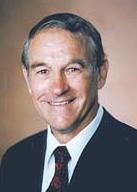 Mr. PAUL. For the past 2 years, the accumulation has been much greater.
Mr. GREENSPAN. That is correct, it has been.
Mr. PAUL. Thank you.
Dr. Ron Paul is a Republican member of Congress from Texas.
 Karl Rove and the Bomb