


US Out of Colombia
March 8, 2002
Get Out of Colombia
As a member of the House International Relations Committee and the Subcommittee on the Western Hemisphere, I would like to state my strong objections to the manner in which this piece of legislation was raised [a resolution urging further US meddling in Colombia as an anti-terrorist scheme]. I was only made aware of the existence of this legislation this morning, just a couple of hours before I was expected to vote on it. There was no committee markup of the legislation, nor was there any notice that this legislation would appear on today’s suspension calendar.
This legislation represents a very serious and significant shift in United States policy toward Colombia. It sets us on a slippery slope toward unwise military intervention in a foreign civil war that has nothing to do with the United States.
Our policy toward Colombia was already ill-advised when it consisted of an expensive front in our failed "war on drugs." Plan Colombia, launched nearly 2 years ago, sent $1.3 billion to Colombia under the guise of this war on drugs. A majority of that went to the Colombian military; much was no doubt lost through corruption. Though this massive assistance program was supposed to put an end to the FARC and other rebel groups involved in drug trafficking, 2 years later we are now being told — in this legislation and elsewhere — that the FARC and rebel groups are stronger than ever. So now we are being asked to provide even more assistance in an effort that seems to have had a result the opposite of what was intended. In effect, we are being asked to redouble failed efforts. That doesn’t make sense.
At the time Plan Colombia was introduced, President Clinton promised the American people that this action would in no way drag us into the Colombian civil war. This current legislation takes a bad policy and makes it much worse. This legislation calls for the United States "to assist the Government of Colombia protect its democracy from United States-designated foreign terrorist organizations . . . " In other words, this legislation elevates a civil war in Colombia to the level of the international war on terror, and it will drag us deep into the conflict.
There is a world of difference between a rebel group fighting a civil war in a foreign country and the kind of international terrorist organization that targeted the United States last September. As ruthless and violent as the three rebel groups in Colombia no doubt are, their struggle for power in that country is an internal one. None of the three appears to have any intention of carrying out terrorist activities in the United States. Should we become involved in a civil war against them, however, these organizations may well begin to view the United States as a legitimate target. What possible reason could there be for us to take on such a deadly risk? What possible rewards could there be for the United States support for one faction or the other in this civil war?
As with much of our interventionism, if you scratch the surface of the high-sounding calls to "protect democracy" and "stop drug trafficking," you often find commercial interests driving US foreign policy. This also appears to be the case in Colombia. And like Afghanistan, Kosovo, Iraq, and elsewhere, that commercial interest appears to be related to oil The U.S. administration request for FY 2003 includes a request for an additional $98 million to help protect the Cano-Limon Pipeline — jointly owned by the Colombian Government and Occidental Petroleum. Rebels have been blowing up parts of the pipeline and the resulting disruption of the flow of oil is costing Occidental Petroleum and the Colombian Government more than half a billion dollars per year. Now the administration wants the American taxpayer to finance the equipping and training of a security force to protect the pipeline, which much of the training coming from the US military. Since when is it the responsibility of the American citizen to subsidize risky investments made by private companies in foreign countries? And since when is it the duty of American service men and women to lay their lives on the line for these commercial interests?
Further intervention in the internal political and military affairs of Colombia will only increase the mistrust and anger of the average Colombian citizen toward the United States, as these citizens will face the prospect of an ongoing, United States-supported war in their country. Already Plan Colombia has fueled the deep resentment of Colombian farmers toward the United States. These farmers have seen their legitimate crops destroyed, water supply polluted, and families sprayed as powerful herbicides miss their intended marks. An escalation of American involvement will only make matters worse.
 At this critical time, our precious military and financial resources must not be diverted to a conflict that has nothing to do with the United States and poses no threat to the United States. Trying to designate increased military involvement in Colombia as a new front on the "war on terror" makes no sense at all. It will only draw the United States into a quagmire much like Vietnam. The Colombian civil war is now in its fourth decade; pretending that the fighting there is somehow related to our international war on terrorism is to stretch the imagination to the breaking point. It is unwise and dangerous.
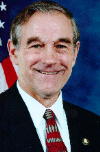
Dr. Ron Paul is a Republican member of Congress from Texas.
Copyright © Ron Paul
 Economics: The Weather-Vane Profession