


US Workers Starved Into Service
November 4, 2009
It was only a matter of time before the nation’s skyrocketing unemployment translated into new recruits for the most powerful military force in the world.
With the official US unemployment rate at 10 percent and climbing (that’s more than 15 million people struggling to put food on the table) and nearly double that number if you include part-time wage-earners who need full-time jobs, never mind all of those “discouraged workers,” it’s little wonder that so many of the nation’s jobless are flocking into its military recruitment offices.
After all, what better way for an unemployed American worker to survive the Great Recession of 2009 than in the “service” of his or her country?
Americans have a long history of consuming and/or killing their way out of crisis. And it isn’t looking as if that model will be up for reassessment anytime soon. The parameters of what we like to call the “national conversation” are as narrow as ever, and they are not widening under the current leadership. So far at least, even Obama’s “Clean Energy Economy” has failed to deliver enough “green jobs” (or any other color jobs for that matter) to begin the process of meaningful transition. With the season of consuming just around the corner, many Americans – especially those in blue-collar jobs like construction, manufacturing and retail service – are staring into the economic abyss.
It is hardly surprising in such an environment that a young person with dismal employment prospects and plummeting self-esteem would be easily seduced by an ad that promises “more than $49,000 in GI Bill Benefits” as does the US military’s current promo. The same ad promises that young recruits can “connect with military and veteran-friendly schools that offer VA approved education programs,” or “get information” about high-paying degrees like Criminal Justice, IT and Legal Studies.
So, when the Pentagon announced on October 13, 2009 that the military had met all of its recruitment goals for the first time since 1973, and that this just happened to coincide with the highest national unemployment rate since the government started keeping track in 1976, it wasn’t surprising that the news was met with a Big National Yawn.
 A Foreign Policy of Fr...
Best Price: $0.25
Buy New $8.85
(as of 06:20 UTC - Details)
A Foreign Policy of Fr...
Best Price: $0.25
Buy New $8.85
(as of 06:20 UTC - Details)

The Few, the Proud, the Desperate
It’s hard not to wonder what would happen if, instead of dutifully reading from the Pentagon’s script on October 13, the media had done their job and informed the public about the real nature of the “service” that potential enlistees were signing up for. Maybe if they had, those recruitment officers would not have been quite so busy recruiting – and stealing the lives of – unsuspecting young people in desperate need of employment.
Maybe those eager masses of young men and women wouldn’t have been so hot to sign up if, for instance, they understood that anyone enlisting in the military right now – whatever branch – is required to sign a document that states: "Laws and regulations that govern military personnel may change without notice to me. Such changes may affect my status, pay allowances, benefits and responsibilities as a member of the Armed Forces REGARDLESS of the provisions of this enlistment/re-enlistment document.” (DD Form4/1, 1998, Sec.9.5b).
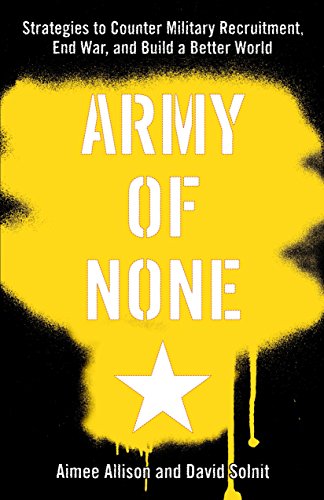 Army of None: Strategi...
Best Price: $3.31
Buy New $7.90
(as of 10:30 UTC - Details)
Army of None: Strategi...
Best Price: $3.31
Buy New $7.90
(as of 10:30 UTC - Details)
In their book Army of None, published in 2007, Aimee Allison and David Solnit advise those who expect the military to pay for their college to “read the fine print.” The authors point out that only a fraction of recruits who signed up for the Montgomery GI Bill received a dime, and that 65 percent “received no money at all for college.” If you receive a less than honorable discharge (as one in four do), leave the military early (as one in three do), or later decide not to go to college, “the military will keep your deposit and give you nothing.”
And when it comes to those signing bonuses, maybe if potential recruits understood that they will be forced to repay the money if he or she leaves the military before the agreed term of service (that’s eight years for first-time enlistees), perhaps they would reconsider signing away life and limb to get it. If those same applicants understood the army data from 2007 revealing that the top bonus of $20,000 was given to only 6 percent of enlistees who signed up for active duty, they might have figured out another way to survive the recession. They might be further divested of their illusions if they knew that military statistics show that 48 percent of enlistees report having “financial difficulty” and that some 33 percent of homeless men in the US are veterans, with nearly 200,000 veterans homeless on any given night.
And another thing: The military does not have to place recruits in their chosen career field or give them the specific training requested. Even if enlistees do receive training, it is often to develop skills that will not transfer to the civilian job market – like firing an M 240 machine gun.
By the way: Military recruiters are notorious liars.
Back in 2004, the New York Times reported that nearly one in five US Army recruiters was investigated for offenses ranging from u201Cthreats and coercion to false promises that applicants would not be sent to Iraq.u201D It’s doubtful that has changed just because the focus is now on Afghanistan. One veteran recruiter told a reporter for the Albany Times Union that, after recruiting for years, he couldn’t think of one recruiter who wasn’t dishonest about it, admitting that, “I did it myself."
Military Service Is Not the Only Option
Just because the Obama administration lacks the political courage to challenge the status quo doesn’t mean there are no other options. But Americans will need to “unlearn” a lot of what we’ve been taught if there is to be a meaningful transition to a peacetime economy.
We will need, for instance, to unlearn that the military is the only legitimate form of national service. We will need also to be willing to challenge those who tell us that being an artist, a pre-school teacher or (god-forbid) an activist, is not a respectable way to earn a living – or to serve one’s country.
 End the Fed
Best Price: $1.12
Buy New $8.53
(as of 10:10 UTC - Details)
End the Fed
Best Price: $1.12
Buy New $8.53
(as of 10:10 UTC - Details)
And while we’re un-learning things, maybe we should reconsider the US military budget.
By most estimates, maintaining the warfare state now consumes 54% of every federal tax dollar. Without first challenging that, we might as well kiss off any chances of ever seeing a “Clean Energy Economy” or, for that matter, anything resembling a future worth living. But first we’ll have to rid ourselves and our children of the idea that a culture rooted in killing and consuming can also be “sustainable.”
Maybe then we’d have a real war tax revolution.
Since the turn of the century, a growing number of high-ranking military officers are questioning the wisdom of – and the motivation behind – the US warfare state. In an open letter dated July 8, 2004, Special Forces Vet Stan Goff wrote to US military troops in Iraq:
“The big bosses are trying to gain control of the world’s energy supplies to twist the arms of future economic competitors. That’s what’s going on, and you need to understand it, then do what you need to do to hold on to your humanity …. Your so-called civilian leadership sees you as an expendable commodity. They don’t care about your nightmares, about the DU that you are breathing, about the loneliness, the doubts, the pain, or about how your humanity is stripped away a piece at a time. They will cut your benefits, deny your illnesses, and hide your wounded and dead from the public. They already are. They don’t care. So you have to. And to preserve your own humanity, you must recognize the humanity of the people whose nation you now occupy and know that both you and they are victims of the filthy rich bastards who are calling the shots."
Humanity has passed the tipping point – economically, culturally and environmentally. The “consuming and killing” model embraced by Americans as cultural norm is, in reality, a cultural aberration. It is destroying everything and everyone in its wake – including those who are fighting and dying to preserve it. In accepting such a model – often without question – Americans have become victims of their own complacency.
The price of such acquiescence may be our humanity.
Reprinted from Global Research.
November 4, 2009
Sandy Leon Vest is a radio and print journalist and the editor-publisher of SolarTimes, an independent quarterly energy newspaper with a progressive slant. SolarTimes is available online at www.solartimes.org, and distributed in hardcopy throughout the San Francisco Bay Area and beyond. Vest’s work has been published locally, as well as internationally, and includes 15 years at KPFA Radio in Berkeley, CA.
 Argentina: Disappearing Farmers, Disappearing Food