


The Columbus Era 1492–2009
June 22, 2009
On the evening of August 3, 1492, an Italian named Christopher Columbus departed from Palos de Frontera, Spain, in a flotilla of three ships. They were traveling under a Spanish flag and were headed west across the Atlantic Ocean. Their goal was to find a shorter passage to India.
The world was much bigger than Columbus had expected, with a continent and another ocean betweeen Europe and India. They never got to India, of course. Yet, with his small fleet, and with a modest crew, it is now clear that Columbus had embarked on a journey that would change the world.
When arriving in the new world on an island he named San Salvador, now part of the Bahamas, Columbus named the indigenous islanders there ‘Indians’, a misnomer that is still in use. In later journies Columbus would become a failure as a Governor administering this and other islands and he died still believing he had reached the east coast of Asia.
If not for the pure luck that America had gotten in the way, Columbus would have been consigned to being just another obscure footnote in history. But without knowing it, Columbus was taking one of the first steps to a establishing a world dominated by Europeans, and later their biggest power – the United States.
It can be argued that in the years since, as a result of Columbus and others from the age of exploration, to the age of colonialism, to the ‘global village’ of today, that the world has been dominated by Europeans’ and their descendants. That great journey of ‘white men’ who have surveyed, conquered, and vanquished the world for the past five hundred years is something I call “The Columbus Era”.
It can be argued that that epic period of time is now coming to an end. Other powers, particularly in Asia are in the forefront, while economic power is now being dispersed around the globe.
Yet, until just two years ago, it could be said that the established order was still in place. The G7, a rich mans club of nations seemed to still control the world. Their only non-white member – Japan, had been alone as the only ‘developed’ economy in Asia. We could until so recently believe that the Europeans and their offspring were still in charge.
Then we went into crisis, with a global economic meltdown started by con-men and cronies in Washington DC and New York, as well as their compatriates in London. Soon it spread from the capitals of world finance, to just about anywhere in the world there was trade and money. Within a few months the crisis and its aftermath had truly exposed the weaknesses of the existing status quo. The emperor had no clothes.
Yet, in America they continue on as if it is business as usual – by printing more money, and looking for more wars and conflict. Yet, they really don’t hold all the cards. America, is in dire straights, and if they can’t continue to borrow money from foreigners, well, the house of cards could fail.
In March, China – the largest holder of US treasuries and bonds, has said that Europe and Asia should trade without the dollar. This is a momentous event, for the dollar has been the world’s reserve currency, and its downfall will have dark ramifications for the US and its economy. Some say this is the beginning of the end for the dollar. We will soon be in a multi-polar world, that will no longer be dominated by people from the West. The East is rising, and they will claim their share of the world.
The Last Colonial Days
Due to some fortunate historical anomolies, Hong Kong and Macao were still administered by their colonial masters long after independence elsewhere in the world. Thus, even in 1980 when I first arrived in Hong Kong I was able to witness the last days of colonial rule in Asia. In those days, just being a white man was the key to opening doors in business, clubs, and society. It was the waning days of the British Empire, and I was glad to be a part of it.
 1421: The Year China D...
Best Price: $1.80
Buy New $5.24
(as of 10:53 UTC - Details)
1421: The Year China D...
Best Price: $1.80
Buy New $5.24
(as of 10:53 UTC - Details)

In the early 80’s it was also a good time to be an American expatriate, particularly in Asia. Stunning cities of today like Seoul, Singapore or Hong Kong, were then relatively sleepy backwaters, not yet part of the rich world. When I first went to Seoul they had just started to manufacture their first car. While in Singapore they were just building their shiny skyline, and Hong Kong still had people living in squalor, all over the place.
Most people thought that Americans and Europeans were the good guys and that the Russians were the bad guys. I also remember Hong Kong Chinese shaking their head in disbelief as China had deteriorated to one of the world’s poorest countries, while America, an upstart, was so rich.
They attributed it to our system, which they admired due to its transparency and perceived lack of corruption. It was the right time to be in a growing, vibrant, yet welcoming region. People like me with a degree from a prestigious university in the US or UK could easily land a good job in Hong Kong or Singapore, despite a lack of cultural or linguistic knowledge.
It is easy to see why America was admired. For America was a different country 30 years ago, as it was a country to reckon with on all fronts, and still very much the center of world commerce, technology, and politics. At the time America had recently withdrawn from Vietnam, and were at the time not fighting any major wars. China’s spectacular rise had not yet materialized, and only America’s complicit little surrogate – Japan, was the power in Asia to contend with.
My Hong Kong girlfriend, who was working for a Japanese company at the time, said her boss marveled that the USA could be so successful in controlling the world. He used to tell her, they (America) had developed a system where 10% of the people (who were smart) could lord it over the world. And, since people in Hong Kong or Japan were smarter, it was only a matter of time when they got their chance too. They just needed a system and some political clout too. Their day would come he assured her, maybe within the course of another generation.
Yet, it could be said, that with the exception of Japan, the world and its balance of economic power had not changed much for hundreds of years. There was the ‘West’ and Japan, and everyone else. Of course there was the USSR and their empire, but it was mostly irrelevant.
The West (Europe) and America in particular were seen as a beacon of hope and optimism for the world, and remained so up to the time of the Tiananmen massacre. As you may recall in 1989 that many of the student protestors admired and emulated America’s ideals, and the Goddess of Liberty they built was inspired by the Statue of Liberty.
I didn’t know it, nor could not have predicted it at the time, but the sun was setting on the white man’s empire. The British and Europeans were in retreat, yet, they could take comfort that they had been replaced by an even bigger power – America. So not all was bad. The English language was on the rise, and just about anything related to pop culture was spreading through the younger communities in all of Asia. Even black Americans such as Michael Jackson would get a rapturous welcome in Tokyo or Taipei.
Yet, it didn’t take long for Asia to start to reassert itself. China’s spectacular growth and other ‘tigers’ meant that East Asia was becoming the center of the economic world. Even after the troubles of the Asian economic crisis in the late 90’s, Asia rebounded, and has gone from strength to strength.
It is clear now that Western companies are losing their grip in Asia, particularly to the Japanese and Koreans, and also now to the Chinese. The Europeans can compete with high end products, but the vast majority of goods now seem to be made in Asia.
Meanwhile, those of us in the West with our cars and big screen TV’s, don’t mind working hard, but certainly will not do so for the same wage as a lowly Chinese. Well, that is a pretty arrogant attitude and will soon be an impractical approach. The market will surely equalize things, and it won’t be long that American wages don’t look so high as they do now.
So what happened? Don’t we have a right to maintain our higher standards of living despite our lower effort, and comparable I.Q. ? Shouldn’t someone in Hannover or Phoenix get paid more than someone in Shanghai or Manila for doing the same exact work? As you might expect, someone in Manila thinks they should certainly be compensated for doing the same work so they can live as well as their colleagues in the West.
A Bit of History
Back in 1492, Columbus had arrived on an island in what is now part of the Bahamas. We refer to this as "Columbus discovering America" despite the fact that the all the continents had been inhabited by people for over 10,000 years. Even all the islands of the Pacific were habitated. And, despite four voyages by Columbus to the new world, he actually never set foot on what is now the most powerful country in the world – America.
But, the white man had arrived. Not only in the "New World," but soon everywhere. And he would never leave. And, to this day, we have never thought to consult the Navajo, Inca, and Mayans, Igarot, Javanese, Hottentot, Bahraini (and others) whether they wanted us to be there in the first place. It was our destiny.
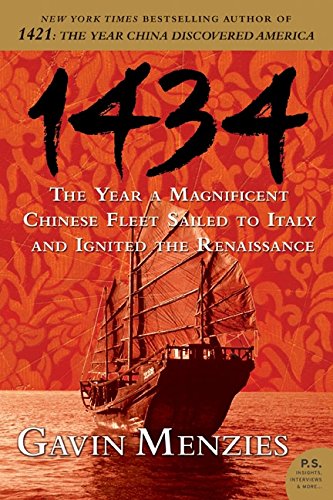 1434: The Year a Magni...
Best Price: $1.11
Buy New $9.51
(as of 10:53 UTC - Details)
1434: The Year a Magni...
Best Price: $1.11
Buy New $9.51
(as of 10:53 UTC - Details)
Hundreds of years ago it wasn’t preordained that the Europeans would conquer the world, for at the time the whole of the European economy was smaller than either that of India or China, and money was tight for such an extremely risky venture. Also, much of the technology that was utilized by Columbus and others, many that we consider to be Western inventions, were in fact, the inventions of the Arab middle-east, Persia, India, and China.
Also, only about 70 years before Columbus, much larger Chinese fleets commanded by Zheng He (a Chinese Admiral) traveled from China to East Africa and the middle-east. Their ships were ten times as large as Columbus’s vessels, and they had comparable technology. Actually, the Chinese discovered Africa and Australia before we did, and they could have easily gone East instead of West and gotten to America as well.
So, why did Europe conquer the world? While other places, particularly China did not. After all, China was larger and in many ways more technically advanced. It is a question for the ages, and one that has been asked by the proud Chinese pretty much continuously over the last five hundred years.
The fact was China was stagnant and riven with internal strife. Meanwhile, Europe was on the move, and was resuming its place in the world after years of slumber. Much of the rennaissance was based on re-discovering much of the legacies of Greek and Roman civilization which had been lost throughout the middle-ages, or dark ages.
We also must thank the Arabs as they had translated much of the Wests’ intellectual inheritance into Arabic. These works were then translated into Latin, Italian and other languages to enable people like Da Vinci, Huygens, Newton, and Galileo to reach the heights of scientific accomplishment. In addition to previous European knowledge, the Arabs also brought such new technologies such as the compass, gunpowder, and algebra, as well as chemistry and the manufacture of paper, which were among the most critical tools that the Europeans needed to conquer the world.
Actually, this transfer of knowledge was a result of the Arabs from Morocco colonizing in the West. For over 500 years, an Islamic caliphate ruled large areas of Spain and Portugal and such places as Granada are a testament to their architecture and technology. This goes along way to explain why Spain and Portugul were the first in Europe to sail the seven seas.
In fact, Europeans were not the earliest seafaring colonizers, just the most recently successful. Even Asians had come to Africa over fifteen hundred years ago, when people from what is now Indonesia (Borneo) arrived and then occupied the island of Madagascar. This was a sea voyage that is over twice as long as that of Columbus and his crew. Their terraced rice fields remain in Madagascar to this day, and much of the population are their descendants.
However, Columbus and his voyages were the beginning of a larger more extensive cultural journey. It was a seminal event. For never again would the Westerners be beholden or intimidated by the heathens of the world. The white man had arrived and would soon conquer the world, and dictate the terms of engagement.
Of course, for most of the world, this was the opening of the largest can of worms ever seen, as for many of the worlds indigenous populations, their first contact with Europeans meant death by new weapons or germs. The Carib Indians of Dominica who met Columbus in 1492 were decimated by disease and war. They were not alone, as this same story was repeated throughout the America’s for the next few centuries. They were the first casualties of what we now call globalization.
From now on the world will be a bit more messy, yet the fact remains, that never in the course of history have so many lives been changed and influenced by just one race of people. We can see evidence of this everywhere. From the fact that oil is priced in dollars, or that English is spoken in Singapore and India, and Brazilians or Koreans are mostly Christian.
Even the Chinese national anthem is played on western musical instruments, and the Indian Army emulates the British down to the last tassel. Even when the Chinese meet Vietnamese, the West will intrude, as the Vietnamese utilize a Western derived alphabet. For anyone in the world, just to post a simple letter or send an email requires the use of ‘our’ alphabet. They just can’t get away with doing it ‘their way’, they are dependent to use something from the West on daily basis.
The legal and economic systems of the existing world order are dominated by Europe, America, and its surrogates such as Japan and Australia. Western music, literature, and movies, continue to be popular throughout the world.
Meanwhile, the whole world has either embraced much of what the West has had to offer or been intimidated to do so. Few societies could make the transition from feudalism to steam engines and electricity. For most, the transition was bloody, and unstable. For it meant out with the old, and in with the new – on a wholesale basis, including political economic, and social norms. Sadly, for many countries it meant throwing the baby out with the bathwater.
So much of modern western culture as it is expressed globally is simply an extension of commercial interests, clothed in the sheeps wool of democracy. Thus, from British railroads, to American burger joints, much of what the world sees of ‘us’ is simply the existence of our successful commercial endeavors. When many discuss ‘the West’, it has mostly been a shorthand for what is modern.
If we look at Afghanistan now, there is this underlying belief that whatever it is that we bring to them, well, it is better than what they have or could make themselves. We never consider that just maybe they don’t want to have what we have, or be just like us. We can’t even consider that what ‘we’ do, is not necessarily right or appropriate for the downtrodden masses. It wouldn’t make sense if they didn’t want to eat hot dogs, and watch TV as we do.
Who doesn’t want modern anyway? Actually, there is a lot to be said for ice cream, cars, and computers. Yet, the fact is that we foisted it on the world, without their asking. Hell, we knew what was good for them, right?
In the case here the ‘we’ is really the Americans, and their perceptions of the world. All the European partners have soured on nation building in Afghanistan, and have come to the realistic conclusion that Afghans will always be Afghans. That if Alexander, Ghengis Khan, Tamerlane, the British, and the Russians would fail, well, the writing is on the wall.
Yet, it always hasn’t been so bad. After all, almost all former European colonies have gained their independence, and were able to retain what was good from their colonial masters if they desired. And, despite not asking for the invasions, disease and dislocations that we have wrought; much of the world by the 20th century had forgiven us for our transgressions. In recent years, these former colonies had their confidence restored, and many soon even welcomed our return as businessmen and missionaries.
It could be said, that from our perspective certainly, and from many of the vanquished, that the world is in many ways a better place because of Europe and then America’s influence in the world. Yet, it is the victor who has always written history, and from the victor’s standpoint, things are surely better – right?
Maybe the world is better, but we haven’t improved. Although we didn’t invent hypocrisy, we certainly perfected it. Just a few months ago at the UN General Assembly the President of the US (head white man) chastised the Russians (almost white men) for invading Georgia without provocation. Gee, haven’t I seen an unprovoked invasion before, and by who?
Certainly, George W. Bush is not a man who concerns himself with the burdens of comprehending history. Yet, if he did look back he would see that the world may be returning to its past of chaos, confusion, and multiple powers. For the uni-polar era of US world domination seems to have passed with a blink of an eye on Wall Street. For W.’s plan of invading foreign countries by using the money borrowed from foreigners, never was sustainable. The foreigners have always known that, even if he didn’t. After all, it was their money he was borrowing.
Yet, if we go back to the time of Columbus, the world was a far more complicated and diverse place. Although the great Eurasian landmass had seen contacts between East and West for thousands of years, there was nothing resembling a "global village", and few large empires. The idea of a nation state was not very developed (there were exceptions) nor were such modern concepts as human rights, or equality.
Europe was a fractured and divided continent, with most control still in the hands of the church and landed gentry. Asia had two major cultural and economic powers, India and China, and other large powers such as Turkey and Iran. They all had contacts among each other and with the rest of the known world. China had recently embarked on their great voyages to Australia, Mideast and Africa, but were now in a period of relative isolation. While the Ottoman Empire straddled East and West. The America’s were mainly tribal and undeveloped, as were Australia and Africa.
Technologically, Europe, the Middle-east and Asia were at parity, with no one region able to dominate another. Yet, that was about to change as Europeans were aggressive both commercially and culturally. They came to conquer, and as they saw it, they were the only ones who really had God on their side.
Yet, there were successful conquerors before, we just don’t acknowledge it. The wide arch from Morocco to Indonesia is dominated by Islamic cultures -it seems they had God on their side too. This happened prior to Europe’s re-awakening and colonization of the world.
In fact, the great conflict between Christian Europe and Islam had been going on for centuries – remember the Crusades? It is just that Europe was not able to conquer and colonize then, so it has been consigned to the ash-heap of history. Ever heard of Sinbad the sailor? Well, this is based on Persian, Arab, and Indian folklore of actual voyages from throughout the Indian Ocean.
So what made Europeans different? I guess the answer is, Europeans were the first to conquer all points of the globe, and they also developed industrially where resources were required from just about everywhere. Europe was very diverse culturally and economically. Columbus’s crew was multinational, and his benefactors had borrowed money from Jewish financiers in Germany. So this, was not simply a Spanish voyage, for even Columbus was Italian. Thus these competitive nation states kept trying to outdo each other in their enslavement of the world.
Thus, within 30 years of Columbus’s success, the Portuguese, Dutch, French, British, and Danish had sent ships to the New World, and the competition was in full swing. Sadly for the Inca’s or Aztecs; their great empires would be devastated and destroyed by this contact. As for Columbus, after declaring that all of the lands belonged to Spain (he didn’t ask the locals) he then proceeded to enslave the local population of Hispaniola to the point of rebellion. Some refer to the enslavement and killing of the native Taino people as genocide.
So, from this modest beginning, the world would never again be the same. If the Taino people could speak from the grave I am sure they would have some advice for the Chagossians who were expelled (thirty years ago) from their residence on Diego Garcia in the Indian Ocean (it is now a US/UK military base). Western imperialism is alive and well after all.
As I live in Thailand, it is possible to see the huge influence that western culture and technology has here. I can walk to a Sizzler’s restaurant or Starbucks, and enroll my child in a British or American run school, and then come home to watch CNN or BBC on TV. My daughter hardly knows that she is not in America, and refuses at times to even speak Thai.
For the people here, the vestiges of Western influence are everywhere even though Thailand was never colonized. The government buildings in Bangkok are modeled on those in Europe, and their parliamentarian debates are among men in suits and ties, and women in skirts. Children compete to be the countries best violinist, and they aspire to go to universities in the West, particularly in the UK or the US. Many schools offer a curriculum, in both Thai and English languages.
And, Thailand is not alone, pretty much the whole world is embracing English as a second language. Yet, I imagine that it will be years before the average American is educated simultaneously in both Chinese and English, if ever.
This is a story that can be duplicated throughout the world. Yet, despite this seemingly replication of European systems, it is alas, only a veneer. The Thai’s are fortunately still Thai’s in character and behavior. And, driving a Toyota, or watching Manchester City on TV is not enough to have them change their stripes. The same can be said of Mexicans, Serbs, or Turks.
So, we have seen a progression of Western Empires from Portugal, Spain, Holland, France, England, and now America. Each have enforced their view of reality onto the world. They have always done so from a position of strength, whether economic, technological, or cultural. At its peak the sun never set on the British Empire, and at its peak (about now) the American Empire has over 700 military bases overseas.
However, over the last few years, the American government has done much to damage the good will that white people as individuals had built up through the years. The aggressive stance of using the military to engage the world at gunpoint has not won us many friends. Sadly for Europe, they are equated with America in most ways, as America is really just an extension of what Europe is and was.
But it is not the economic legacy and modernity of the West that will be missed. It is the moral authority and ethical behavior that many wanted to emulate. After all, Europe and then America were seen as societies where there was more fairness, less rigidity, and more chances for the little guy. When I first came to Hong Kong they marveled at the fact there were so many educational opportunities in America from Junior College to University, many of them almost free. They envied our democratic institutions, and transparency, as opposed to the back room dealings of Hong Kong or intrigue of China.
Yet, much has changed now. Although Europe still has some credibility, for We as American’s are not held in high esteem any more. In addition to their contempt for our economic policies that have resulted in the financial meltdown of Wall Street, they see no value in our form of democracy either. Friends of mine who were educated in the states, and 20 years ago very pro-American, now refuse to send their kids to school there, and avoid business trips due to what they perceive as the beginnings of a police state. These are the same people who would be most disposed to spread our values, and embrace our culture, and they are rejecting it.
Meanwhile, with our economy in crisis, I am hearing from people in China say such things as "don’t worry, America will never be a third world country". Very comforting, indeed.
Now in the year 2009 it is obvious that change is in the air. Asia is on the rise, and if America is on top of the world now, it is only doing so with tenuous grip, as the winds of change buffet it from its perch. When America goes down it will take much of Europe with it. For when America stumbles, Europe, Australia, and other outposts of the white crusaders will be tarnished as well.
Who will Asia emulate now? If America’s brand and panache is degraded and thus devalued, who to look at for inspiration now? Maybe nobody. They will mix and match from many sources, rather than just rely obediently on answers from a white man.
We see other powers on the rise, particularly China. The successful Olympics and the associated publicity has put China on the world stage, maybe this time for good. I was in China during the Olympics, and watched the opening ceremony in Shenzhen among some baffled, yet proud observers. This ascendancy had been so long in coming , and with so many false starts, that many Chinese saw their could not believe their eyes. Such a spectacular Olympics ceremony, it was almost too good to be true.
There was a quiet confidence among the crowds, that yes, China was back, and the Chinese people could be proud again. When the opening ceremony show ended my wife said "that was terrible, they have no respect for anyone". She was referring to the Londoners, not the Chinese. Her point was that since China made such an effort to impress the world, the British didn’t have the courtesy to reply sufficiently in kind. Their silly ‘Red London Bus’ show, with David Beckham kicking a football, well, that was another injustice visited on Asians by the West.
Well, China has arrived on the world stage, and their success in undeniable. It sure won’t be easy for London to eclipse this Olympics, as China has raised the bar. Actually, ‘the bar’ has been raised many times before. In 1964 Tokyo made their debut, and quite impressively, and the same could be same of Seoul in 1988.
But this is China, which raises the stakes to a whole different level. After all, China has a larger population than all the Olympic host countries of the last 100 years. Got that? More than all of them combined. Also, at this Olympics, China won the most gold medals, by a large margin. America will most likely have to get used to being Number two.
From the Chinese perspective they have been playing catchup with the West for 500 years, and have almost always failed to impress. Not this time. Even though the Olympics were a Greek invention, and most of the sports, and all of the rules, were set up by white people in the West. This time they beat us at our own game, yet on their turf.
That is the way things have been. The West has defined the world, and dealt with others by using their own rules. In most instances, such as banking, commerce, law, music, military, and politics, we were the u2018gold standard'. In fact, nothing could really be accomplished without the Wests' blessings. Thus, we have never felt shy about imposing our values or systems on others – after all we were superior. The most extreme example was the time of Western conquest and colonialism.
However, this realization by the West that China is capable of doing anything we can do, really puts the world on notice. China and its over one billion people are poised to change the world. And, they are not alone. The so-called BRIC (Brazil, Russia, India, and China) together have the people, money, skills, and motivation to change the world order that had excluded them for so long.
I look upon this paradigm shift with a bit of trepidation. After all, I am an American White Male. I say three strikes for the status quo. The existing world order and its glass ceilings suits me fine, as all the negatives really don’t apply to me. Yet, I recognize that when others are beating us at our own game, they deserve our respect.
Yet, I am among the first generation to witness the precipitous decline of the West compared to the rest of the world. This has been a long time coming, and for many it is the first time to negotiate with the white man on equal terms. For past colonies of European powers such as Indonesia or Brazil, and dominated countries of the American empire like the Philippines and Korea, this is a welcome change. They actually believe some of the idealism that Europe and America espouse, and hey, maybe they deserve to be treated fairly.
The fact that others are now our equals and can achieve much if not all that we can, is not so bad. It doesn’t mean the world is going to go to hell. It just means that like a parent watching their kids grow up, we are simply losing control over our offspring, and that they will rewrite the world in their own image. For those of us in the West, that doesn’t mean we eat any less, but maybe it means the free ride is over. For the old world order is now gone.
A few months ago India sent a spacecraft to the moon. They did so without being beholden to anyone. China is now the world’s largest automobile market, bigger than the US.
America particularly has demonstrated that we don’t have the perfect system, and that we can fail just as spectacularly as everyone else. And, it turns out the world is not as homogeneous as we may think. Not everyone wants a hamburger in their freezer and credit cards in their drawers. Maybe there are alternatives to the one size fits all crony-capitalist model that we seem to have run aground. Maybe China, India, and others will have some new ideas to put us back on track.
Besides, life is not just about money and fast cars. Most of the world has always known that, it is just that we may have forgotten our roots. My Grandmother knew where she was from, and she was frugal and hard working. For her government was an abstract with whom she wanted no part of. She was happy with her local life, and local friends. She didn’t even enjoy watching TV, visiting doctors, or taking on debt. Yet, she was part of the generation that really solidified American culture, in a good way.
And, the funny thing is, America through the behavior of Americans like her, was admired for our ideals, our political system, and our culture. No, not the Britney Spears culture, but the one of generosity and tolerance, that enabled millions of immigrants to assimilate and join the American dream. No other country has absorbed so many different and diverse people so successfully. For years, youth and intellectuals around the world looked to America as a shining light, and example of how to run a society. They valued our opinion, and in many ways we kept this exalted status until just recently.
Yet, recent generations in America have truly believed that the worlds’ people want to emulate not just our economy, but our pocketbook. This is of course only partly true. Sure everybody wants to live better, and money is a requirement. But as we have seen in Europe and Japan, they have taken a more moderate route, as they try to retain the old, without penalizing the new.
America though has always had the belief that if it sells, and makes money it must be good. Yet, this model has gone astray, as for years now we have been borrowing money from foreigners to keep our house of cards afloat. And, now that the warts have been exposed, just where are our ideals? I guess out to lunch.
You may recall when the Nez Pearce Indians were relocated by treaty, that the paperwork was signed not by the leaders of the tribe but by their ‘lawyer’. Effectively, their land was sold right from under their feet, by a traitorous member of the family.
Something like that is happening now, the American people are being committed to buy companies and take on mountains of debt without being asked. There is a government ‘lawyer’ or elected representative to sign the paperwork on their behalf. But the result is, you now have new mortgages to pay, forever, without your consent. I am sure that Sitting Bull is happy to see us suffer.
America is in the process of a socialistic experiment to bail out billionaires with the middle classes hard earned money. We have simply done again what is expedient, yet, it will only defer the day of reckoning. American politicians, and Wall street elite are morally, ethically and financially bankrupt. It is no longer a model for the world. When the people with money (foreigners) start to call in their debt, you can’t blame them for being a bit smug. We have been warned that our reckless habits would one day not go unpunished, well that day is coming soon.
For the fact is that money has no conscience, only people do. You can’t expect an unrestrained free market to resolve all the worlds’ problems. The world has been there before, and what has come about – Marx, Stalin, and Mao. Thankfully, nobody of such stature is on the horizon, and maybe this time the world will be more measured in their response to the global meltdown.
But the fact is, for America, it will be the first time in generations where they will have to deal with the world on equal terms. That means no more dealings exclusively in dollars, and as they go cap in hand to beg, they better be contrite. Yet, knowing the attitude of the bankers and Washington elite, I am not optimistic, as they continue to assume they control the world.
The major consequence of this crisis is that America will no longer have the resources to finance their military adventures and empire. This costly endeavor is simply not sustainable. They will have to choose their battles more carefully, and withdraw from most of the world. This is not unlike the British after the second world war, but the difference is that America has over 700 military bases, while the British only had 40.
Yet, the world will carry on, and there is no reason to panic. In Thailand even with the foreigners owning banks, retail stores, and property, life goes on. As much of the world has found out, having foreign corporations owning much of your economy is really not a bad thing, and it won’t be too bad for America either.
As far as your grandchildren, well, now is not too late to write them a letter of apology for the lower standard of living you have consigned them to. Maybe they will learn to speak Chinese, or get a PHD in Physics, and maybe the Engineering School at Berkeley will start to have more whites enrolled. Or maybe not.
Yet, we can thank Cook, De Gama, Newton, Galileo, Nelson, Edison, Darwin, Nelson, Disraeli, Mountbatten, Roosevelt, Einstein, and others, for we did have a good run. Five hundred years of being top dog. But, it looks like one thing is certain, the Columbus era has ended, and most of the world thinks that is a good thing.
For me, I’m not so sure if that is good, for I was quite comfortable with the old world order, and I am not sure if what comes next will be better. After all, the American system is a somewhat benevolent one when compared to India, China or Russia. Yet now, not only China or India, but other countries are rising, and they are not only changing the balance of power, but they have also altered the balance of perceptions as well. The world is a different place.
What if Columbus was around now, just what would he do? My guess is that he is in lots of debt for a failed investment in a gold mine, and is lucky to be collecting the dole in Genoa.
June 22, 2009
 Free Leonard Peltier!