


Wag the Dog
July 5, 2005
American Foreign Policy Explained
by Ryan McMaken by Ryan McMaken
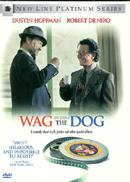 Wag the Dog: Platinum Edition (2003) New Line Home Entertainment
When it was first released in 1997, Barry Levinson’s film Wag the Dog was a hit among Conservatives. Many saw it as commentary on the Clinton administration’s use of military operations to distract from a variety of domestic scandals and lackluster policies. By 1999, with the unfolding of the Lewinsky scandal, the impeachment proceedings, and the convenient timing of Operation Desert Fox, the film would come to be regarded as uncannily prophetic.
Given the fact that the fictional president in Wag the Dog was using a staged war to distract from his electoral problems, the film seemed to many Conservatives like a hilarious send-up of presidential foreign policy. Life imitated art so closely in fact, that many analysts of international affairs (including numerous Conservative pundits) began to refer to a "Wag the Dog situation" surrounding Clinton’s wars of the late 90’s.
The accusations were hardly unfounded. Clinton used these tactics well. In fact, Operation Desert Fox, one of the virtually perennial bombing raids on Iraq since Bush 41’s invasion, successfully delayed some of the votes necessary in the House for the impeachment proceedings to proceed. Coupled with the ongoing bombing of Serbia in Operation Allied Force, Clinton had managed to get two splendid little wars going as the impeachment approached. Given the fact that Americans can always be relied upon to rally ’round the flag like Pavlov’s dog any time Americans are bombing some tiny foreign country, the mini-wars did manage to distract from the doomed impeachment effort and to many, made it look like an inconsequential sideshow. After all, what is impeachment compared to war?
The connection drawn by the Clinton-haters was certainly appropriate, but the film had not been created with Clinton in mind. According to its creators, the film was based on the novel American Hero by Larry Beinhart, in which it is discovered that Bush 41’s Operation Desert Storm was actually a Hollywood production choreographed by White House press agents and mainstream filmmakers. While the novel specifically targeted Bush, the makers of Wag the Dog, were smart enough to avoid making any direct connections to any particular president or political party.
In interviews, Levinson would note that the tools of deception and mass manipulation used in the film are a trademark of the modern presidency in general, not the mark of any particular president. Thus, the film features an "everyman" president. Nameless, faceless, without political affiliation, this president can be any president, and he does what any president is willing to do: whatever it takes to be re-elected.
At first, the film seems like dozens of other mediocre "political" movies, featuring a popularity crisis for a president, and how he deals with it. Yet Wag the Dog takes a turn that is so cynical, so abusive of American gullibility, and so unpleasantly close to real life, that the viewer soon finds himself both enthralled and repulsed.
As one would expect in the age of Clinton, the movie opens with a president caught sexually assaulting a teenage girl. There are only two weeks until the election, and the president’s new strategist, Conrad Brean (Robert De Niro) concludes that a war with some inconsequential foreign backwater would solve the "problem." Rather than fight a real, war, Brean wonders, why not fight a fake one? It would be cheaper, and there’s no danger of American casualties.
When the press secretary (Anne Heche) worries that "they will find out" Brean asks "who are u2018they’? The American people? Who’s gonna tell ’em?”There’s hardly any danger in them figuring anything out on their own. Seeing is believing after all, and who is the public going to believe? Some kook’s theory about the war, or the real life war right there on the screen in front of them?
This disconnect between the images on the screen and the situation in the real world is the central conceit of the movie, and it is Brean’s greatest weapon. Brean knows that the public will never question the images fed to them by the unblinking eye of the television, even when they’re provided with virtually no evidence at all. In fact, the less visual evidence, the better. Let the spin do the rest.
Enlisting the help of Hollywood producer Stanley Motss (Dustin Hoffman) to "produce" the war, Brean explains the rules of the game:
"You watched the Gulf War. What did you see day after day? The one smart bomb falling down a chimney. The truth? I was in that building when we shot that shot. We shot it in a studio in Falls Church, Virginia on a 1/10th scale model of a building."
"Is that true?"
"How the f__k do we know?"
Brean is able to secure Motss and a team of other top talent for his "pageant" of war, but Brean is always careful to deliver a special message: "You can’t tell anyone about this," he tells them with a smile. The murderous threat behind that smile is not lost on anyone.
The pageant continues, Albania is named the new national enemy and production begins on fabricated newsreels, patriotic songs, and "F__k Albania" t-shirts. Motss calls in "The Fad King" (Denis Leary) to create a successor to the "yellow ribbon" phenomenon, which we learn, was itself a creation of the government public relations machine.
But why Albania?:
"We have to have something they want," Motss wonders, "what do we have that they want?"
"Uhhh…freedom?"
"Well, why would they want that?"
"Uhhh…oppressed?"
"No, no, no, f__k freedom, they want to destroy the godless Satan — they want to destroy our way of life!"
But the question of why to invade remains…
"We just found out they have The Bomb — suitcase bomb — and it’s in Canada!"
It only takes minutes to get the brain-dead press hooked on this bogus story, of course, and soon, opposition melts in Washington. But as time goes on, it’s increasingly difficult to keep the public entertained by a war in a place as presumably uninteresting as Albania. So, as the "war" effort stalls, Motss and Brean decide that what every war needs is a war hero. They find a mental patient named Willie Schumann, and trot him out as America’s new hero. The Fad King, inspired by Schumann’s surname, orchestrates the "discovery" of an old blues tune "Old Shoe." Women weep at the mere invocation of Schumann’s name, and masses of school children take part in great shoe-related demonstrations in a "spontaneous moment of sheer patriotism."
The whole thing ends as every militaristic farce must— with a state funeral for the dead soldiers as the politicians (all alive and well) look on. Willie Schumann is laid to rest by the invented Special Forces Unit, "the men of the 303." The public swoons, the President is re-elected, and secrecy is assured forever when Stanley Motss soon turns up dead following a "heart attack." Americans sit glued to their television sets drinking it all in, staring blankly, believing everything.
In the end, as much as the Conservatives might have missed it during the Clinton years, Wag the Dog isn’t just a film about using wars to distract from the personal problems and power abuses of presidents. It’s a mocking and venomous commentary on the entire enterprise of war in America, the deceptions concocted by governments, and the American willingness to believe virtually anything, as long as the evening news tells them its true. The arbitrary selection of Albania as a threat against the "godless Satan" is the product of about as much realistic analysis as the conclusion that "they hate us because we’re free." The latter catchphrase is no doubt a line that Levinson can only wish he had thought up first.
So while once promoted by the anti-Clinton forces as a "must see" it’s not exactly difficult to see why Wag the Dog has so fallen out of favor with the Conservative punditry. For them, the joke just isn’t funny anymore. It doesn’t take a degree in film studies to see the Willie Schumann scam in the Army’s attempts at lionizing Pat Tillman or Jessica Lynch. Even Walter Jones now sees the idiocy of the anti-French "Freedom Fries" hysteria. And most damaging and lasting of all: Iraq’s weapons of mass destruction have turned out to be about as realistic as the Albanian suitcase bomb in Canada.
Much of this stems from the fact that American Conservatism’s opposition to unconstitutional wars and interventionist foreign policy during the 1990’s was about as serious as Albania’s nuclear weapons program. All it ever really amounted to was an opposition to Clinton’s unconstitutional wars. Once upon a time, Conservatives claimed to revile government, to revel in the exposure of its lies, its manipulations, and its paper dragon "enemies." Today, of course, the whole idea of Conservative opposition to government intervention is an oxymoron. Conservatives are in the excuse-making business for pretty much anything the White House does as long as their man is living in it.
 In the years since its original release, Wag the Dog has only become more insightful and more prophetic in its vision of America’s relationship with the media in wartime. Featuring a haunting soundtrack by Mark Knopfler and showcasing some of the best comic work ever done by Dustin Hoffman, this film stands on its own simply as an entertaining feature, but it should also rank as one of the greatest satires Hollywood has ever produced. In 2005, the age of gutless media, it’s hard to imagine a movie like this one being made at all, but thankfully that’s unnecessary. This film hasn’t aged a day, and Wag the Dog is more relevant today than ever.
The new Platinum Edition features a running commentary by the director and Dustin Hoffman, a featurette on Hollywood and politics, and interviews.
 Missing Officers