


Heroes of the Old West
July 26, 2004
 When I was growing up in Kentucky in the 1960’s, one of my favorite TV shows was Davy Crockett.
 As the story went, Davy Crockett was the best hunter, Indian fighter and politician of his time. He died in Texas trying to fend off the invading Mexican army. The legend of Davy Crockett belongs to a collection of stories that are intended to define America’s national character.
 Probably the most famous American legend after Davy Crockett is Johnny Appleseed. After Davy and the Pioneers had conquered the frontier, Johnny set forth on an apple crusade armed with a Bible and cooking pot. Johnny Appleseed was an actual man named John Chapman, he helped settlers to comply with Federal law. You had to plant fifty apple trees if you wanted a free homestead.
 Then there was Pecos Bill, the greatest cowboy who ever lived. Pecos Bill rode a horse named Widowmaker; the two of them were best friends UNTIL Sluefoot Sue showed up.
 Sluefoot Sue was a beautiful girl who came riding down the river on the back of a fish. When Pecos Bill saw her, his belly did flip-flops. So, he asked Sluefoot Sue for her hand in marriage, and she agreed. But she had two demands.
 First, she wanted a bouncy bustle (It was the latest style). Second, she wanted to ride Widowmaker. Unfortunately, things didn’t work out. As soon as Sluefoot Sue was mounted in the saddle, Widowmaker started bucking.
Sluefoot Sue’s bouncy bustle caused her to bounce higher and higher until the reins broke, and she was bucked into the sky never to be seen again. Thus, she was punished for three separate crimes: vanity, conduct unbecoming a lady, and getting between a man and his horse.
 The last of the State legends that I will include in this story is John Henry, the steel-driving man. He was killed while attempting to compete with a steam drill. Each of these legends is designed to speak to some point in the nation’s past.
But State sponsored legends only tell part of the American story. To really understand the broader sweep of American folklore, you must also examine American film. Especially the Western as it began early in this century, and especially the bad guys.
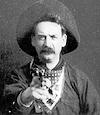 The first bad guys appeared in a film called The Great Train Robbery. The villains of this movie board a train and kill the crew.
 Ultimately, they are destroyed, but at the end of the movie there is an important scene. A tough looking desperado (played by George Barnes) fires his six-shooter directly into the camera. This gunslinger would become the model of masculinity upon which all future Western villains would be based. And where you have villains, you must have heroes.
 So, let’s examine one of the most important heroes of American film. The meanest gunslinger of them all: William S. Hart. Hart was a Shakespearean actor, and a huge fan of Western culture. He brought the frontier ethos to Hollywood: Solitary individualism and the cowboy code of silence. Hart was actually one of two pre-depression Western Heroes. The other was The Virginian. Played by Gary Cooper, The Virginian was released in November of 1929, only a month after the stock market crash. The ruthlessness of both The Virginian and William S. Hart were designed to reflect a change in values that Washington wanted to impose on the American people in response to the terrible economic conditions of the depression. (Never mind who caused the depression in the first place).
 In particular, Washington wanted to promote the idea that fixing America’s problems would require ruthlessness and direct physical action.
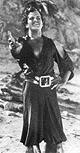 Now we must briefly discuss two men who came before Hart and the Virginian: Tom Mix and Douglas Fairbanks. Tom Mix was the nice guy cowboy. He carried guns, but he didn’t use them. Instead, he used his lasso to rope the bad guys. He was often rescued by his best friend, Tony the Wondorhorse. Mix represented a model of manhood that was based on strength and kindness, and he shared the roaring twenties with another screen hero: Douglas Fairbanks. Fairbanks was the ultimate Anglo Saxon. He combined athleticism, charm, and good looks, but more importantly, his characters always portrayed fully integrated men. Fairbanks sense of humor and charm stood in direct contrast to most of the other masculine heroes of the American screen that would come later.
 Now that we have discussed the nice guys and the not-so-nice guys, let’s turn to the gangsters. At the beginning of the great depression, millions of people were thrown out of work, and some began to feel that the system of Capitalism had failed. Even though the Communist party in America had never been strong, Washington launched an all out anti-communism campaign to promote toughness, individualism, and self-reliance. It is from these anti-communist roots that the Gangster hero was born. The most important Gangster movie was called Little Caesar.
 Hollywood hoped that when people watched Little Caesar fight and win in the struggle for money and power, they would be able to experience release of their own frustrations. Little Caesar was an anti-communist. So is Fifty Cent.
Thus, an evolution of American masculinity emerged: The charm and integrity of Mix and Fairbanks, morphed to become the ruthlessness of Hart and the Virginian, and then morphed again to become the anti-social viciousness of Little Caesar. While the story above is incomplete, it illustrates the role that Washington and Hollywood have played in shaping the American masculine worldview.
 Along these same lines, Washington constantly reinforces the image of the frontiersmen because he forms a connection between the Virginian and the Patriot. Both are pro-state anti-intellectuals. Hart and the Virginian may have been tough, but they were not thinking men. They knew instinctively what was right and wrong and took action. This formula is repeated again and again by modern actors such as Charles Bronson, Clint Eastwood, and Arnold Schwarzenegger.
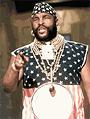 To better illustrate the relationship between the Virginian character type and the Patriot, look at the two pictures. The picture of Mr. T above left shows him as a Little Caesar/Virginian blend. The lower right picture shows him as Patriot. In both images masculine identity is equated with a lack of introspection. Both are tough anti-intellectuals; real American men.
If we use the history of the cinema as a guide, American masculinity can be expressed through three primary character types;
1. The Virginian 2. Tom Mix 3. Little Caesar
Hollywood has actually summed up these character types in a movie called:
The Man Who Shot Liberty Valence
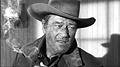 Starring John Wayne, this movie was an attempt by Hollywood to come to terms with the closing of the frontier. It was intended to be a sad look at the loss of the values of the old West. What makes this movie special is that it clearly shows the conflict between the three primary American masculine character types:
John Wayne (above) as Tom Doniphon plays a ruthless frontiersman (The Virginian).
 Lee Marvin (right) as Liberty Valence plays an outlaw (Little Caesar), And James Stewart (below) as Ransom Stoddard plays an effeminate intellectual (Tom Mix).
 The premise of the movie is that after the American frontier had been conquered, the gunslingers would have to be eliminated since their services were no longer required. But who could get rid of these bad men? In the movie, two choices are given.
The first is that the conquered West will have to be civilized by Virginians; men of action who can meet the bad guys blow for blow. The second is that the West will be civilized by men of reason; The Mix’s. In the end, the movie concludes that only Virginians are qualified to do this job. Like another movie, The Magnificent Seven, it was a sad farewell to the old West.
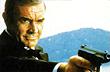 In noting the passing of the men of the West, however, Hollywood created two replacement heroes: James Bond, and Harry Callahan. Again, they are extensions of the Virginian/Mix/Caesar formula.
Bond was designed, above all, to be an employee of the government. In fact, the central message of all Bond movies is that government men have to protect the common people. Bond may be tough, but he is always obedient. The message is clear: Real men follow orders. And lesser men (non-government men) should never interfere.
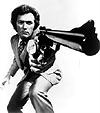 The other government hero was Clint Eastwood as Harry Callahan. But before we cover Callahan in detail, it’s important to note why Hollywood brought him into existence. Earlier in the century, two films had been made in an attempt to address the growing alienation of the American people from government: The first was Mr. Smith goes to Washington, filmed in 1939 and the second was On the Waterfront, filmed in 1954. The theme of both movies was that government can still be reformed, if you just get rid of the few bad apples.
When it became obvious in the 1970’s that the Federal government had become hopelessly corrupt, Washington responded by ordering Hollywood to endorse all forms of government; especially law enforcement.
Hollywood obediently responded by reverting yet again to the Virginian/Mix/Caesar formula. They created Callahan. Silent, athletic, and willing to break the law, Callahan became a government superhero. In reality, Callahan had several roles to play. First, he was intended to send the message that men of few words (like the Virginian) are necessary to maintain the social order.
Second, Callahan made it clear that breaking the rules (like Little Caesar) is a necessary part of survival, especially for cops. Bond and Callahan had another thing in common: Both of them were designed to promote the idea that social unrest is never justified. True men, we are told, place themselves under the control of government, which is the only organization that has enough information to make wise decisions.
Thus, Hollywood and Washington created a complete system of American masculine mythology. But to understand this mythology you have to understand the underlying character types.
The Virginian — Tough, anti-intellectual, pro-state, silent, man of action.
Tom Mix — Sensitive, intelligent, honest, fully integrated, good guy.
Little Caesar — Ruthless, independent, brash, competitive, fighter.
 Actually, The Virginian, Tom Mix, and Little Caesar are not character types. They are archetypes. What is an archetype? Well, to answer that you need to know about a psychologist named C.G. Jung. He was an expert on mythology. Jung discovered that every culture has invisible heroes. In psychological terms, these heroes are called archetypes. They can be combined in different ways to create masculine role-models. Thus, The Virginian, Tom Mix, and Little Caesar archetypes can be combined to create men like Bond, Callahan, and even a President.
 To illustrate, consider all the recent talk about Ronald Reagan. The federal government loved Reagan. In their view, he was a tough, silent law-man, not afraid to stand down the evil Soviets. As a result, he received the highest honor that the American government could bestow. He wasn’t Sainted; he was Virginianized.
C.G. Jung’s most important discovery was that archetypes are responsible for character development. When he died, his work was continued by another man: Erik Erikson. Erikson was an expert on the human life cycle. He was fascinated with the invisible role-models that Jung had identified. Erikson discovered that If the archetypes can peacefully coexist within a man, he will reach a position of ego integrity. If they cannot, the resulting internal conflict will lead to neurosis.
Thus, an epic struggle take place in the heart of every young man as he struggles to achieve this position of ego integrity. In America, it’s a battle between the three Anglo-Protestant archetypes: The Virginian, Tom Mix, and Little Caesar. Ultimately, every young American man must reconcile these three identities, and then choose one who will serve as a role model for the rest of his life. In general, Anglo Saxon boys favor the Virginian, Jewish boys favor Tom Mix, and Black boys favor Little Caesar.
For such an important life decision, one would think that the American educational system would be right there, helping young men along with information and good advice. Obviously, that is not the case. Why not? Because the country is at war. With the Arabs? No. In the eyes of Washington, war is a permanent condition. Although the total number of wars are difficult to estimate, the most important ones are probably the oil war, the intellectual property war, the currency war, and the tax war. So, how do you win a war?
By controlling as much information as possible.
This leads to a question: What is more important: Giving young men the knowledge that they need to reach a position of integrity as they move through the stages of the life cycle, or protecting the State? The answer, of course, is to give young men the knowledge. Young men are real; the State is just a collection of special interest groups, nothing more.
I’ve already noted that boys who prioritize the Virginian or Little Caesar archetype tend to become anti-intellectuals. This may explain to some extent the huge drop in literacy and the low college attendance of America’s young men. Many people believe that the source of America’s masculine anti-intellectualism is unknown, but to a large extent it’s the result of a policy decision made in Washington. In 1975 The DOD gave a $100 million grant to a think-tank called The Stanford Research Institute, also known as SRI. In return, SRI produced a flowchart of American archetypes. The report was called: The Changing Images of Man. The purpose of the report was to redefine Christianity and American Culture so that it could be analyzed in terms of behavioral science. The flowcharts trace (among other things) the stages of character development of young men and women. The charts also show how particular types of character development can promoted, or blocked.
And in terms of character development, another issue related to SRI has emerged: Mental illness among little boys. One of the most common forms is called Attention Deficit Disorder. It’s a so-called mystery disease that causes boys to misbehave for no apparent reason. I’m willing to bet that many of these young men are simply trying to reconcile their archetypes. It’s interesting to note that Anglo Saxon boys comprise the majority of diagnosed ADHD cases, and there is probably a good reason for that. As noted earlier, white boys tend to become Virginians.
Teachers in the feminized school system instinctively recognize the three archetypes and respond to each in a different manner. The Tom Mix’s are fully cooperative, and thus represent no threat. The Little Caesars are completely outside the system, and thus judged to be not dangerous. But the Virginians are a problem. These boys represent independent masculine strength inside the system. To a feminist, this is unacceptable. The teacher hates the young Virginian because he is masculine, and he hates her because she is blocking his archetypical fantasy. So what is the answer? Ritalin.
America’s boys are being forced to internalize the worldview of The Virginian, Tom Mix, and Little Caesar as a single unit; they are never allowed to see the three archetypes separately, or to understand the separate worldview that each archetype represents. As a result, the boys suffer terribly in the attempt to reconcile forces that they can’t understand. This leads to criminal behavior, and leaves many adults wondering why America’s young men have so many problems. There is, of course, a solution to all this: Tell them the truth.
All young men should be thoroughly trained in the archetypes, and the stages of the life cycle. They will be healthier and happier, and everyone else will be too.
 SEC vs. Free Speech