


War Remembrance
December 28, 2005
Human history, it might be said, is simply a series of wars. Virtually all cultures have put war and warriors on a pedestal; literally on monuments, but also figuratively in art, literature, and museums. Through these means we remember war. I have been thinking about how we should remember war. What kind of war museum could depict the ultimate horror of war?
A couple of years ago I taught American engineering students in Brussels. I lived near the Cinquantenaire Park where there is a rather quaint military museum.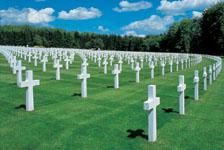 It is quaint, because the displays are amateurish by typical US standards; however, the collection is good, especially with pieces from the Napoleonic wars (Waterloo is nearby) and the two world wars. It is pleasant to visit on a quiet afternoon to watch the Belgian school children as well as to view the exhibits. In a manner, the museum makes war seem fun, a great game.
 Our group visited the American Military Cemetery at Hamm, Luxembourg. The immaculate rows of graves, the chapel, the monuments depicting the campaigns of the fallen, and the grave of General Patton make this a special place. The majority of these valiant soldiers had perished during the Battle of the Bulge as the cemetery is located in the Arden Forest. One could not help but to desire to die for the US and to be buried at a place like this.
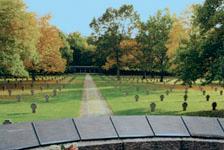 Only about one mile away is a Cemetery for German Soldiers at Sandweiler. Here the grounds are not so immaculate, there are four corpses buried under each stone, and of course they were the enemy fighting for Hitler’s Germany. Yet it is still moving, especially noting the young age of many of the victims, younger than the college students I was traveling with.
War is certainly not all fun, and nor even all honor and glory. There are victims, not only enemy soldiers, but totally innocent and defenseless civilians. I saw this depicted in two very famous paintings on a trip to Madrid to visit another group of students. In the Prado Museum is the painting the "Execution on May 3rd, 1808" by Francisco de Goya.
In this scene Spanish citizens are being executed by French soldiers after a rebellion. Nearby at the Reina Sofía, Spain’s national museum of modern art, is the mural "Guernica" by Pablo Picasso.
This abstract vision of the population of the town of Guernica being bombed by the German Luftwaffe during the Spanish civil war is perhaps the most well-known image depicting the horror of modern war.
A very different wartime museum is located a few miles north of Brussels in the prosperous, little, Flemish town of Mechelen. The dean of the college I was teaching at was a proud citizen; so he wanted me to see his town. The Mechelen Museum of Deportation and Resistance is located in the very building that was the starting point for the road to Auschwitz. What are most poignant for me are the pictures and stories of the individual victims. The victims depicted by Picasso are abstract, by Goya foreign; but the family photos with victims tinted in red, are horrifying because you can easily imagine your own photos so marked. To personalize the events gives them the most impact.
All of these experiences have crystallized in my mind the design for a different type of museum for war remembrance. What people should remember is that in war one’s soul can be in greater danger than one’s life. Even when fighting for a righteous cause, the nature of war is to kill or be killed, true enemies or innocent victims. Fighting in a foreign land within a foreign culture, differentiation is difficult if not impossible. What is the greater horror, to be the victim or the perpetrator of a war crime?
 Murder in war is not by faceless, evil people, but by you and me if put into a similar situation. Goya does not show us the faces of the firing squad. Picasso shows no cause for the horror and anguish. But those French soldiers might have been artists themselves. The German bomber crews certainly loved their own mothers, wives and children who resembled their victims. The soldiers rationalize the murders because they are taught to do so by politicians. It is literally part of their training to dehumanize the enemy soldiers and civilians alike. We should know now that those rationalizations have been shown historically to be largely fabrications. For example, the British propagandized that the Germans were killing Belgian babies to convince the US to enter WWI. Similarly, we were told that the Iraqi soldiers were pulling the plugs on child incubators in Kuwait during the Gulf war. Consider how the adjacent images make Arabs think of us. The first is a marine is killing a wounded prisoner in a mosque in Fallujah and the second is a NASA satellite image of "Shock and Awe" over Baghdad.
We should understand that our troops are in serious moral danger when Louisiana Governor Kathleen Blanco could state with no irony and with none taken, that National Guard troops recently returned from Iraq "have M-16s, and they’re locked and loaded,” “These troops know how to shoot and kill, and they are more than willing to do so, and I expect they will.” How can we train fellow citizens to be more than willing to kill!
A proper war museum would be like the one in Mechelen, but now it would follow the lives, even the personalities, of soldiers who in war became murderers. Perhaps we could read the poignant letter of a soldier to his mother the day before he murders someone else’s mother. The point is to make society, individual citizens, be afraid of war. To make people always remember that war should not be natural but is evil, that it is the antithesis of civilization, that we should not look for glory and honor in killing an enemy thousands of miles from home. This museum should remind us to pray to "forgive us our trespasses, as we forgive those who trespass against us; and lead us not into temptation, but deliver us from evil."
 Imperialist Blowback
