


A 'Reckoning' Amid the Wreckage
March 3, 2009
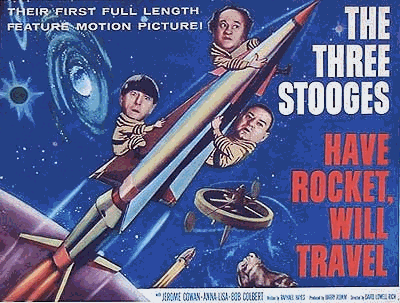 Space Keynesianism: All hail the grand architects of our renewed prosperity, Ben Bernanke (nearest to the nosecone) and Tim Geithner (straddling a fin), who for some reason decided to bring along Harry Paulson (clinging to the underside of the rocket).
“At this very moment, the President of the United States is announcing a New Age of Space to relieve unemployment. Billions of dollars are going to be spent on unmanned space ships, just to make work. The opening episode in this New Age of Space will be the firing of The Whale next Tuesday. The Whale … will be loaded with organ-grinder monkeys, and will be fired in the general direction of Mars.”
~ From The Sirens of Titan by Kurt Vonnegut
Well, why not?
If the secret to prosperity is simply to permit the government to spend money it doesn’t have in any quantity our rulers can imagine, why shouldn’t they commission the construction of a huge fleet of spacecraft to be filled with organ-grinder monkeys and dispatched into the void?
 Or why not emulate the ancient Egyptians under the tyrant Cheops by commissioning an immense mausoleum to stand in eternal testimony of our bold and visionary ruler, Pharaoh Obama the First?
According to Herodotus, Cheops achieved full employment by enlisting nearly the entire population to build his legendary pyramid — but this was done by depleting the treasury so thoroughly that the ruler had to sell his own daughter into slavery to raise the funds for some forgettable and long-effaced bit of decorative filigree.
The same ancient historian observes that for centuries after Cheops died, the Egyptians refused so much as to utter his name (or that of his equally despicable brother, Chefren), so reviled had he become on account of his tyrannical profligacy.
Pointless expenditures on space exploration or construction of monuments to the vanity of the ruling class would actually make more sense than the Regime’s present course, which is to ruin the currency in a doomed effort to save a terminally insolvent banking system.
The $3.8 trillion budget disgorged by the regime of Obama the Magnanimous includes a budget deficit of nearly $1.8 trillion — a figure, as the observant Anthony Gregory points out, roughly equivalent to the entire federal budget in the year 2000.
When budgets and annual deficits go hyperbolic, hyperinflation is sure to follow. But the cruelly amusing fact is that neither Obama nor the gallery of trained seals called Congress is in charge of the public purse.
Sure, Obama can propose a budget and Congress can ratify it on a party-line vote, but the real economic power now resides with the Commissar for Official Counterfeiting, Ben Bernanke, and the Commissar for Fiscal Fraud, Tim Geithner.
Obama is seeking to salve the electorate’s economic wounds with oleaginous words about hope, change, and determination. Meanwhile, Geithner — as pure a product of the bankster elite as ever drew an undeserved breath — is “finishing touches on a plan that will dump $1 trillion of toxic assets on the US taxpayer,” warns Mike Whitney of CounterPunch. “The plan, which goes by the opaque moniker [of] the `Public-Private Investment Fund’ (PPIF), is designed to provide lavish incentives to hedge funds and private equity funds to purchase bad assets from failing banks. It is a sweetheart deal that provides government financing and guarantees for illiquid mortgage-backed junk for which there is no active market.”
There is other mischief afoot behind the obscuring barricade of official acronyms.
First came TARP (Troubled Assets Relief Program), which was supposedly intended to buy up bad mortgage-backed securities, but in practice was an open-ended conduit of funding to prop up any corrupt financial institution of the Treasury Secretary’s choice. Now we confront the Fed’s Term Asset-Backed Securities Loan Facility (TALF), which will open for business in a few days. TALF will provide another $1 trillion to finance the purchase of securities backed by new classes of failing loans — credit cards, auto loans, small-business loans. We can expect TALF, like TARP, to gain considerable girth as the depression deepens.
The same is true of the PPIF, which was created by the Fed and the Treasury Department on their own supposed authority without specific congressional authorization. (Remember, TARP removed Congress from this equation.) That new “public-private partnership” — a euphemism for a corporatist, which is to say fascist, entity — amounts to what financial analyst Kevin G. Hall calls “a blank check to ensure that the top banks — those with assets over $100 billion — remain solvent.”
Beginning in late April, as Hall explains, squads of federal regulators will start administering “stress tests” to the 19 largest banks. Those found to be “under-capitalized” will be given six months either to raise capital in private markets, or to “ask for a capital buffer from the government.”
The PPIF begins with a ridiculously low credit pool of $500 billion, with a provision to expand immediately to $1 trillion. But as Hall says, the program is, in principle, “a virtually unlimited solvency guarantee” to the nation’s 19 largest banks. This means that it could keep pouring “liquidity” — that is, inflation-debauched dollars — into the banking system until the Fed runs out of zeroes.
This is where the really bloody business of butchering the middle class is taking place. Apart from occasional fits of televised grousing, Congress has no role in the process, having abdicated its constitutional control over public expenditures to the Treasury Department last September.
So when Obama the Munificent, framed — appropriately enough — by the fasces that decorate the wall in the well of the House of Representatives, invited Congress to gorge itself on a new menu of spending programs, this gesture was a bit like conferring a consolation prize on the second-place finisher in a two-man competition.
As he sketched, in vague outline, a campaign to enlarge what is already the largest and most expensive government in human history, His Holiness Obama the Blessed declared: “I do not believe in bigger government.”
That odd and discordant sentence begs the question, bigger than what? A reasonable surmise would be that Obama meant something along the lines of the following: “I believe in a government somewhat bigger than Betelgeuse, but no bigger than Antares.”
The best summary of Comrade Obama’s Address to the Central Committee may be the one offered by an enraptured Ross Douthat of The Atlantic:
“[Obama]laid out the most ambitious and expensive domestic agenda of any Democratic President since LBJ, and did it so smoothly that you’d think he was just selling an incremental center-left pragmatism. I think that he has an acute sense — more acute than most people in Washington, probably — of just how much running room is open in front of him at the moment, and he intends to make the absolute most of it… It was the speech of a man seeking to turn a moment of crisis into a domestic-policy revolution…. Now all he has to do is find a way to pay for it.”
Hey, no problem: Obama can always whip out his Presidential Express Card (neither Gold nor Platinum being sufficiently rare and precious to provide the required cachet, Obama’s is a Moonrock Card, with an astronomical spending limit). As long as Geithner and his minions can sell Treasury Debt, the government can keep the party going.
When foreigners decide to dump their T-bills, and Bernanke sends his printing presses into hyperdrive, we’ll thus have the opportunity to experience all the romance and enchantment of distant, exotic Zimbabwe — without leaving the comfort of our own homes. Assuming any of us still has a home by then.
Obama’s speech to Congress, while heavy on facile uplift and melodrama, was almost entirely devoid of humor. I must admit that the speech managed to wrench one bitter chuckle from me when Obama announced that a “Day of Reckoning” had arrived.
That phrase would make sense if the government over which Obama presides were to permit the market to function. This would mean mass liquidation of bad assets and, yes, continued and deepening deflation. It would mean the immediate end to two foreign wars and rolling up the infrastructure of Washington’s global empire. It would hurt like hell for a few years, and then recovery would begin.
What Obama apparently meant by “Day of Reckoning,” however, was something along these lines: “My spendthrift predecessor somehow neglected to destroy every pocket of prosperity and productivity left in this economy — so I reckon it’s up to me to finish that job.”
As the indispensable Peter Schiff points out, a genuine Day of Reckoning is inevitable, and it will come “when our money is worthless, and the rest of the world will no longer take our [government] paper.”
 When the actual Day of Reckoning arrives, one of three scenarios will play out:
- Sanity will seize our population and our chastened political class will restore the foundations of the pre-1913 (or, better yet, pre-1861) political system.
Yeah, I don’t think so either, but it is a possibility.
-
The productive elements of the population will divorce themselves from the parasitical ruling class and its client constituencies, eventually creating some kind of loose confederation. While the parasites won’t surrender their host without a violent struggle, this is probably the best we can hope for.
-
We’ll see the Regime continue to inflate, spend, and regiment the population until we achieve the ne plus ultra of Keynesian economics: The government will achieve full employment by forcing all of us to build immense pyramids out of its useless, unwanted fiat currency.
(My sincere apologies for traducing the Three Stooges by comparing them to federal political appointees.)
The Best of William Norman Grigg
 Working in 'Communist' China