


When the Crash Comes
August 4, 2007
When It Hits the Fan Considering the U.S. economy’s future, Crash Proof offers steps to avoid diminishing your standard of living
by Doug French by Doug French
 CNBC, the financial network, often lives up to what its critics call it — “Tout TV.” All of the guests seemingly are singing from the same hymnal: “buy and hold stocks,” “inflation is low,” “economic growth is strong,” “the Federal Reserve has everything under control,” blah, blah, blah.
But occasionally the network offers another point of view. A point of view built on an education of the Austrian Business Cycle Theory. Those in the Austrian school believe that business cycles are caused by the central bank intervention in the economy. In America, the Federal Reserve creates too much money, a boom is engendered, characterized by malinvestment in stocks or real estate or commodities or fine art or whatever. But, a bust ultimately follows, wreaking havoc on the economy.
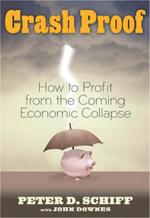
Although he is no academic, Peter Schiff, President of Euro Pacific Capital, faces off against mainstream economists like Diane Swonk and Mark Zandi frequently, articulating the case that the United States economy is a house of cards built on excess money creation from the Fed, and that while all looks well for the moment, economic disaster is just around the corner. During multiple FreedomFest presentations, Schiff discussed the themes of his new book, Crash Proof: How to Profit from the Coming Economic Collapse.
The book is an easy-to-read crash course on what’s wrong with the American economy, why it will crash, and how to protect your assets. Point by point, the author debunks the common wisdom spewed forth by Wall Street talking heads. The large trade deficit is not a sign of our credit-worthy economy; it reflects a country that under-produces and over-consumes, ultimately leading to disaster.
Inflation is not under control; the real inflation rate is much higher than what is being reported. There are no real productivity gains, like ex-Fed chief Alan Greenspan and current Fed head Ben Bernanke tell us there are. “[W]hy, if it is true that we are more productive than our trading partners, our trade deficit gets bigger, not smaller,” Schiff asks. And the GDP (Gross Domestic Product) numbers are full of fluff and aren’t an accurate measure of this country’s economic health and growth.
Inflation is an expansion in the money supply, Schiff explains. And with more dollars circulating, those dollars are worth less, or put another way, the things we trade dollars for — goods and services — take more dollars to purchase. “Any kid who collects baseball cards understands it,” Schiff writes. “The more a particular card is in circulation, the less it is worth.”
As the federal government goes into hock, so has the U.S. consumer. Ultimately, these debt problems will catch up to us, according to Schiff, with the result being a substantial reduction in the American standard of living. Except for those following Schiff’s advice laid out in three steps that are the last three chapters of Crash Proof.
The first step is to “rethink your stock portfolio.” Given a falling dollar, Schiff believes U.S. investors should trade in their U.S. shares for investments in foreign companies. U.S. stocks are overvalued, while many foreign stocks are not. Plus, investors will get the tailwind benefit of rising currency values with stocks denominated in foreign currencies. Schiff offers a number of tips for investing in foreign stocks, with the primary one being to use his firm, Euro Pacific Capital, to execute these trades. (Although this writer does not have an account with Euro Pacific, friends who do, tell me they are very happy with Schiff’s firm.)
Step two is to begin investing in gold. Schiff believes the price of the yellow metal may go to $5,000 per ounce. Why? Private citizens will reinstitute a gold standard on their own; troubled currencies may tie to gold rather than dollars; central banks are becoming buyers of gold, instead of sellers; mining companies are buying back short positions; short covering will cause gold to rise; Wall Street will rediscover gold; the supply of gold can only increase slightly; and there is much more paper money to be created by central banks to pay for wars and expanded entitlement programs such as Social Security and Medicare.
 The last step is to stay liquid and turn adjustable-rate loans into fixed-rate ones.
So when is the manure going to hit the fan? Schiff doesn’t know, but “when the bubble is this big, there are just so many potential pins that it is impossible to guess which one it will find first.” Ignore Mr. Schiff at your financial peril.
This article originally appeared in Liberty Watch Magazine.
 The Instruments of Tyranny