


A Secret History of Dissent in the All-Volunteer Military
July 1, 2009
Recently by Tom Engelhardt: The Ir-Af-Pak War
The All-Volunteer Force (AVF) exists for a reason captured in a study by Colonel Robert D. Heinl, Jr., author of the “definitive history of the Marine Corps,” published in Armed Forces Journal in 1971. The U.S. military in Vietnam was at that moment at the edge of chaos. As Colonel Heinl put it, it was experiencing “widespread conditions… that have only been exceeded in this century by the French Army’s Nivelle mutinies of 1917 and the collapse of the Tsarist armies [of Russia] in 1916 and 1917.”
In fact, statistics flowing back to Washington about the American war machine in Vietnam then pointed toward an unimaginable nightmare. Drug use was rampant; desertions stood at 70 per thousand, a modern high; small-scale mutinies or “combat refusals” were at critical, if untabulated, levels; incidents of racial conflict had soared; and strife between “lifers” and draftees was at unprecedented levels. Reported “fraggings” — assassination attempts — against unpopular officers or NCOs had risen from 126 in 1969 to 333 in 1971, despite declining troop strength in Vietnam. According to Colonel Heinl’s figures, as many as 144 antiwar underground newspapers were being published by, or for, soldiers. And most threatening of all, active duty soldiers in relatively small numbers (as well as a swelling number of Vietnam veterans) were beginning to actively organize against the war.
When, in January 1973, before the war was even over, President Richard Nixon announced that an American draft army was at an end and an all-volunteer force would be created, this was why. The U.S. military was in the wilderness without a compass, having discovered one crucial thing: you couldn’t fight an endless, unpopular counterinsurgency war with the kind of conscript army a democracy had to offer. What resulted, of course, was the AVF, a moniker that, as Andrew Bacevich has written in his book The New American Militarism, was but “a euphemism for what is, in fact, a professional army… [that] does not even remotely ‘look like’ democratic America.” Citizenship and the obligation to serve were now officially severed and, from the 1980s on, most Americans would ever more vigorously cheer on the AVF from the sidelines, while it would be a force theoretically purged of possible Vietnam-style dissent and refusal.
In that sense, it could be considered a success. We’ve now been at war seven and a half years in Afghanistan and more than five in Iraq, two catastrophic counterinsurgency struggles, and yet a Vietnam-style movement has neither arisen in the military, nor for that matter in the streets of what’s now called “the homeland.” But as TomDispatch regular Dahr Jamail indicates below and in his new book, The Will To Resist: Soldiers Who Refuse to Fight in Iraq and Afghanistan, dissent has proved irrepressible. With the generous support of the Nation Institute’s Investigative Fund, Jamail has produced a report on the seeds of refusal and dissent in the military that may — in a quagmire future in Afghanistan and possibly Iraq — grow into something far larger. ~ Tom
Refusing to Comply: The Tactics of Resistance in an All-Volunteer Military
By Dahr Jamail
Research support for this article was provided by the Investigative Fund at the Nation Institute.
On May 1st at Fort Hood in central Texas, Specialist Victor Agosto wrote on a counseling statement, which is actually a punitive U.S. Army memo:
“There is no way I will deploy to Afghanistan. The occupation is immoral and unjust. It does not make the American people any safer. It has the opposite effect.”
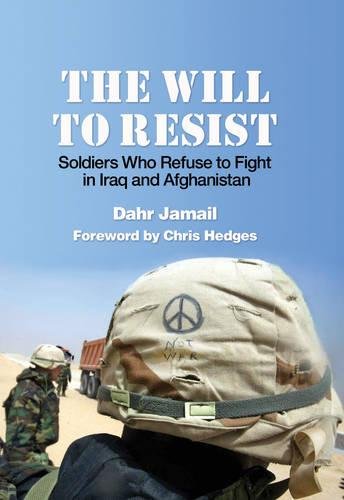 The Will to Resist: So...
Best Price: $6.29
Buy New $14.68
(as of 09:50 UTC - Details)
The Will to Resist: So...
Best Price: $6.29
Buy New $14.68
(as of 09:50 UTC - Details)
 Ten days later, he refused to obey a direct order from his company commander to prepare to deploy and was issued a second counseling statement. On that one he wrote, “I will not obey any orders I deem to be immoral or illegal.” Shortly thereafter, he told a reporter, “I’m not willing to participate in this occupation, knowing it is completely wrong. It’s a matter of what I’m willing to live with.”
Agosto had already served in Iraq for 13 months with the 57th Expeditionary Signal Battalion. Currently on active duty at Fort Hood, he admits, “It was in Iraq that I turned against the occupations. I started to feel very guilty. I watched contractors making obscene amounts of money. I found no evidence that the occupation was in any way helping the people of Iraq. I know I contributed to death and human suffering. It’s hard to quantify how much I caused, but I know I contributed to it.”
Even though he was approaching the end of his military service, Agosto was ordered to deploy to Afghanistan under the stop-loss program that the Department of Defense uses to retain soldiers beyond the term of their contracts. At least 185,000 troops have been stop-lossed since September 11, 2001.
Agosto betrays no ambivalence about his willingness to face the consequences of his actions:
“Yes, I’m fully prepared for this. I have concluded that the wars [in Iraq and Afghanistan] are not going to be ended by politicians or people at the top. They’re not responsive to people, they’re responsive to corporate America. The only way to make them responsive to the needs of the people is for soldiers to not fight their wars. If soldiers won’t fight their wars, the wars won’t happen. I hope I’m setting an example for other soldiers.”
Today, Agosto’s remains a relatively isolated act in an all-volunteer military built to avoid the dissent that, in the Vietnam era, came to be associated with an army of draftees. However, it’s an example that may, soon enough, have far greater meaning for an increasingly overstretched military plunging into an expanding Afghan War seemingly without end, even as its war in Iraq continues.
Avoiding Battle
Writing on his blog from Baquba, Iraq, in September 2004, Specialist Jeff Englehart commented: “Three soldiers in our unit have been hurt in the last four days and the true amount of army-wide casualties leaving Iraq are unknown. The figures are much higher than what is reported. We get awards and medals that are supposed to make us feel proud about our wicked assignment…”
Over the years, in response to such feelings, some American soldiers have come up with ingenious ways to express defiance or dissent on our distant battlegrounds. These have been little noted in the mainstream media, and when they do surface, officials in the Pentagon or in Washington just brush them aside as “bad apple” incidents (the same explanation they tend to use when a war crime is exposed).
But in the stories of men and women who served in the occupation of Iraq, they often play a different role. In October 2007, for instance, I interviewed Corporal Phil Aliff, an Iraq War veteran, then based at Fort Drum in upstate New York. He recalled:
“During my stints in Iraq between August 2005 and July 2006, we probably ran 300 patrols. Most of the men in my platoon were just in from combat tours in Afghanistan and morale was incredibly low. Recurring hits by roadside bombs had demoralized us and we realized the only way we could avoid being blown up was to stop driving around all the time. So every other day we would find an open field and park, and call our base every hour to tell them we were searching for weapon caches in the fields and everything was going fine. All our enlisted people had grown disenchanted with the chain of command.”
Aliff referred to this tactic as engaging in “search and avoid” missions, a sardonic expression recycled from the Vietnam War when soldiers were sent out on official “search and destroy” missions.
Sergeant Eli Wright, who served as a medic with the 1st Infantry Division in Ramadi from September 2003 through September 2004, had a similar story to tell me. “Oh yeah, we did search and avoid missions all the time. It was common for us to go set camp atop a bridge and use it as an over-watch position. We would use our binoculars to observe rather than sweep, but call in radio checks every hour to report on our sweeps.”
According to Private First Class Clifton Hicks, who served in Iraq with the First Cavalry from October 2003, only six months after Baghdad was occupied by American troops, until July 2004, search and avoid missions began early and always had the backing of a senior non-commissioned officer or a staff sergeant. “Our platoon sergeant was with us and he knew our patrols were bullshit, just riding around to get blown up,” he explained. “We were at Camp Victory at Baghdad International Airport. A lot of the time we’d leave the main gate and come right back in another gate to the base where there’s a big PX with a nice mess hall and a Burger King. We’d leave one guy at the Humvee to call in every hour, while the others stayed at the PX. We were just sick and tired of going out on these stupid patrols.”
These understated acts of refusal were often survival strategies as well as gestures of dissent, as the troops were invariably undertrained and ill-equipped for the job of putting down an insurgency. Specialist Nathan Lewis, who was deployed to Iraq with the 214th Artillery Brigade from March 2002 through June 2003, experienced this firsthand. “We never received any training for much of what we were expected to do,” he said when telling me of certain munitions catching fire while he and other soldiers were loading them onto trucks, “We were never trained on how to handle [them] the right way.”
Sergeant Geoff Millard of the New York Army National Guard served at a Rear Operations Center with the 42nd Infantry Division from October 2004 through October 2005. Part of his duty entailed reporting “significant actions,” or SIGACTS — that is, attacks on U.S. forces. In an interview in 2007 he told me, “When I was there at least five companies never reported SIGACTS. I think ‘search and avoids’ have been going on for a long time. One of my buddies in Baghdad emails that nearly each day they pull into a parking lot, drink soda, and shoot at the cans.” Millard told me of soldiers he still knows in Iraq who were still performing “search and avoid” missions in December 2008. Several other friends deploying or redeploying to Iraq soon assured him that they, too, planned to operate in search and avoid mode.
Corporal Bryan Casler was first deployed to Iraq with the Marines in 2003, at the time of the invasion. Posted to Afghanistan in 2004, he returned to Iraq for another tour of duty in 2005. He tells of other low-level versions of the tactic of avoidance: “There were times we would go to fix a radio that had been down for hours. It was purposeful so we did not have to deal with the bullshit from higher [ups]. In reality, we would go so we could just chill out, let the rest of the squad catch up on some rest as one stood guard. It’s mutual and people start covering for each other. Everyone knows what the hell’s going on.”
Staff Sergeant Ronn Cantu, an infantryman who was deployed to Iraq from March 2004 to February 2005, and again from December 2006 to January 2008, said of some of the patrols he observed while there: “[They] wouldn’t go up and down the streets like they were supposed to. They would just go to a friendly compound with the Iraqi police or the Kurdish Peshmerga [militia] and stay at their compound and drink tea until it was time to go back to the base.”
As a Stryker armored combat vehicle commander in Iraq from September 2004 to September 2005, Sergeant Seth Manzel had figured out a way to fabricate on screen the movement of their patrol and so could run computerized versions of a search and avoid mission. As he explained:
“Sometimes if they called us up to go and do something, we would swiftly send computer reports that we were headed in that direction. On the map we would manually place our icon to the target location and then move it back and forth to make it appear as though we were actually on the ground and patrolling. This was not an isolated case. Everyone did it. Everyone would go and hide somewhere from time to time.”
Former Sergeant Josh Simpson, who served as a counter-intelligence agent in Iraq from October 2004 to October 2005, said he witnessed instances of faked movement. “I knew soldiers who learned to simulate vehicular movement on the computer screen, to create the impression of being on patrol,” said Simpson. “There’s no doubt that people did it.”
Saying “No” One at a Time
“There was nothing to be done,” Corporal Casler says of his time in Iraq, “no progress to be made there. Dissent starts as simple as saying this is bullshit. Why am I risking my life?”
Sometimes such feelings have permeated entire units and soldiers in them have refused to follow orders en masse. One of the more dramatic of these incidents occurred in July 2007. The 2nd Platoon of Charlie Company, 1st Battalion, 26th Infantry Regiment, in Baghdad had lost many men in its 11 months of deployment. After a roadside bomb killed five more, its members held a meeting and agreed that it was no longer possible for them to function professionally. Concerned that their anger might actually touch off a massacre of Iraqi civilians, they staged a quiet revolt against their commanders instead.
Kelly Kennedy, a reporter with the Military Times embedded with Charlie Company prior to the revolt, described the shape the platoon members were in by that time: “[T]hey went right to mental health and they got sleeping medications, and they basically couldn’t sleep and reacted poorly. And then, they were supposed to go out on patrol again that day. And they, as a platoon, the whole platoon — it was about 40 people — said, ‘We’re not going to do it. We can’t. We’re not mentally there right now.'”
In response, the military broke up the platoon. Each individual involved was also “flagged” so he would not get a promotion or receive any award due.
To this day, troops in Iraq continue to be plagued by equipment and manpower shortages, and work long hours in an extreme climate. In addition, their stress levels are regularly raised by news from home of veterans returning to separations and divorces, and of a Veteran’s Administration often ill-equipped and unwilling to provide appropriate physical and psychological care to veterans.
While no broad poll of troops has been conducted recently, a Zogby poll in February 2006 found that 72% of soldiers in Iraq felt the occupation should be ended within a year. My interviews with those recently back from Iraq indicate that levels of despair and disappointment are once again on the rise among troops who are beginning to realize, months after the Obama administration was ushered in, that hopes of an early withdrawal have evaporated.
With the Afghan War heating up and the Iraq War still far from over, even if fighting there is at far lower levels than at its sectarian heights in 2006 and 2007, with stress and strain on the military still on the rise, dissent and resistance are unlikely to abate. In addition to small numbers of outright public refusals to deploy or redeploy, troops are going absent without official leave (AWOL) between deployments, and actual desertions may once again be on the rise. Certainly, there’s one strong indication that despair is indeed growing: the unprecedented numbers of soldiers who are committing suicide; the Army’s official suicide count rose to 133 in 2008, up from 115 in 2007, itself a record since the Pentagon began keeping suicide statistics in 1980. At least 82 confirmed or suspected suicides have been reported thus far in 2009, a pace that indicates another grim record will be set; and suicide, though seldom thought of in that context, is also a form of refusal, an extreme, individual way of saying no, or simply no more.
According to Sergeant Simpson, here’s how a feeling of discontent and opposition creeps up on you while you’re on duty: The part of the war you’re involved in, interrogating Iraqis in his case, “doesn’t make any sense. You realize that the whole system is flawed and if that is flawed, then obviously the whole war is flawed. If the basic premise of the war is flawed, definitely the intelligence system that is supposed to lead us to victory is flawed. What that implies is that victory is not even a possibility.”
After finishing his tour in Iraq, Simpson joined the Reserves because he believed it would grant him a two-year deferment from being called up, but he was called up anyway. In his own case, he says, “I thought to myself, I can’t do this anymore. First of all, it’s bad for me mentally because I’m doing something I loathe. Second, I’m participating in an organization that I wish to resist in every way I can.
“So,” he says, “I just stopped showing up for drill, didn’t call my unit, didn’t give them any reason for it. I changed my telephone number and they did not have my address.” Eventually, he reached the end date of his contract and managed to graduate from Evergreen State University in Washington. “I don’t know if technically I’m still in the reserves,” he told me. “I don’t know what my situation is, but I don’t really care either. If I go to jail, I go to jail. I’d rather go to jail than go to Iraq.”
Unready and Unwilling Reserves
Sergeant Travis Bishop, who served 14 months in Baghdad with the 57th Expeditionary Signal Battalion — the same battalion as Agosto, who served north of the Iraqi capital — recently went AWOL from his station at Fort Hood, Texas, when his unit deployed to Afghanistan. He insists that it would be unethical for him to deploy to support an occupation he opposes on moral grounds.
On his blog, he puts his position this way:
“I love my country, but I believe that this particular war is unjust, unconstitutional and a total abuse of our nation’s power and influence. And so, in the next few days, I will be speaking with my lawyer, and taking actions that will more than likely result in my discharge from the military, and possible jail time… and I am prepared to live with that…. My father said, ‘Do only what you can live with, because every morning you have to look at your face in the mirror when you shave. Ten years from now, you’ll still be shaving the same face.’ If I had deployed to Afghanistan, I don’t think I would have been able to look into another mirror again.”
I spoke with him briefly after he turned himself in at his base in early June. He said he’d chosen to follow Specialist Agosto’s example of refusal, which had inspired him, and wanted to be present at his post to accept the consequences of his actions. He, too, hoped others might follow his lead. (He and Agosto, now in similar situations, have become friends.)
Agosto, whose hope has been to set an example of resistance for other soldiers, sees Bishop’s refusal to deploy to Afghanistan as a personal success and says, “I already feel vindicated for what I’m doing by his actions. It’s nice to see some immediate results.”
His actions, he’s convinced, have affected the way his fellow soldiers are now looking at the war in Afghanistan. “The topic has come up a lot in conversation, with soldiers on base now asking, ‘What are we doing in Afghanistan? Why are we there?’ People feel compelled to bring this up when I’m around. Even the ones that disagree with me say it’s great what I’m doing, and that I’m doing what a lot of them don’t have the courage to do. If anything, the people I work with have now been treating me better than ever.”
On May 27th, rejecting an Article 15 — a nonjudicial punishment imposed by a commanding officer who believes a member of his command has committed an offense under the Uniform Code of Military Justice — Agosto demanded to be court-martialed.
According to Agosto, the Army has now begun the court martial process, but has not yet set a trial date. Bishop, too, awaits a possible court martial.
On June 1st, a day when four U.S. soldiers were killed in Afghanistan, Agosto told me in a phone call from Fort Hood, “I haven’t had to disobey any orders lately. A sergeant asked me if it’d be okay if I had to follow orders, and I said no, and they didn’t force it.”
 The World According to...
Best Price: $1.49
Buy New $14.57
(as of 05:40 UTC - Details)
The World According to...
Best Price: $1.49
Buy New $14.57
(as of 05:40 UTC - Details)
Agosto and Bishop are hardly alone. In November 2007, the Pentagon revealed that between 2003 and 2007 there had been an 80% increase in overall desertion rates in the Army (desertion refers to soldiers who go AWOL and never intend to return to service), and Army AWOL rates from 2003 to 2006 were the highest since 1980. Between 2000 and 2006, more than 40,000 troops from all branches of the military deserted, more than half from the Army. Army desertion rates jumped by 42% from 2006 to 2007 alone.
U.S. Army Specialist Andr Shepherd joined the Army on January 27, 2004. He was trained in Apache helicopter repair and sent first to Germany, then was stationed in Iraq from November 2004 to February 2005, before being based again in Germany. Shepherd went AWOL in southern Germany in April 2007 and lived underground until applying for asylum there in November 2008, making him the first Iraq veteran to apply for refugee status in Europe.
He, too, has refused further military service because he feels morally opposed to the occupation of Iraq. While he awaits word from the German government and is still technically AWOL, Shepherd is being supported by Courage to Resist, a group based in Oakland, California, which actively assists soldiers who refuse to deploy to Iraq or Afghanistan.
A counselor and administrative associate at that organization, Adam Szyper-Seibert, points out that “in recent months there has been a dramatic rise of nearly 200% in the number of soldiers that have contacted Courage to Resist.” Szyper-Seibert suspects this may reflect the decision of the Obama administration to dramatically increase efforts, troop strength, and resources in Afghanistan. “We are actively supporting over 50 military resisters like Victor Agosto,” Szyper-Seibert says. “They are all over the world, including Andr Shepherd in Germany and several people in Canada. We are getting five or six calls a week just about the IRR [Individual Ready Reserve] recall alone.”
The IRR is composed of troops who have finished their active duty service but still have time remaining on their contracts. The typical military contract mandates four years of active duty followed by four years in the IRR, though variations on this pattern exist. Ready Reserve members live civilian lives and are not paid by the military, but they are required to show up for periodic musters. Many have moved on from military life and are enrolled in college, working civilian jobs, and building families.
 The End of Victory Cul...
Best Price: $5.06
Buy New $15.79
(as of 03:00 UTC - Details)
The End of Victory Cul...
Best Price: $5.06
Buy New $15.79
(as of 03:00 UTC - Details)
At any point, however, a member of the Ready Reserve can be recalled to active duty. This policy has led to the involuntary reactivation of tens of thousands of troops to fight the ongoing wars in Iraq and Afghanistan. Lieutenant General Jack C. Stultz, the Chief of the U.S. Army Reserve and Commanding General of the U.S. Army Reserve Command, told Congress on March 3rd that, since September 11, 2001, the Army has mobilized about 28,000 from the Reserves. There have been 3,724 Marines involuntarily recalled and mobilized during that same period, according to Major Steven O’Connor, a Marine Corps spokesman. (According to Major O’Connor, as of May 2009, the Marines are no longer recalling individuals from the IRR.)
Ironically, under a new commander-in-chief whom many voters believed to be anti-war, the Army is continuing its Individual Ready Reserve recalls. “The IRR recall has not seen any change since Obama became president,” Sarah Lazare, the project coordinator for Courage to Resist, says. “It’s difficult to predict what the Obama administration’s policy will be in the future regarding the IRR, but definitely they haven’t made any moves to stop this practice.”
Needing boots on the ground, according to Lazare, the military continues to fall back on the Ready Reserve system to fill the gaps: “Since these are experienced troops, many of them have already served tours in Iraq and Afghanistan.” Lazare adds, “When Obama announced his Afghanistan surge, we got a huge wave of calls from soldiers saying they didn’t want to be reactivated and to please help them not go.”
The Future of Military Dissent
 Right now, acts of dissent, refusal, and resistance in the all-volunteer military remain small-scale and scattered. Ranging from the extreme private act of suicide to avoidance of duty to actual refusal of duty, they continue to consist largely of individual acts. Present-day G.I. resistance to the occupations of Iraq and Afghanistan cannot begin to be compared with the extensive resistance movement that helped end the Vietnam War and brought an army of draftees to the point of near mutiny in the late 1960s. Nevertheless, the ongoing dissent that does exist in the U.S. military, however fragmented and overlooked at the moment, should not be discounted.
The Iraq War boils on at still dangerous levels of violence, while the war in Afghanistan (and across the border in Pakistan) only grows, as does the U.S. commitment to both. It’s already clear that even an all-volunteer military isn’t immune to dissent. If violence in either or both occupations escalates, if the Pentagon struggles to add more boots on the ground, if the stresses and strains on the military, involving endless redeployments to combat zones, increase rather than lessen, then the acts of Agosto, Bishop, and Shepherd may turn out to be pathbreaking ones in a world of dissent yet to be experienced and explored. Add in dissatisfaction and discontent at home if, in the coming years, American treasure continues to be poured into an Afghan quagmire, and real support for a G.I. resistance movement may surface. If so, then the early pioneers in methods of dissent within the military will have laid the groundwork for a movement.
“If we want soldiers to choose the right but difficult path, they must know beyond any shadow of a doubt that they will be supported by Americans.” So said First Lieutenant Ehren Watada of the U.S. Army, the highest ranking enlisted soldier to refuse orders to deploy to Iraq. (He finally had the military charges against him dropped by the Justice Department.) The future of any such movement in the military is now unknowable, but keep your eyes open. History, even military history, holds its own surprises.
 'Fight Them Over There vs. Over Here' a False Choice