


Bush Rhetoric vs. Reality
January 5, 2005
A nation’s foreign policy is bankrupt, Walter Lippmann wrote, when its strategic assets, its arms and alliances, are insufficient to cover its liabilities — i.e., its commitments to defend critical territory and vital interests.
Japan’s strike on Pearl Harbor and rapid seizure of Guam, Wake Island and the Philippines, Lippmann wrote, revealed the bankruptcy of FDR’s prewar policy. Lippmann apologized for having supported the Washington Naval Treaty of 1922 that permitted Imperial Japan to gain naval parity with the United States in the Pacific.
U.S. foreign policy today is surely not bankrupt. The United States has a surplus of power to cover its vital interests. But, with his rhetoric, President Bush has been handing out promissory notes that our military and alliances cannot cover, if called in.
To the architects of this war, Iraq was to be a projection of U.S. power, a strategic base camp flanking and paralyzing the rogue states of Iran and Syria, an Arab democracy that would attract the admiration and envy of other peoples, producing a domino effect across the Middle East. Thus far, that has turned out to be a myth.
Iraq today appears as an exposed salient, a bridge too far, a war against a dispossessed Sunni minority, that we can neither win nor walk away from without its becoming the haven for terrorists it never was before we invaded. Half our army is now either in Iraq, has been through Iraq or is on the way. U.S. Reserve and Guard units, which have provided 40 percent of the troops for the war, are no longer meeting recruitment goals.
The cost of the Afghan and Iraq wars is running at $4 billion a month. Manpower pressures on the Army and Marines show us to be nearing imperial overstretch. One by one, allies in the “coalition of the willing” are peeling off and pulling out. Even The New York Times is calling for an expansion of U.S. ground forces by 100,000.
To get the money for the new brigades, the Pentagon is cutting back the F-22 Raptor interceptor, mothballing the John F. Kennedy, one of our 12 carriers, and cutting the purchase of new destroyers.
Under the Bush Doctrine — axis-of-evil nations will not be allowed weapons of mass destruction — Iran and North Korea are on notice not to pursue nuclear arsenals. Yet, Pyongyang is defying the doctrine and Tehran is testing it. No Asian ally has shown any willingness to support us in a confrontation with North Korea. No NATO ally supports a U.S. clash with Iran.
While America has the strategic striking power to devastate their nuclear facilities, we lack the ground forces to deal with an enraged counterstrike by North Korea or Iran. Should Iran retaliate by inciting the Shia to revolt in Iraq and launch attacks on our ships in the Gulf or allies on the south shore, the region could go up in flames and oil could shoot to $80 or $100 a barrel.
Our Arab allies are resisting the Bush-proclaimed “world democratic revolution.” But has anyone considered what we would do if it succeeded, and revolutions brought down regimes in Morocco, Egypt, Jordan or Saudi Arabia? How would the United States respond if our indispensable ally in the war against the Taliban, President Musharraf, fell to one of the assassins who have been seeking his death since he cast his lot with America?
Pakistan has nuclear weapons. Even more than Iran, it is a nation with a population so large and militant the U.S Army could not invade and hold the country. Yet, our war in Afghanistan depends upon the survival of this one man.
 Then, there is the neoconservative drive to expand NATO to the Ukraine of the Orange Revolution. But if Putin was offended by NATO’s expansion into the Baltic republics, to bring in Ukraine, tied to Russia by history, faith and geography, would be to humiliate and enrage Moscow. And for what? Can anyone believe that if eastern Ukraine broke free of Kiev and asked for support, and the Kremlin responded, we would go to war?
Then there is the Bush commitment to do “whatever it took” to defend Taiwan. Despite that pledge, Beijing continues to ratchet up the rhetoric against Taiwan and build up its naval, air and missile forces across the strait. Everywhere, it appears, the shock and awe of Operation Iraqi Freedom seem to have worn off.
How, then, do our ledgers read? America has a surplus of power to protect vital interests. But with allies alienated and forces stretched, she does not have the power to maintain a Pax Americana or carry out the promiscuous commitments made by President Bush in his first term, as his second shall almost surely demonstrate.
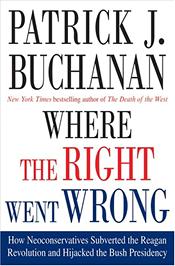
Patrick J. Buchanan [send him mail], former presidential candidate and White House aide, is editor of The American Conservative and the author of eight books, including A Republic Not An Empire and the upcoming Where the Right Went Wrong.
The Best of Patrick J. Buchanan
 Indians Should Know Better