


Ron Paul's Hour of Power
October 31, 2009
The decades-long campaign of Ron Paul to have the Government Accountability Office do a full audit of the Federal Reserve now has 313 sponsors in the House.
Sometimes perseverance does pay off.
If not derailed by the establishment, the audit may happen.
Yet, many columnists and commentators are aghast.
An auditors’ probe, they wail, would imperil the Fed’s independence and expose it to pressure from Congress to keep interest rates low and money flowing when the need of the nation and economy might call for tightening.
They cite Paul Volcker, who to squeeze double-digit inflation out of the economy in the late Carter and early Reagan years, drove the prime rate to 21 percent, causing the worst recession since the Depression. Volcker, they claim, prepared the ground for the Reagan tax cuts and seven fat years of prosperity.
That decade, America created 20 million jobs — and another 22 million in the Clinton era. Without Volcker putting the economy through the wringer, it could not have happened. And had he been forced to explain his decisions, Congress would have broken his policy.
Such is the cast for Fed independence.
But if true, what does this say about our republic?
Is it not an admission that, though Congress was created by the Constitution, and the Fed is a creation of Congress, our elected representatives cannot be trusted with the money supply, cannot be trusted with control of the nation’s central bank? To have decisions made in the national interest, we need folks who do not have to answer to voters.
If this be true, the republic is closer to its end than its beginning, when Thomas Jefferson said, “In questions of power, let us hear no more of trust in men, but rather bind them down from mischief with the chains of the Constitution.”
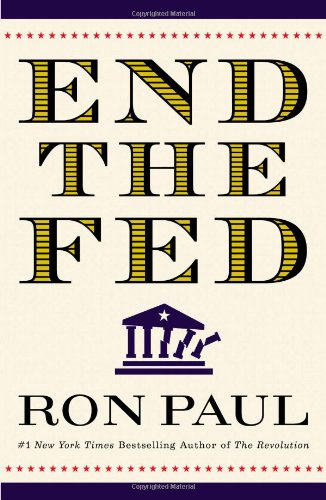 End the Fed
Best Price: $1.12
Buy New $8.53
(as of 10:10 UTC - Details)
End the Fed
Best Price: $1.12
Buy New $8.53
(as of 10:10 UTC - Details)

Others contend that were it not for the independence and vision of Fed Chair Ben Bernanke, the economy might have gone over the cliff and into the abyss after the Lehman Brothers collapse in October 2008.
What opponents of Paul’s audit are thus saying is that elected legislators must be kept out of the temple where the great decisions about the economy are made, that these decisions must rest with bankers and economists answerable, as is the Supreme Court, to themselves and no one else.
But has the performance of the Fed been so brilliant any intrusion upon its privacy is sacrilege?
Among the failures of the Fed is the Great Depression. As Milton Friedman related in his “Monetary History of the United States,” for which he won a Nobel Prize for Economics, the Fed hugely expanded the money supply in the mid-to-late 1920s.
Following a path of least resistance, the money flowed into the equity markets, where stocks could be bought on 10 percent margin. The market soared, and a huge bubble was created. When it popped, scores of thousands of investors conducted a run on the banks to get their money out to meet their margin calls.
Thousands of banks, short on cash, closed. One-third of the money supply was wiped out, and the Fed failed to replenish the lost blood. Thus did the Fed cause the Great Depression.
Smoot and Hawley were framed.
Moreover, every bubble from the dot-com of the late 1990s to housing this decade is a result of Fed policy. For unless there is an excess of money sloshing around, funds that surge into one market, be it housing, stocks or Third World loans, have to come out of another.
Moreover, if the Fed has not failed dismally in its duty to keep prices stable, how come candy bars and Cokes that cost a nickel in the 1950s cost 50 or 75 cents today, and new Cadillacs that sold for $3,200 in the late 1940s cost $55,000 or $60,000 now? Who is responsible for inflation, if not the Fed?
Moreover, it is now conceded that the Fed, in the early years of this 21st century, kept interest rates near 1 percent for too long, and created the bubble that popped in 2008 and almost brought down our own and the global economies.
 Because the Fed can create money out of thin air, we have been able to wage wars on credit, shovel out trillions in foreign aid, World Bank and International Monetary Fund loans, and run humongous budget and trade deficits that have brought our country to the brink of ruin.
And if Bernanke is a genius, how is it he didn’t see the train wreck coming and had to double-time it to the Hill with Hank Paulson to plead for $700 billion to bail out AIG, Fannie and Freddie, and buy all that rotten paper on the books of Citibank & Co.?
The greatest economy the world had ever seen has been horribly mismanaged and virtually ruined by the decisions of presidents, Congress and the Federal Reserve. Main Street has been wiped as Wall Street was bailed out. Why?
Bring on the auditors!
The Best of Patrick J. Buchanan
 The Ten Best-Read on LRC for November 2009 Source of readership stats: Google Analytics