


Money! Moola! Credit! Cash!
May 9, 2007
"Sarkozy must have won the elections," Elizabeth deduced.
Americans, meanwhile, are nowhere near elections, yet there too the politicians are hogging time on the big screen. People can’t seem to take their eyes off of it — except to tune in to the Dow, of course, which hit yet another high on Friday.
What is going on? What is so much nice money doing in a place like this?
Here at the Daily Reckoning headquarters, we continue to give out dire warnings. And yes, our Crash Alert flag still flutters.
Not since the late ’20s have we seen such a long stretch of highs, without a major correction. Does this tell us that we are in a New Era…when stocks can only go up? Nobody is quite talking about a "New Era," but probably only because they don’t want to put a hex on it. Most people think we’ve reached some new omega point in the world’s economic development. That’s what the stock market is telling us, they believe.
Here, we set up the argument for a New Era…just so we will have the delicious pleasure of knocking it down later:
1) New technology — especially the Internet — is increasing output and efficiency. 2) Globalization permits a huge new expansion of the world economy. 3) Billions of people who were formerly shut out of the modern economy — by communism, by distance, or by culture — are now taking part. 4) The triumph of capitalism helps to focus governments on intelligent wealth-producing policies.
All those things are superficially correct…but they are hardly unique. The same things could have been said at the top of almost any major bull market in history. In ’29, for example, who could have doubted that the world was on a roll? Automobiles, trucks, railroads, telephones, electrical appliances…the resurgence of the German economy…the spectacular advances of the Japanese…modern planning and administration…not to mention the vast expansion of the capital markets!
We don’t have to tell you that that "New Era" ended badly. But what about the peak in the mid-’60s? There, the "New Era" arguments were less compelling…but they still abounded. People had become fascinated by computers and drugs. Remember the man in the gray flannel suit, with the narrow tie? American go-go corporate management was said to be conquering the world. General Motors (NYSE:GM) was still thought to be unstoppable. It was just a matter of time before the entire planet would be owned by U.S. corporations — except all the parts run by communists, of course.
Stocks hit a peak in ’66…and then a double peak in ’68. And from there, they went down — catastrophically down when adjusted for inflation — for the next 14 years.
And then, as recently as eight years ago, came another New Era. So loony were the hopes for the dotcoms and telecoms that the experience left some investors permanently skeptical of all "New Era" claims.
But what was really behind all three of these New Era booms?
Money! Moola! Credit! Cash! Each New Era coincides with a massive expansion of liquidity. The cash and credit drive up prices. Investors look around and wonder why. And then they begin to invent post hoc explanations. One explanation is as good as another…until the credit expansion ends. By then, nobody cares; they are too busy running for cover.
What is remarkable about the present expansion is that it is so big…and so durable. First, stock markets went up in the ’90s…then housing in the 2000—2007 period…and now, as near as we can tell, stocks are enjoying another big gust of wind at their backs. Mergers, acquisitions, buyouts…hedge funds, pensions funds, private equity funds, private investors…deals…deals…deals on wheels! We’ve never seen anything like it.
But behind it all is the same phenomenon — an enormous expansion of money and credit. Liquidity is like a bead of mercury; it’s hard to put your finger on it. Still, when the Bank of England tried to measure the growth in global liquidity, recently, it found that liquidity had doubled in the last four years. Now, everyone’s a player…and all the players are leveraged far more than they were a few years ago.
"There’s capital everywhere," says Henry Kravis of Kohlberg, Kravis, Roberts.
"There’s too much liquidity in the system," says a rival at 3i Group (LON:III).
"The world isn’t pricing risk appropriately. Investors are simply not being paid for the risks they’re taking," adds Steve Rattner of the Quadrangle Group.
Money is competing with money. Assets are bid up to prices that are no longer attractive. In order to get a decent return, fund managers have to venture into rougher neighborhoods. Many will be lucky to make it out alive.
And more views:
u2022 The price of gold continues to climb towards $700. And the dollar, at a 10-year low, seems to be giving up ground against other currencies.
Is gold too high or too low? How about the dollar?
In the stock market, it is fairly easy to say whether prices are high or low. You just look at the expected return. Dividend yields are less than 2%. Which means, you are paying $50 for every $1 of annual dividend income — not very good; you can get more than twice as much by putting your cash into a money market fund.
Or, if you look at it in terms of earnings, you find the typical Dow company priced at about 18 times earnings. You pay $18 for $1 of company earnings, in other words — still not very good. At low points, you can get a dollar’s worth of earnings for only $5 to $10, which is another way of saying that the $1 of earnings you buy now for $18, is a risky proposition. Because, if the stock market were to go back down — as historically, it always has — you would lose as much as $13 by the time it reached bottom. And then, if the patterns of the past repeat themselves, you could wait another 20 to 30 years before prices returned to these levels.
So, stocks are simply expensive…and not, on the average, worth the risk.
But what about gold and the dollar? A few years ago, a barrel of oil was worth $15…and an ounce of gold $300. A single ounce of gold would buy 20 barrels of oil. Now, you can only buy about 12 barrels of oil with an ounce of gold.
Is oil too expensive…or gold too cheap? Or were they merely mis-priced seven years ago?
We don’t know, but when people are fearful they buy gold for safety. When they are confident they buy investments for profit. Now, by all the evidence, they are flush with cash and confidence. When that bullish sentiment swings the other way, gold should go up.
u2022 We live in a very conservative part of town. There would have been no celebration last night had Ségolène Royal won.
"My friend Pierre said his father was going to leave France if Ségolène won," Edward reported.
We do not have a television; but the couple across the street has such a big screen that if we wanted to watch TV, all we would have to do is look out the window.
"Yes, Sarkozy must have won," Henry reported. "He’s on the TV…and there are scenes of people celebrating and waving Sarkozy banners."
Elizabeth has been following the elections closely. Each time we voiced our opinion, that it was unwise and unhealthy to interest oneself in politics, we found our self in an argument:
"Look, we live in a world governed by politics and politicians," Elizabeth replied. "If you put your head in the sand, it doesn’t make them go away. They’re still there. And you’re better off knowing what they’re up to…and, yes, you’re better off participating in the political process. Because others will, even if you don’t. And you’ll end up with a government you don’t like. Besides, it’s interesting."
This morning, Elizabeth was so busy catching up on the election coverage that our eggs were overcooked.
 "There, you see. There you have the whole story in an eggshell," we explained. "You are so caught up by things you can’t possibly control or even influence that you have forgotten the eggs. u2018Love afar is spite at home,’ as Emerson put it. We aren’t French. We can’t vote here. Nothing you can say or do has any effect on French politics.
 "Besides, we vote in the only honest way — with our feet and our money. When we don’t like it here, we’ll go somewhere else…and spend our money somewhere else. We don’t have to try to tell the frogs how they should run their country. Instead, we should be concentrating on running ourselves…which means watching to make sure the soft-boiled eggs don’t get too hard. Always and everywhere when you become overly interested in politics, the quality of life declines. And we have had an example of it this morning."
"Then, watch your own eggs," came the reply.
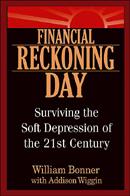
Bill Bonner [send him mail] is the author, with Addison Wiggin, of Financial Reckoning Day: Surviving the Soft Depression of The 21st Century and Empire of Debt: The Rise Of An Epic Financial Crisis.
 Why Do They Love the Fed?