


Crash Warning
December 30, 2006
It is like Siberia here…or at least as we imagine Siberia; we’ve never been there. This morning, everything — trees, grass, houses — are all covered in white crystal — not snow, but thick frost.
But the stock market is hot. The Dow hit a new record yesterday. With only two days left to go in the year, traders and investors are getting in position…adding the shares they want to own for 2007…snorting with confidence…chaffing at the bit to begin another run around the track.
The IMF says investors are "too complacent." We agree. That’s why we have issued our Crash Warning. Not that we know something is going to go wrong soon…it’s just that if something were to go wrong, a lot of people would be greatly inconvenienced. The are so many optimists…betting so heavily that things will continue as they have been…that the odds favor the naysayer, the contrarian, the pessimist, the crank doom-and-gloomer.
The typical investor owns stocks that are too expensive…compared to the dividend yield he receives. And the typical householder owes too much money to too many people — especially the people who’ve lent him money on his house. His house, too, is over-priced for what it is; if he had to rent it out, he’d never get enough money to cover his costs and give him a fair return on his capital.
But the news dribbles in day by day…and so far, the news is not bad. New house sales are greater than expected, according to the most recent report. So, investors and economists are beginning to think — as Alan Greenspan has proclaimed — that the worst of the housing slump is behind us.
"The worst is behind us" is a remarkably upbeat assessment. We turn our heads and we don’t see anything bad back there. Stocks have been hitting new highs…consumers are still spending…and even house prices are, officially, holding at their highs or even creeping up a little. If that’s the worst there is — well, bring it on!
Oops…there, we’ve said it, haven’t we? Like George W. Bush, we’ve tempted the gods. Now, they will want to teach us a lesson; that there are some times when you don’t "muddle through." Most of the time, trends in motion tend to stay in motion. But not all the time. Sometimes, they stop and a new, different trend begins. That is when the gods "bring it on" and give it to us good and hard. And that is when you discover that all those things that you thought were so smart, were too clever by half.
Who are the smartest people around today? Derivatives traders and hedge fund managers, of course. They’re the ones earning millions of dollars each year. They are building huge houses in the Hamptons and bidding up prices of Picassos.
And as long as the pot is getting bigger…they will probably do all right.
John Succo, a hedge fund manager, addressed a letter to the New York Times, explaining:
“The Federal Reserve creates credit through its open market operations like REPOS and coupon passes. If the Fed wants to inject liquidity (credit) into the system, they simply call up large broker dealers and buy some of their bonds with credit they create out of thin air (this expands their balance sheet). The dealer then passes this credit on to u2018the market’ by making loans to mortgage companies or margin accounts or whatever. Because each layer of lender is only required to keep marginal capital on hand, a $1 billion REPO done by the Fed eventually creates as much as $100 billion in new credit to the consumer.
“That credit creates the liquidity for additional consumption in the U.S., but these days we are buying our stuff from China (other countries too but we will just say China to make it easy). When a Chinese company receives dollars in trade, this normally would drive up U.S. interest rates: the company goes to the central bank of China to exchange Yuan for dollars; the central bank of China would normally sell those dollars into the currency market for Yuan thus driving up U.S. interest rates. But in our world of today these dollars are being sterilized: the central bank of China prints the Yuan to give to the company and takes the dollars and buys U.S. securities.
“It is not the excess savings of Chinese investors that are buying U.S. securities. It is central banks creating credit themselves to buy those securities. The tick data that measure foreign inflows of money does not distinguish between private investors and central banks going through brokers to buy U.S. securities. We believe that as much as 90% of foreign money buying U.S. securities (not just Treasury bonds, but corporate bonds, mortgages, and yes, stocks) is not private investment, but central banks.
“In order for other central banks like China’s to print the Yuan necessary, they too must create credit. Public debt in Asian countries is expanding as a result and creating worries: this is why Thailand came out essentially raising margin requirements to reduce speculation that is occurring as a result. Notice how they were quickly slapped down by their trading partners who do not want to rock the boat at this time.
“This situation is very unstable in the long run. The Federal Reserves’ balance sheet this year alone has expanded by $30 billion in this way and created $3.5 trillion of new credit in the U.S. Public debt around the world is growing exponentially and total debt in the U.S. now stands at nearly 3.6 times GDP (1929 was 2.8 times).
“My hedge fund’s position is the opposite of the carry trade you mention. There is coming (timing is unclear where it may be tomorrow or may be years away) a massive correction in debt and derivatives whose magnitude is only growing with time.”
It could be tomorrow. It could be years away. But it will be eventually. And the more complacent people are, the more they will suffer when it does come.
u2022 It looks like oil will end the year at about $60…the dollar at $1.31 to the euro…and gold at $630.
u2022 Last night, at a cocktail reception, we met a man who has started up a WIMAX business, with a license for half of France:
“WIMAX is just the next generation in broadband communications,” he explained. “We use old radio towers and transmit a signal. It can be used to connect to the Internet, of course, but also a lot of other things. You can use it to make phone calls. Or to connect your GPS system. Or to turn to monitor your home heating system. We believe it will replace all these fixed wire systems as well as the public WIFI systems. The trouble with WIFI is that you can’t control who uses it or what they do with it. And it is only in one direction. WIMAX is different. Each customer has an account; you can control the users. You can control how they use it. And it is almost infinitely versatile. This is going to be where the money is made in communications technology in the years ahead.”
u2022 It is colder than we are used to. France has a mild climate, generally neither as cold nor as hot as most places in America. And here, we have a big stone house, without insulation. We cannot hope to heat the whole thing, so we concentrate in a few rooms — where the radiators are turned up and fires burn in the fireplaces.
“I was cold all day long,” said Elizabeth after dinner last night. “Maybe we should go back to Paris.”
“I don’t know how your grandparents did it,” she continued after a few minutes. “They lived in a house in Maryland without electricity or central heating. It was colder there than it is here. And they had nothing to look forward too. They didn’t say to themselves… ‘Oh, next year we’ll put in central heating.’ Instead, they just lived with those wood stoves…and they must have been very cold. And they couldn’t decamp to the city…or move to Florida. After your grandfather was wiped out in the Depression, I guess they had no choice.”
 Why bother to make money, dear reader? Here we have the answer: so you can get warm.
But wait…before the days of central heating, everyone must have heated with wood, coal and open fires. Surely they were not all freezing cold. It must be a question of organization and technology too.
 “It probably wasn’t so bad,” we replied. “They must have had their own tricks and secrets. For example, my grandfather heated up bricks on the stove and put them in his bed to warm it up. And it must have been cozy in the kitchen where they all gathered to keep warm. And think how much they appreciated it when spring came!”
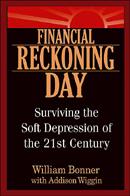
Bill Bonner [send him mail] is the author, with Addison Wiggin, of Financial Reckoning Day: Surviving the Soft Depression of The 21st Century and Empire of Debt: The Rise Of An Epic Financial Crisis.
 What To Do About Venezuela