


The force of a correction is equal and opposite to the deception and delusion that preceded it. Alan Greenspan, George W. Bush, and all the great nabobs of positivism assure us that there is nothing to fear. Our favorite imperial columnist, Thomas L. Friedman of the New York Times, explained that "the next big thing almost always comes out of America . . . [because] . . . America allows you to explore your own mind."
Friedman believes the world would be a better place if America were more aggressive about "empowering women" and "building democracies." He also thinks that technical innovations give America a permanent advantage. Americans are always innovating, always figuring things out. Heck, we even invented outsourcing, says Friedman:
"This is America’s real edge. Sure Bangalore has a lot of engineering schools, but the local government is rife with corruption; half the city has no sidewalks; there are constant electricity blackouts; the rivers are choked with pollution; the public school system is dysfunctional; beggars dart in and out of the traffic . . . and so forth."
Among the things Mr. Friedman seems to lack is a feeling for verb tenses. He goes to Bangalore and notices that it is backward. His conclusion is that it will always be so. "Is" is forever in Friedman’s mind. "Will be" has no place. It is as if he looked at the stock market in 1982. "Stocks are cheap," he might have said. "Stocks elsewhere are expensive," he might have added, without it ever occurring to him that they might change places. And yet, why else would anyone outsource work from Baltimore to Bangalore unless Bangalore was relatively, though not necessarily permanently, cheaper? Let us imagine that Bangalore had no electricity blackouts or pollution or beggars. Let us imagine that it was like Beverly Hills or Boca Raton. We might just as well imagine that stocks were expensive in 1982. Of course, if they had been, there never would have been the bull market of 1982 to 2000. It is only because they were cheap in the past that they had the potential to be expensive in the future. And it is only because Bangalore is a Third World hellhole that it is cheap enough to take work away from overpaid Americans 10,000 miles away. Whether it will, neither Friedman nor we can know.
We always try to get our day off on the right foot by reading Friedman’s column before breakfast. There is something so gloriously naïve and clumsy in the man’s pensée, it never fails to brighten our mornings. It refreshes our faith in our fellow men; they are not evil, just mindless. We have never met the man, but we imagine Friedman as a high school teacher, warping young minds with drippy thoughts. But to say his ideas are sophomoric or juvenile merely libels young people, most of whom have far more cleverly nuanced opinions than the columnist. You might criticize the man by saying his work is without merit, but too that would be flattery. His work has negative merit. Every column subtracts from the sum of human knowledge in the way a broken pipe drains the town’s water tower.
Not that Mr. Friedman’s ideas are uniquely bad. Many people have similarly puerile, insipid notions in their heads. But Friedman expresses his hollow thoughts with such heavy-handed earnestness, it often makes us laugh. He seems completely unaware that he is a simpleton. That, of course, is a charm; he is so dense you can laugh at him without hurting his feelings.
Friedman writes regularly and voluminously. But thinking must be painful to him; he shows no evidence of it. Instead, he just writes down whatever humbug appeals to him at the moment, as unquestioningly as a mule goes for water.
One of the things Friedman worries about is that America will "go dark." As near as we can tell, he means that the many changes wrought after 9/11 are changing the character of the nation, so that "our DNA as a nation . . . has become badly deformed or mutated." In classic Friedman style, he proposes something that any 12-year-old would recognize as preposterous: another national commission! "America urgently needs a national commission to look at all the little changes that were made in response to 9/11," he writes. If a nation had DNA and if it could be mutated, we still are left with the enormous wonder: What difference would a national commission make? Wouldn’t the members have the national DNA? Or should we pack the commission with people from other countries to get an objective opinion — a U.N. panel and a few illiterate tribesman — and achieve cultural diversity?
But this is what is so jaw-dropping about Friedman’s ideas: Even mules and teenagers have more complex views. His work is a long series of "we should do this" and "they should do that." Never for a moment does he stop to wonder why people actually do what they do. Nor has the thought crossed his mind that other people might have their own ideas about they should do and no particular reason to think Mr. Friedman’s ideas are any better. There is no trace of modesty in his writing — no skepticism, no cynicism, no irony, no suspicion lurking in the corner of his brain that he might be a jackass. Of course, there is nothing false about him either; he is not capable of either false modesty or falsetto principles. With Friedman, it is all alarmingly real. Nor is there any hesitation or bewilderment in his opinions; that would require circumspection, a quality he completely lacks.
Friedman fears he may not approve of all the post-9/11 changes. But so what? Why would the entire world "go dark" just because America stoops to empire? The idea is nothing more than a silly imperial conceit. America is not the light of the world. Friedman can stop worrying. The sun shone before the United States existed. It will shine long after she exists no more. But, without realizing it, imperial conceits are what Mr. Friedman offers, one after another. He knows what is best for everyone, all the time.
But even at his specialty, Friedman is second-rate. It is not that his proposals are much dumber than anyone else’s, but he offers them in a dumber way. He sets them up like a TV newscaster, unaware that they mean anything, not knowing whether to smile or weep, out of any context other than the desire to make himself look good. He does not seem to notice that his own DNA has mutated along with the nation’s institutions . . . and that he does nothing more than amplify the vanities and prejudices that pass for the evening’s news. Is there trouble in Palestine? Well, the Palestinians should have done what we told them. Have peace and democracy come to Iraq? If so, it is thanks to the brave efforts of our own troops. Is the price of oil going up? Well, of course it is; the United States has not yet taken up the comprehensive energy policy he proposed for it. Friedman’s world is so neat. So simple. There must be nothing but right angles. And no problem that doesn’t have a commission waiting to solve it.
It must be unfathomable to such a man that the world could work in ways that surpass his understanding. In our experience, any man who understands even his own thoughts must have few of them. And those he has must be simpleminded.
But we enjoy Friedman’s insipid commentaries. The man is too clumsy to hide or disguise the awkward imbecility of his own line of thinking. The silliness of it is right out in the open, where we can laugh at it. His whole oeuvre can be reduced to the proposition that Arabs ought to shape up and start acting more like New Yorkers. If they don’t want to do it on their own, we can give them some help. He says we can send "caring" and "nurturing" troops to "build democracies" in these places and "protect the rights of women." But he doesn’t understand how armies, empires, politics, or markets really work. American troops can give help, but it is the kind of help that Scipio gave Carthage or Sherman gave Atlanta. Armies are a blunt instrument, not a precision tool.
Friedman urged the Bush administration to attack Iraq. But the man has a solution for every problem he causes. "So how do we get the Sunni Arab village to delegitimize [we love these big words — every one of them hides a whole dictionary of lies, fibs, prevarications, malentendus, misapprehensions, miscalculations, guesswork, hallucination, conceit, and mendacity] suicide bombers?"
 Simple. Propaganda! "The Bush team needs to be forcefully demanding that Saudi Arabia and other key Arab allies use their news media, government, and religious systems to denounce and delegitimize the despicable murder of Muslims by Muslims in Iraq."
That ought to do it. What is wrong with the Bush team? Why didn’t they think of that? "Forcefully demand" that the Arab states do more propaganda. Yes, problem solved.
 By the way, your authors have no position on foreign policy. We only notice that the people who do have them are idiots.
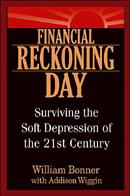
Bill Bonner [send him mail] is the author, with Addison Wiggin, of Financial Reckoning Day: Surviving the Soft Depression of The 21st Century and Empire of Debt: The Rise Of An Epic Financial Crisis.

