


Shanghai and Mao
August 18, 2005
Shanghai, 1985, and Mao: The Unknown Story
by June Morrall and Burton S. Blumert by June Morrall and Burton S. Blumert
Shanghai, 1985 By June Morrall
It was like jumping hurdles when I decided to fly from the US to Red China in 1985. There was no choice of air carriers. It had to be CAAC, the Chinese state airline’s direct flight from San Francisco to Shanghai — and, in those early days, travelers from Europe and the US harbored deep concerns about survival when they boarded CAAC’s planes, all purchased from the Soviet Union.
(I was gripped with fear on this very CAAC flight when, after being over the Pacific for 3 hours and without a word of explanation in Chinese or English, we returned to San Francisco. They did put us up at a decent hotel and the next morning we departed without incident. Still without a word of explanation.)
Only a trickle of Americans flew CAAC, usually in official clusters. The Chinese were mystified by my presence on that San Francisco-Shanghai flight twenty years ago. They were unaccustomed to seeing a young woman flying alone, and it was evident later that they were suspicious about the purpose of my trip.
Well, there was no mystery: Shanghai had a special hold over me and I knew one day I would make that visit. Let me explain: although born in San Francisco, I was u201Cconceivedu201D in Shanghai. That fact was as much a part of me as the color of my eyes.
Like many victims of Hitler’s Third Reich, my parents were slow to accept the reality of how dangerous it was for them to remain in Germany.
Finally, in 1938, my father made the decision to flee; to abandon home and business, knowing he would never see them again. It was time to survive, to begin a new life.
My father soon learned the planet had slammed all doors shut to European Jews on the run. The solitary exception, at that moment in time was Shanghai. And even though China itself was in turmoil, threatened with civil strife and war with Japan, my father managed to overcome every obstacle and move his immediate family to their new beginnings in Shanghai.
As the most Europeanized city in China, Shanghai had been dubbed the u201CParis of the East.u201D About a half-century earlier the colonial powers had forced u201Cconcessionsu201D from the Chinese government, and the city was carved up into European-style enclaves.
My 1985 trip to Shanghai was not just a sentimental journey. After all, my parents had lived in that exotic mixture of east and west from 1938 until 1947, yet I knew little of what their lives were like. The visit to Shanghai might help me understand them better.
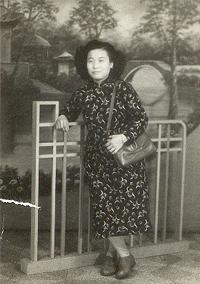 After several months in Shanghai, my father (and his sister and their parents) opened Elite Fashion, a little storefront business that manufactured silk blouses similar to those the family had made in Berlin. Successful from the outset, Elite Fashion employed both European refugees and local Chinese as sewing-machine operators.
As a youngster, rummaging through the family’s archives, I found a photograph of Omia, a young Chinese woman, who worked at Elite Fashion. In the photo she is wearing a Chinese-style, tight-fitting dress. The brief note on the back of the picture made it clear that this vital young woman was more than an employee. Omia had become part of the family. Decades later, my parents still had her address, as if retaining it kept alive the hope of seeing Omia again.
Omia’s fate was important to me. Had she survived Chairman Mao’s cultural revolution, I wondered. If so, had she exchanged her fashionable clothes for the baggy jacket and pants uniform worn by the slaves of Chairman Mao? I had to know.
If she was alive, I would find her, but I needed help.
There were perks working for Time Magazine. I had just ended a stint at their San Francisco news bureau. This gave me access to Time people throughout the world. The Hong Kong bureau chief arranged to have a young Chinese woman in Shanghai act as my interpreter and guide.
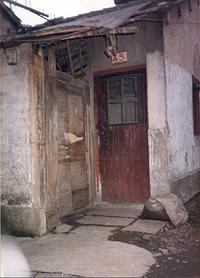 This is where Omia lived in Shanghai.
After recovering from the sixteen-hour CAAC flight, I met my guide, Miss Li, in the lobby of the hotel. She let me know that her last client was Margaret Thatcher. (Now, I don’t know if u201Ctheyu201D thought I was somebody special, but if being special meant that they searched your things in the hotel room, I guess I was special.)
Could Miss Li help me find Omia? I showed her the address, and in less than an hour we stood before a depressing collection of compact huts, made of concrete or cinderblock. I peeked inside one and noted cooking utensils hanging on the wall, but little else. These people were very poor.
Miss Li directed her questions to the u201CBlock Leader.u201D
Is this where Omia lived? Is she alive? If so, where is she now?
The Block Leader’s answer lacked emotion as did Miss Li’s translation. Omia had been murdered during the Cultural Revolution in 1966. Her crime? Contact with Europeans. That was it. Under Mao’s paranoid regime, knowing foreigners made you a spy.
Upon returning to San Francisco, I was surprised at how curious people were about Red China. I was bombarded with the usual questions: How was the food? Do the hotel rooms have toilets? How are women treated?
My impressions were well received, that is until I began to tell them about the murderer Chairman Mao. It was as though someone had thrown a switch. Their eyes would glaze over and whatever I said from that point fell on deaf ears. To many, particularly my media associates, the Chairman was given an historical u201Cpass.u201D
u201CStalin and Hitler were the really bad guys. Mao was basically a reformer. He significantly improved the plight of the Chinese peasants,u201D they said.
Earlier this year I found a magnificent book that explodes the myths about the u201Cloveable, rotund Land Reformer, Chairman Mao.u201D
Mao: The Unknown Story by Jung Chang and Jon Halliday, Knopf 2005. Reviewed by June Morrall and Burton S Blumert
Like a bolt of lightening, Alexander Solzhenitsyn’s masterpiece Gulag Archipelago, published in 1974, destroyed in an instant, over 50 years of lies and deceit about the Soviet Union and its leaders. Stalin would never again be seen as kindly Uncle Joe, but as a ruthless killer of millions.
 Some scholars suggest that it was Solzhenitsyn’s revelations that led to the collapse of the Soviet Union rather than Ronald Reagan’s strategy of u201Cspending the u2018evil empire’ into oblivion.u201D
Like the u201CGulag,u201D we finally have this extraordinary work by Jung Chang and husband Jon Halliday that will forever end the web of lies that has insulated Chairman Mao from his true place in history as the worst murderer the world has known.
Mao: The Unknown Story is a step-by-step guide to how this evil man used terror as a tool to subjugate every Chinese citizen. Fear of a horrible, slow death, torture and humiliation silenced every voice. Only what the Chairman said or thought mattered.
You must read this book.
It wasn’t fashionable to criticize Mao in the West, particularly in the US. In San Francisco’s Chinatown, only the local Kuomintang, Chiang Kai-shek’s Nationalist Party, attacked Mao and they were marginalized as u201Creactionaries.u201D
During the hippie era of the 1960s, in many households, Mao’s Little Red Book was a popular Christmas Stocking stuffer. Mao was thought of as a modern Confucius, a gentle peasant who had freed China from its corrupt warlords.
Was it the media that promoted this false image about the worst tyrant who ever lived? It’s time to know the real Mao.
You must read this book.
Clearly the authors despise Mao, so it was essential that they support their 650-page treatise with an additional 200 pages of meticulously researched notes. Not just scholarly citations, but countless interviews with people who worked for, or otherwise knew Mao personally, and survived the violence of his regime. The notes also include many official documents that have not been seen in the West before.
Mao wanted to impress Stalin and modeled his state after that killer-thug. He then proceeded to u201Cone-upu201D his Soviet teacher. Stalin would wait for the right moment to use violence and treachery against his enemies. Mao was brazen and did not need a timetable. He used torture and murder on a daily basis to control fellow communists.
Chairman Mao made it known that his tactics were never on holiday. Often his punishment was meted out in front of huge crowds. This was certain to spread the news quickly. u201CWatch out! Everyone is a potential spy. And you could be next.u201D
The masses were easy to control. He simply starved them to death.
In the end, Mao had either killed or imprisoned, or sent to work camps so many of his former officials that he had run out of credible bureaucrats to run the day-to-day business of government.
He had no choice but to u201Crehabilitateu201D some that he had purged earlier, like the u201CCapitalist Roader,u201D Deng Xiao-ping. These men hated Mao, and the Chairman made a critical error in underestimating how they would undermine him as his health began to fail.
Most interesting was the revelation that the Nationalist leader Chiang Kai-shek (who later fled to Taiwan) was thwarted in his earlier negotiations with Mao because the Soviets were holding Chiang’s son "hostage." By appeasing Stalin and Mao, Chiang hoped he would get his son back.
During his reign of terror, Mao forced the peasants to grow huge amounts of wheat and eggs and other foodstuffs to give to Stalin in return for technical information on how to build The Bomb. Mao starved his already poverty-stricken people and conducted public executions if quotas were not met. Business as usual for Chairman Mao.
Mao turned the country into one big concentration camp and he was the gatekeeper, allowing in selected outsiders, controlling what they saw so that when they returned home they would glorify what the Chairman had accomplished for his people.
Mao had little difficulty locating western media whores who would promote the lies about Mao and life in Red China and spread them like a deadly virus. There should be a special place in Hell for these people.
If there is a deficiency in this book, Mao: the Unknown Story, it is that after hundreds of pages outlining Mao’s unspeakable cruelty, the reader becomes numb and desensitized. The fault is not the author’s, but with the endless crush of evidence present.
As an antidote to becoming desensitized, keep in mind that this is not about a madman like Pol Pot. Mao may, in fact, match the crazed Cambodian in savagery. But, there’s a major difference; Today, Pol Pot, often considered a protg of Mao’s, is a statistic in the World List of Lunatics, while Mao retains his place as a great figure in world history. This remains true 20 years after the Chairman’s death. Well, until this Chang and Halliday masterpiece.
You must read this book.
Here are some tidbits from Mao: The Unknown Story:
-
A conservative estimate is that 70 million perished — in peacetime — as a result of Mao’s misrule.
-
During the famous, u201CLong March,u201D rather than trudging along with the troops, Mao reclined in an elaborate u201Clitteru201D weighted down with his favorite books and other comforts, all carried by peasants forced to perform like pack animals.
-
Mao spent about US$4.1 billion to create a Chinese atomic bomb. That money if spent on food would have saved the 38 million Chinese lives lost in the famine.
In a recent TV ad promoting the 2008 Summer Olympic Games to be held in Beijing, China, the camera focussed on what appears to be Tiananmen Square. In the center of the screen, lo and behold, is a giant portrait of the despicable Chairman Mao.
 Why do nations continue to show reverence for their tyrants?
Yes an economic miracle is taking place in today’s China. The by-product of such an explosion is always freedom. China is a long way from being a totally free society, but, if this book, Mao: The Unknown Story, leads to the Mao portraits finally being torn down, that will be a giant symbolic stride towards individual freedom in China.
And maybe in other countries as well.
 Getting Swept