


The Man Who Introduced Me to Murray Rothbard
March 10, 2009
Larry Moss, RIP
I first met Larry Moss in 1966. He was a first year economics graduate student at Columbia University; I was one year ahead of him there, in my second year.
It soon became clear that we were on the same wavelength as far as political economy was concerned; he and I were part of a small band of free enterprisers at Columbia, surrounded by a bunch of critics of the marketplace, both amongst the students and faculty. He and I had a lot more in common; we were both from New York City. He had recently graduated from Queens College, and I from Brooklyn College, sister schools in the City University of New York (CUNY) system. We were both Jewish, and, in order to embrace the free market philosophy, both became outliers in our families. We both lived in the upper west side near Columbia, just a block or two from each other.
However, despite these commonalities, I never really grew close to Larry at this point. Why not? Because he kept saying that he wanted to introduce me to this fellow, Murray Rothbard. I would have been willing to do so, but Larry said that Murray was an anarchist, among his other descriptions. Well, that did it for me. I was in my Randian stage at that time, and I knew, I just knew, that all anarchists were nuts and fruitcakes. My respect for Larry plummeted. He and I didn’t have too much to do with each other at that point.
However, one day I met Larry and his then roommate, Jerry Woloz, another friend of Murray Rothbard’s. The two of them ganged up on me; they made anarchism sound almost palatable; not quite of course, but enough so that I finally became willing to meet Murray (who converted me to this position in about five minutes).
 Then, began my and Larry’s overlap during the "living room" period of both our lives. The two of us, and Jerry Woloz, along with the remnants of Murray’s circle Bastiat, would hang around in Murray’s living room until all hours of the night, discussing economics, libertarianism, playing Risk (don’t ask, you had to be there to appreciate this), and laughing so hard we thought our stomachs would burst. Murray was fiendishly funny. This lasted, at least for me, until 1978, when Larry’s and my path diverged from each other’s.
Larry and I kept in touch with each other after that, but it became more sporadic, with me on the west coast of Canada, and he in the New York City and later in the Boston area, where he taught for many years at Babson College. We would see each other from time to time at economics conferences, and renew old times, old friends. When he became editor of the American Journal of Economics and Sociology, we began a new chapter in our lives, as I published some half dozen articles with him over the years. But, I’ll never forget my graduate school friend. I’ll be eternally grateful that he had the chutzpa to keep pushing Murray Rothbard on me, despite my initial protests. My life would likely have been very different, and much poorer, were it not for Larry’s assertiveness in this regard.
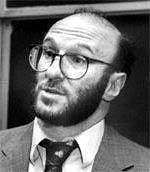 I’ll never forget one class I took with Larry; it was Donald Dewey’s course in Industrial Organization. For some reason it had a very small class size; there was me, Larry, two Randians, and miracle of miracles, 3—4 other supporters of laissez faire capitalism. In his first class, Dewey was attempting to set the stage for opinion within the economics profession concerning anti-trust law. To do so, he took a survey of the class members. First, he asked for a show of hands of those who wanted to strengthen and extend this law; no takers. With a bit of surprise on his face, he then called for those who favored the status quo in this regard; again, no one raised his hand. Very perturbed now, Dewey asked those of us who favored a reduction in the power of this law to identify ourselves. He was truly amazed, again, that not a single hand shot up. Exasperated, he finally offered us the fourth alternative: complete repeal of this law. Every hand was raised, amidst general mirth, at least on our parts. Larry and I grinned at each other.
Larry Moss, rest in peace. We didn’t agree on every jot and tittle of Austro-libertarianism, but you did the Lord’s work, promoting liberty and Austrian economics.
 GPS Coordinates Are Becoming Latest Travel Destination