


The 'Progress' of the End of Tsarism
November 7, 2005
Once in our lives we wanted to make the people happy and this is something for which we will never forgive ourselves.
~ an old Russian leftist to Nadejda Mandelstam, Leftism Revisited
 This year we mark the centenary of the revolution that gave birth to the Russian Duma Monarchy. Today is the 88th anniversary of the dreadful event that goes by the name of the Russian Revolution, in which the Kerenski provisional government was overthrown.
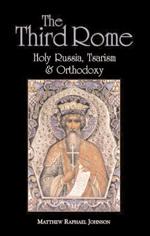
A book from 2003 is on this occasion very relevant indeed. The Third Rome: Holy Russia, Tsarism and Orthodoxy is a book by Dr. Matthew Raphael Johnson and published by the Foundation for Economic Liberty. An excerpt is available online.
The book starts out in the preface with what one could call a sort of Hoppean challenge of the Whig theory of history:
The purpose of The Third Rome is to alter the political universe of those who read it. In other words, it was to challenge the assumptions that underlie the liberal/conservative consensus in western countries. Such assumptions include the superstitious belief in progress, the linear (i.e. evolutionary) development of history and, importantly, the continued dominance of the idea that western democracies are morally superior to not merely the rest of the globe, but also superior to all systems of rule that have ever existed.
Further down in the preface Dr. Johnson goes on:
For the exoteria of western politics, one is routinely treated to myths about the linear development of European history from the "darkness" of the middle ages to the "light" of the Enlightenment, science and its progeny, postmodernism. The "tyranny" of medieval and early modern kings is contrasted to the benevolence of modern republics. The evils of feudalism are contrasted to the capital/state alliance. This makes up every introduction to political science in universities, and it is at the very nature of "civic discourse" as it is contrived in the west. The only difficulty is that it is nonsense.
At no time in global history have ruling classes amassed such centralized power: surveillance techniques, media power, armies, advanced weapons, computers and a disciplined bureaucracy that can track each and every citizen with pinpoint accuracy throughout his life form the vulnerable underbelly of the tripe concerning "democracy" and "republicanism" in the west. Tyranny previous to modernity was largely impossible: the technological apparatus needed to create "totalitarianism" simply did not exist. Only modernity can create tyranny.
Johnson is right on the money when he tells us:
[T]he day to day functioning of royal government, is not contrasted with the actual functioning of republican systems, but rather with idealistic theory of republicanism.
The book is not only a defense of the Russian monarchy. It is also a defense of the Orthodox branch of Christianity. Johnson is an Orthodox Christian. In his book he puts himself in conflict with the Catholic Church. The third Rome is Moscow, the second Byzantium, and, of course, the first is Rome. An important part of the book is the theme that the Orthodox Church, Russian culture, and the Russian monarchy are tightly linked.
I cannot say I agree with everything Dr. Johnson says. Nor have I double-checked all the facts. Most LRC readers will probably react negatively to Johnson’s anti-globalization and anti-capitalist rhetoric.
We know so very well how many Western intellectuals have wanted to see the Russian Revolution and the more than 7 decades of Communist rule through rose-colored glasses. We should probably read Johnson’s book with critical eyes, but the history we have been taught by said Western intellectuals should probably viewed at least as critically — if not more. Johnson is probably not very far from the truth when he claims:
[T]he English language historical literature on Russia merely rehashes 90-year-old Bolshevik propaganda and calls it history.
We are taught that what gave the West its success is small political units, as opposed to China and Russia. However, what works for the West does not necessarily work for Russia. As Erik von Kuehnelt-Leddihn told us in his Leftism Revisited:
[T]he brilliant, scintillating, amiable intelligentsiya were the guiltiest of all. For generations they had undermined the fabric of Holy Mother Russia, either by siding with the Social Revolutionaries, the Narodnaya Volya, the Social Democrats, or by being "open-minded," by deriding the national heritage, by spreading polite doubt, by stupidly imitating Western patterns, ideas, and institutions that would never do for Russia.
One can disagree with Raphael Johnson’s anti-Western rhetoric, but he undoubtedly has a point in that Russian culture is quite different from Western culture. Besides, given all the anti-Russian rhetoric that has been in circulation, anti-Western rhetoric the other way is perhaps the least one could expect.
Johnson echoes Bertrand de Jouvenel when he tells us that absolutism in the Russian monarchy was absolutism in the political sphere only. Today the political sphere includes everything, and the modern man hardly understands how limited royal "absolutism" actually was. Johnson tells us that the monarchy was invisible to roughly 90 % of the Russian population until the revolution. Johnson describes a decentralized system:
The peasant commune controlled the social life of the peasant, and was completely independent of the tsar.
Dr. Johnson attacks the modern regime in which the workers stand alone in an environment where the employers have no responsibility for the workers’ well-being. Johnson’s attack on the "Robber Barons" would probably find many disagreements among many of the readers of LRC. However, Johnson does have a point when making us aware of the responsibility masters of old had for the well-being of those who worked for them. In a sense he echoes Bertrand de Jouvenel’s reflections on the same issue in his On Power. One can easily — to some extent at least — agree that one of the major problems of our times is freedom from responsibility.
Johnson describes a high level of social legislation, especially legislation protecting workers from poor working conditions. Now, it is at least questionable that such legislation is desirable. However, the legislation at the time was probably nothing compared to what we have nowadays. There is little doubt that if such legislation were in place in pre-1917 Russia, the claims that old Russia was a "reactionary" system exploiting the lower classes do not have very much basis.
Johnson also seems sympathetic to the idea that the modern centralized state, which more or less has crushed the institutions that would protect the individual from power, does not give any real individualism:
An "individual," isolated from his commune or region, would, as in all "democracies," be a meaningless legal fiction, easily exploited. This is the esoteria of "individualism" in political theory; it is easier for the oligarchy to dominate isolated individuals than to deal with larger and more powerful communal and municipal structures.
On Nicholas I Johnson tells us:
In liberal democracies, those who have the most ambition to rule are those who run for office. Nicholas showed the opposite that, even when the crown was handed to him, he rejected it in favor of the (formal) heir apparent. Only under pressure did he accept the crown. In democratic thinking, only the ambitious and obnoxious are capable of doing what is necessary to get elected. American politicians are whores. They are forced to alter their views depending on the group with which the politician is meeting with or speaking. He is constantly asking for money with far less grace than a common prostitute.
On taxes The Third Rome tells us the Russians were the least taxed in all of Europe at the time:
St. Nicholas II was brought to the throne in 1894. He found a Russia far from being "backward," but, in a few years — by the start of World War I — was the envy of the world. She had the lowest taxes in all Europe. Direct taxation per capita amounted to 3.1 rubles per year, versus 13 for Germany, 10 for Austria, 12 in France and 27 in progressive, democratic and capitalist Britain. Indirect taxation was also the lowest in Europe, amounting to 6 rubles per capita for Russia, but 10 for Germany, 11 for Austria, 16 for France and 14 for Britain.
This level of taxation should absolutely give cause to consider the old Russian order in a favorable light. Moreover, the old Russian regime’s attitude towards central banking is quite interesting indeed:
Russia was just beginning her economic expansion into world markets. There can be no question that the refusal of the Romanovs to set up a central bank under the rule of the global financial elite marked them for extinction. Imperial Russia was the only major European power who refused to set up a Central Bank, though the Bolsheviks, as always, willingly obliged.
It seems here that Johnson has nothing against world trade and making money. So what is the anti-capitalist rhetoric for? Is it merely an attack on the alliance between state and capital? Or is it an attack on a lack of worker protection? Both concepts are attacked by Johnson. I am not in this essay defending Johnson’s pro-welfare perspective. By no means. The pro-welfare perspective is very little relevant to the book’s key point, namely that the emperor was far more a friend of liberty than the brutal barbarism that was soon to come.
When reading Leftism Revisited, we are told:
[Serfdom] did exist until 1861, but it was no more and no less characteristic of Russia than slavery was of the United States. It was, moreover, incomparably milder than slavery and did not exist at all in the majority of the empire. Some serfs were rich — with fortunes amounting to from 30 to 60 million dollars (present purchasing power) — and they paid only a microscopic head tax.
The Third Rome tells us of serfdom that:
It is, regardless, far from clear that the liberation of the serfs was an unmitigated gain for the peasantry. Nevertheless, in 1861, what took the American republic years and hundreds of thousands of American lives to accomplish (in the case of slavery), the Russian Tsar accomplished in one fell swoop, the elimination of serfdom and the liberation of the peasant.
One of the things I recall having been taught in school about Russia is something like that 10 % of the Russian population owned 90 % of the land. Raphael Johnson counters such teachings in Western schools when saying, e.g.:
By 1917, the peasantry controlled the overwhelming majority of farmland — more than three times what was controlled by the nobility.
Another thing we are generally taught is that Russia was a police state and the most absolute state in all of Europe. Such teachings are again countered by Johnson:
De Goulevitch claims there were 3,500 members of the St. Petersburg police force. However, Kochan and Keep (1997) claim that there were 5,000 full time policemen in the entire empire of 180 million souls, which would make Russia one very poor example of a police state. In fact, the total number of government workers, including the zemstvo employees, policemen and employees at all levels never exceeded 330,000. By contrast, much smaller France, in 1906, had budgeted for 500,000 employees.
Moreover, Johnson tells us that the royal government did not dare step into the domain of the peasant communes, and that:
The peasant rebellions of the Russian countryside were on the scale of large civil wars.
Moreover, in one of his many well-placed rants against democracy, Dr. Johnson tells us:
"Free elections" are the easiest way for an oligarchy to enslave a population without them knowing it.
Johnson covers many topics such as the question whether Ivan the Terrible is a correct translation from Russian and whether he was a butcher. Johnson believes Ivan the Awesome is a more correct translation. Johnson claims to be clearing up some misunderstandings, and he should be credited for this. However, his antipathy — when describing the fight over power between the Tsar and the aristocracy — against the aristocracy, which serves as a check on power, I do not have much sympathy for.
The fact that Russia had to fight the Mongols has probably had more influence on the development of the geographically largest nation on this planet than we generally think of. Johnson also gives us a bit of his thoughts on this.
Johnson claims that Peter I was an un-Russian emperor, in the sense that he was bringing about "enlightened absolutism." This is according to Johnson a European concept and not a Russian one. Johnson has consequently little sympathy for Peter the Great. According to what we are taught in Western schools Russia is the example of absolutism in Europe. Again, Raphael Johnson offers here a perspective which is well worth looking into. Among the checks on the Emperor’s power were — according to Johnson — the Orthodox Church and the peasant commune.
Johnson gives us a pretty good overview of Russian history until 1917. He has left post-1917 out because he believes this is not particularly Russian. He does quite well in explaining a system prior to democratic absolutism and the totalitarianism and atrocities of the 20th century. This was by no means a perfect system, but it seemed to work quite well for Russia, and it was unfortunately brutally brought to an end.
It is commonly believed that the first revolution in 1917 was progress, whilst the October revolution was the great tragedy. This is similar to the conception that the end of Habsburg and Hohenzollern rule was progress, whilst the rise of the Hitlerite monster was the great tragedy. Of course, it is true that the rises of Lenin, Stalin, and Hitler were great tragedies. However, to think that the end of Romanov, Habsburg, and Hohenzollern rule was progress is a grave error. As for Russia, Erik von Kuehnelt-Leddihn sums it all up in one brilliant sentence in Leftism Revisited:
In Russia, the fall of the monarchy in March 1917 destroyed the center and object of all loyalty.
As — amongst others — Bertrand de Jouvenel has noted, revolutions never bring about better leaders in the end. This is also true for Russia, and one of Erik von Kuehnelt-Leddihn’s 1188 notes in Leftism Revisited tells us no different when describing Alexander Kerenski:
I met the man twice in the United States. He was "nice" but, listening to his views, I could only pity him. George Katkov was absolutely right when he said that the Russian "liberals" who destroyed the old regime had no idea of the crime perpetrated, nor the least capacity to steer the ship of state on an even keel.
Although I am generally satisfied with Dr. Johnson’s communicating the end of Tsarism as decline, and with his attempt to refute survived propaganda about Tsarism, I feel that the myth about the two independent steps of revolution in 1917 is not sufficiently countered. The Kerenski error should have been countered more thoroughly.
Johnson has an extensive bibliography to be used for further studies. However, there seems to be something missing in this bibliography. Erik von Kuehnelt-Leddihn wrote in Leftism Revisited:
The misconceptions, moreover, about the Russian class structure that prevail in the Western world are so manifold and so deeply rooted that they seem ineradicable. The three brilliant volumes by Anatole Leroy-Beaulieu on late nineteenth-century Russia, L’Empire des tsars et les Russes, give a glimpse of a totally mixed society based neither on birth nor on money. Needless to say, the same impression is conveyed by the great Russian novelists of that period. Actually, before Red October Russia was Europe’s "Eastern America," a country where social mobility was greater than elsewhere, where titles had none of the nimbus they had in the West, where fortunes could be made overnight by intelligent and thrifty people regardless of their social background. Skilled European workers and specialists in many fields emigrated to Russia rather than to the United States. And, even before 1905, knowing how to speak and to write gave total liberty.
Anatole Leroy-Beaulieu’s work is available in English as Empire of the Tsars and the Russians. Considering this tribute in Leftism Revisited and considering that anyone seriously involved with disputing the transition from monarchy to democracy being progress should be familiar with Leftism Revisited, I find it peculiar that one cannot find any reference to Anatole Leroy-Beaulieu in Johnson’s book. Specifically, anyone involved in disputing the development from monarchy as progress paradigm when it comes to Russia should be familiar with the 10 pages — and the associated notes — in Leftism Revisited on Russia, i.e., the chapter by the name of From Socialism to Communism. Again, why Leroy-Beaulieu is not referred to is puzzling. Moreover, the above quote from Anatole Leroy-Beaulieu gives a perspective which is not clearly communicated — or perhaps even lacking — in Johnson’s book.
The Third Rome is highly recommended. Many LRC readers will find the rhetoric disagreeable. The book should — despite its shortcomings and disagreeable rhetoric — be read by anyone seriously interested in the transition from monarchy to democracy. It is high time we start viewing the Russian Revolution as Erik von Kuehnelt-Leddihn did:
Imagine a very popular, intelligent, conscientious, good-looking and responsible young man, obviously destined for a highly successful life. One day, having had a few drinks too many, he runs his car into a tree and ends up a paraplegic. Accidents happen not only in the lives of persons, but also in the lives of nations.
 There is no meaning behind the course of history.
Ignore an anti-modernist book on the geographically largest nation on this planet if you so wish, but that would probably be for the good of your own ignorance.
The Best of Jørn K. Baltzersen
 Stomping Studer