


Rothbard and Burke vs. the Cold War Burkeans
The monarchic, and aristocratical, and popular partisans have been jointly laying their axes to the root of all government, and have in their turns proved each other absurd and inconvenient. In vain you tell me that artificial government is good, but that I fall out only with the abuse. The thing! the thing itself is the abuse! ~ Edmund Burke, 1756
The Original Controversy
 Some weeks ago, LRC ran the late Murray Rothbard's "A Note on Burke's Vindication of Natural Society" (originally published in the Journal of the History of Ideas in January 19581) under the provocative title "Edmund Burke, Anarchist." In this essay, Rothbard argued that the Vindication, Burke's first important publication, was a serious and rationalistic analysis of the evils of "artificial society" – that is, political government – and was thus perhaps the first statement of modern anarchism. It was an anarchism that grew naturally out of 18th-century liberalism with its commitment to natural rights and natural law.
The Vindication was so radical that the young Burke published it anonymously. The style and manner of argument were based on those of the late Tory publicist Henry St. John, Viscount Bolingbroke. Burke later added a preface to the work, claiming the Vindication had been a "satire" on Bolingbroke's deistic notions of natural religion.
In short order, Rothbard's thesis drew forth a response from John C. Weston, Jr. in the same journal.2 Weston asserted that Rothbard's bold argument had forced him into an otherwise "gratuitous demonstration" of the satirical character of the Vindication. He brought forward four long quotes from the Vindication in aid of his reassertion of the conventional pro-satire position. He next sought to score a number of points against Rothbard's case, claiming Burke's critique of wars and forms of government as witnesses for the satire interpretation, wrapping the whole package up with assertions of Burke's lifelong consistency in his views.
And there the matter might have come to an end.
In June 1960, Rothbard wrote to a close friend and colleague that he intended to reënter the fray soon. There is, in fact, an eight-page answer to Weston in Rothbard's papers: "The Alleged Irony of Burke's Vindication: A Reply."3 Here Rothbard disposes rather quickly of three of the long quotations brought forth by Weston. Of the fourth, containing Burke's views on Rousseau, Rothbard said that his opponent's use of it only revealed "Professor Weston's confusion on the nature of the libertarian tradition." Hostility to Rousseau proved little because an "individualist anarchist" would oppose him: "for the Vindication was not opposed to u2018civilized society'…. On the contrary, as I pointed out, Burke, in the libertarian tradition, champions u2018natural society' as against the depredations of the State."4
Next Rothbard addressed Weston's claim that irony shines forth as Burke "lays the blame to government" for mass-murder through warfare "u2018in four amusing arguments.'" Rothbard wanted to know just where the amusement might be. Among other things, Burke said that political organization and improved instruments of war together had brought about far more slaughter than could ever otherwise have been the case. Burke wrote that citizens "engage under [rulers'] banners with a fury greater than if they were animated by revenge for their own proper wrongs." Rothbard called this "a brilliant, not an absurd, observation on the workings of the spirit of patriotism."5
If the Vindication was merely a reductio ad absurdum of Bolingbroke's arguments for deism, Rothbard wanted to see a few of the supposed absurda. Burke's text seemed entirely straightforward (non-ironic) with regard to lawyers and Weston maintained that, there, some of Burke's real views leaked out. In those passages the "satire" was not fully sustained. Rothbard found "this singularly unconvincing, especially when we consider that distrust of lawyers and their alleged vested interest in tyranny, was part-and-parcel of the very libertarian tradition of the eighteenth century that Burke is said to be satirizing."6
There are many such "leakages" in conventional readings of the book. At some point in his research, Rothbard acquired a copy of Joseph Cressman's dissertation, which was dedicated to sustaining the satire theory.7 Rothbard's extensive underlining and marginal comments flag every case where Cressman discussed passages that clashed with the satire theory. Once again, Burke's "real views" were spotted bubbling up through the sham-Bolingbrokeanism. Cressman was especially sure of this in passages where Burke spoke of the plight of the poor. He may well be right – but how many cases of Burke's real views can there be before the whole satire business topples over? Rothbard saw all such weaknesses as evidence for his own reading.8
The Burke literature of the time generally suffered from a tendency to confine treatment of Burke's ideas within certain highly artificial, twofold oppositions. 18th-century figures were thus either "for nature" or "for civilization." Rousseau or the Bank of England, take your choice. Primitivism or statism!
"Nature versus Art" Was Not the Only 18th-Century Game in Town
Historical knowledge grows at its own speed. In the United States it seems to proceed dialectically through endless series of twenty-year debates over false alternatives. The now-dwindling war between the republican school and the so-called neo-Lockeans comes to mind. Happily, this is not the only thing that happens. Sometimes there are surprises. Thus in 1977, Isaac Kramnick, in the course of explaining the bourgeois radicalism of the 18th century, provided much support for Rothbard's reading of Burke's Vindication.
Before looking at Kramnick's contributions to our specific question, there are some other things to clear away.
What was at issue in the quarrel over Edmund Burke's authorial "voice"? Was there more to it than a mere academic debate over his consistency of thought or his literary style? Indeed, there was.
As Kramnick sees it, American conservatives of a certain kind clasped Burke to their bosoms and reinvented him as a Cold War prophet. Thus, "the Burke packaged in the 1950s and 1960s as a natural law theorist was less the result of a philosophical reading than a political one."9 The Cold Warriors' Burke would be much more convincing if his ideas had undergone no change from his first writings to his last. This position was fraught with difficulties.
The Official Burkeans held that Burke's reading of natural law was a traditionalist one having little (perhaps no) links with such later heresies as rights inherent in mere individuals. No, indeed. Burke's outlook rested on such happy notions as hierarchy, subordination, consecrated and mysterious authority, prejudice, long-standing usage, corporate bodies, and the like. If rights existed at all, they were chartered ones and existed only as part of the above-mentioned mysterious, consecrated networks.
Well, that's as may be, but it was the prescriptive, concrete, anti-abstract, empiricist, and pragmatic Burke who said a good many things that do not fit very well the theory of an unchanging Burke modeled solely on his later writings. Murray Rothbard, who had not forgotten about Burke, highlighted some of them in his work on American history.
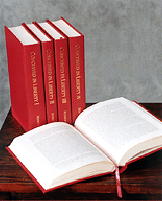 In volume three of his Conceived in Liberty, Rothbard zeroed in on Burke's appreciation for Americans' near-anarchist state of freedom, as revealed in his famous Speech on Conciliation with the Colonies. Writes Rothbard: "Burke saluted American achievements and economic development" and "harked back to the crucial distinction he had made in his first work, A Vindication of Natural Society (1756), between the benefits of natural voluntary actions in society (u2018natural government'), and the mischievous effects of the coercive intervention of the state (u2018artificial government')."
Further: "Burke hailed the u2018fierce spirit of liberty' that had grown up among the Americans" and "saw with acute perception the radically new nature of what the Americans had recently been doing. He saw that they had been creating, in their network of local and provincial committees of correspondence, of enforcement, and conventions of delegates, both provincial and continental, an approach to a state of anarchism. For here were revolutionary institutions completely illegal and outside the legal framework, created spontaneously by the people building from the grassroots."10
And here is what Rothbard quotes from Burke himself: "We thought, Sir, that the utmost which the discontented colonists would do, was to disturb authority; we never dreamt they could of themselves supply it." As for conditions in Massachusetts, Burke said: "we were confident that the first feeling, if not the very prospect of anarchy, would instantly enforce a complete submission. The experiment was tried. A new, strange, unexpected face of things appeared. Anarchy is now found tolerable. A vast province has now subsisted, and subsisted in a considerable degree of health and vigor, for near a twelvemonth, without governor, without public council, without judges, without executive magistrates."11
Thus, the sober, unchanging Burke. That he should have made such empirical observations as a warning to Parliament to mend its policies, or become irrelevant in British North America, is rather interesting. Evidently, empiricism and practicality are not always to be reckoned on the side of the Cold War Burke.
Indeed, Burke's down-to-earth, unworried comments on Massachusetts bear comparing with Murray Rothbard's discussion, in the first volume of his American history, of actually-existing anarchism in colonial Pennsylvania from 1684 to 1688.12
 Treating Thomas Paine's argument in Common Sense against so-called balanced government, Rothbard sees it as "reminiscent of Edmund Burke's blast against the idea of mixed and balanced government in his anarchistic work, The Vindication of Natural Society." Here is part of Burke's salvo: "[T]his junction of regal, aristocratic, and popular power, must form a very complex, nice, and intricate machine… liable on every accident to be disordered." Hence, this "system is like a city, where trades that require constant fires are much exercised, where the houses are built of combustible materials, and where they stand extremely close."13
Hans Hoppe might well agree. (Professor Weston, who could not imagine a radical young Burke making a case against political government as such, construed Burke's serial rejection of all forms of government as part of his high wit.)
For a parallel jape about fires and mixed government, we turn to the poet Percy Bysshe Shelley: "If a man was accused of setting fire to a house, which house never existed, and from the nature of things could not have existed, it is impossible that a jury in their senses would find him guilty of arson. The English constitution, then, could not be offended by the principles of virtue and freedom."14
Burke and Shelley together again – on our show (with apologies to Ed Sullivan). What can that mean? It seems to mean that there was in the late 18th century a spectrum of bourgeois liberalism. Burke moved from its radical pole to the conservative one, while Shelley did the opposite.
Here is another Burkean observation: "He that deliberately views the machine of human society, will even in his speculations approach it with awe. He will recollect with alarm, that in this scene u2018fools rush in, where angels fear to tread.' The fabric that we contemplate is sort of a fairy edifice, and though it consists of innumerable parts, and hides its head among the clouds, the hand of a child almost, if suffered with neglect, may shake it into ruins."15
But wait! This is not Burke, but William Godwin, whom everyone credits with outright anarchism but whose views on strategy were deeply gradualist, making him an "ally," in effect, of Burke in criticizing the so-called English Jacobins.
So what happened with Burke? Was he, all his life, an anarcho-gradualist like Godwin, but under deep cover? Probably not.
As Rothbard saw it, as early as 1770 a split was arising within English liberalism between libertarian, radical Whigs and moderate Whigs.16 During the debates over the American secession, Rothbard noted, "Burke, who habitually dealt in terms of utility and expediency, or else tradition, now acknowledged in part the validity of the Americans' stress on their rights. Yet he was gradually being outflanked on his left."17 As the gap widened, Burke chose to go with the moderates.
But even in the 1780s, in his speeches impeaching Warren Hastings for abuses committed in India (and modeled on Cicero's impeachment of Verres), the prescriptive, expedient Burke could still say things of this sort:
"The rights of men – that is to say, the natural rights of mankind – are indeed sacred things; and if any public measure is proved mischievously to affect them, the objection ought to be fatal to that measure, even if no charter at all could be set up against it…. Indeed… formal recognition, by the sovereign power, of an original right in the subject, can never be subverted, but by rooting up the holding radical principles of government, and even of society itself."18
Kramnick's Vindication of Rothbard
We can be grateful to Professor Kramnick, whose views I have promised to canvass, for setting Burke outside the Cold War. Kramnick has a certain objectivity and perspective, partly because he rather frowns on bourgeois thought. From his angle, he can treat laissez faire liberalism-to-radicalism with less partisanship that do some, who might be "within" that outlook. That Murray Rothbard, who embraced bourgeois radicalism, came to similar conclusions is not altogether shocking.
Kramnick specifically refers to Rothbard's 1958 essay in a chapter in which he heaps up evidence for a radical reading of the early Burke. I cannot summarize it all here, but Kramnick resorts to Burke's early writings in Ireland, his fragment on English history, and an early essay on the law, and finds therein radical bourgeois liberalism fully consistent with the content of the Vindication. The views Burke allegedly set forth there as irony and satire, Kramnick says, are ones "Burke happens to have repeated… in a large number of u2018serious' contexts."19
Kramnick's approach strikes me as far superior to that of a certain outside agitator and sometime Irish Senator, who likes to lecture us – this side of the water – on whether or not we may find anything admirable in Thomas Jefferson, and who has made Burke a sort of conservative hero for modern social democrats.
On the standard view, then, the young Burke addressed the late Viscount Bolingbroke thus: "Sir, you argued thus and so regarding artificial religion and its outgrowths, but are not the results of artificial government far, far worse?" – and, bang, Henry St. John's ideas on deism are out the window. But if, on the facts, the effects of political government had been grievous – not exactly an unknown proposition – it makes more sense to say with Rothbard and Kramnick that Burke aped Bolingbroke's style and employed his religious argument for the entirely different project of airing his (Burke's) radical bourgeois views on the state.
Burke's own religious views hardly need come into it at all.
And What of the Later, Counter-Revolutionary Burke?
 As for the later Burke, who clearly had shifted ground, there is much worth reading even in the Reflections on the Revolution in France. For all the high-toned feudal-sounding rhetoric that crops up, there is much wisdom and not a little classical liberalism. A certain Reverend Fawcett went about in the 1790s with Burke's Reflections and Tom Paine's Rights of Man bound in one cover, because, he said, together "they made a good book."
William Godwin personally profited from the satire theory of the Vindication. Acceptance of that view made Godwin, and not Burke, the first liberal anarchist. Despite his gradualism, he and the later Burke were indeed miles apart. His view of Burke was this: "He… sought wealth and plunged in expense, instead of cultivating the simplicity of independence; and he entangled himself with a petty combination of political men, instead of reserving his illustrious talents unwarped, for the advancement of intellect, and the service of mankind."20
There may be something in that. On the other hand, Burke might well have made the prudential, empirical judgment that the French Revolution in fact differed in important ways from the American. Looking about him at the English radicals, he might have wagered that their programs could not have been put into practice at an acceptable cost. He might even have made that judgment without changing the views he had in 1756, although it seems certain that he had changed them.
After all, in the Reflections Burke reasoned as follows about political projectors: "They form their plans upon what seems most eligible to their imaginations, for the orderly of mankind. I discover the mistakes in those plans, from the real known consequences which have resulted from them."21
 Almost had you there! Burke does reason along such lines in the Reflections; but this quotation comes from the Vindication and his chosen target was "the abettors of artificial society."22 Burke had a healthy interest in how things work; hence his reading of political economy. He suspected ethical theories that could not be put into practice. In this respect, some of his later work calls to mind Rothbard's praxeological critique of ethics in Power and Market.
A Parthian Shot
Burke needs saving from the Cold War Burkeans. Whatever his actual shifts and turns, at least he took some time to realize them, as his new-found celebrity and political connections softened (or corrupted) his views. In contrast, how long would it take a Cold War Burkean to trample the "cake of custom" underfoot when offered a federal grant or a lucrative berth in the warfare state? Under five minutes, I'd say, and anyway – just for the record – the sophisters and calculators of the war party look very much like the real chirping sectaries of this or any other age.
The warmongering, imperial "Burkeans" ought to wipe the cake of custom off their faces; they didn't bake it and they have long since forgotten the recipe.


